Crate expectations
Anticipated legislation changes in the EU will likely require sows to be provided with greater freedom of movement during lactation. Teagasc is researching the practical implications to ensure optimal welfare gains for both sows and piglets.
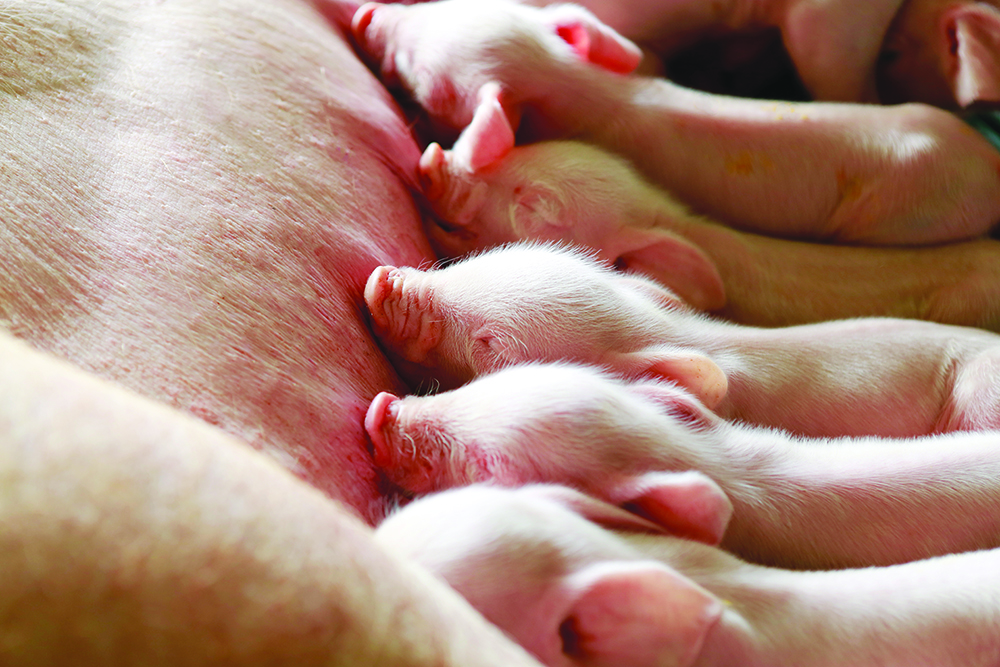
Sows are placed in farrowing pens shortly before farrowing, their birthing period. While intended to protect newborn piglets, farrowing pens can impair the welfare of both sow and piglets. With legislative changes pending, researchers at Teagasc Moorepark’s Pig Research Facility are examining the welfare implications.
Farrowing pens are usually equipped with metal crates which confine the sow so that she can stand up and lie down, take a step forward and back, but not turn around. They help to prevent the sow from crushing her offspring, which is a major cause of death for suckling piglets. The crate slows and controls the sow’s movements as she changes posture, allowing the litter time to move out of her way.
“While crated, sows cannot turn towards or move away from their piglets or choose where and how to lie down,” explains Alan Foley, a Teagasc Walsh Scholar. “Thus, although crates reduce overall crushing risk, a crated sow cannot easily reposition herself in response to a trapped piglet.”
Additionally, confinement prior to farrowing can cause stress, affecting both sow behaviour towards piglets, and milk let-down. Lastly, the bars of the crate can obstruct access to teats during nursing.
Alternative systems
In 2021, the EU Commission responded to the ‘End the Cage Age’ European Citizens’ Initiative by committing to legislative changes prohibiting cages in the livestock industry. The EU strategy for Livestock was announced on 7 July 2026 and identified animal welfare as a central part of sustainable livestock production. For pigs, the aim is to announce revised rules by Q2 of 2027, explicitly covering the transition from crates to less restrictive farrowing systems.
“It is essential that alternative systems are thoroughly researched before widescale adoption,” notes Alan. “The main knowledge gaps include effectively transitioning sows from fully crated to less-restrictive systems and safeguarding piglet welfare beyond survival alone.”
Teagasc is currently focusing on investigating strategies to help both pigs and farmers achieve this.
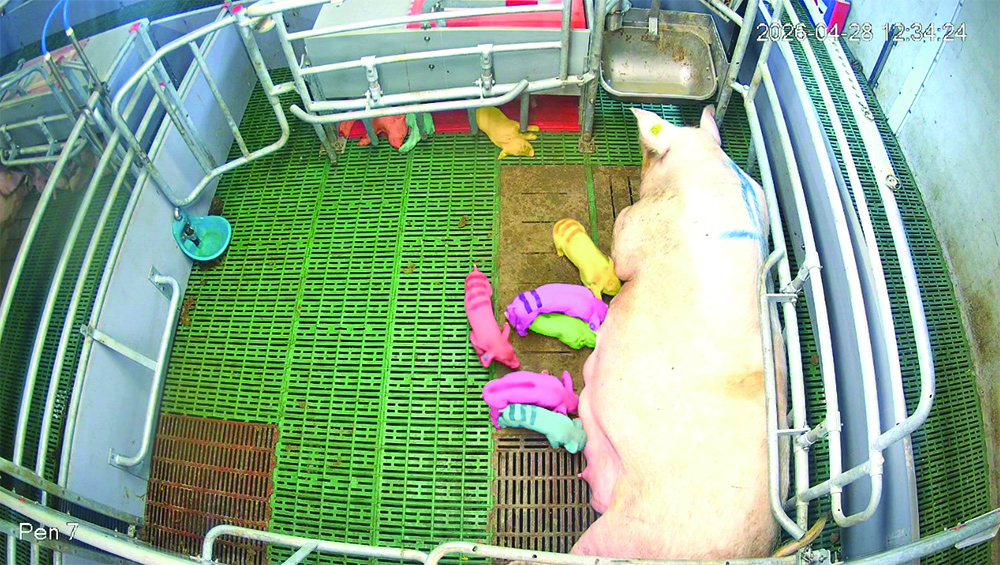
At the end of 2025, Moorepark’s Pig Research Facility installed 24 new farrowing pens. Each pen has a total area of 6.76m² and contains a crate that can be either kept closed (similar to traditional crates) or opened to allow the sow access to approximately 5m² of free space. Anti-crush rails along the pen walls provide piglets with a protected space as the sow lies down.
The crates are left open until the day before farrowing, then closed, and re-opened approximately 5 days post farrowing. This protects piglets when the risk of crushing is highest, while allowing the sow freedom of movement for most of lactation. This management system is normally referred to as ‘temporary crating’.
Balancing act
Farrowing crates are designed to control sow movement but should be large enough that the sow is not at risk of abrasion and can stand comfortably. Mismatches between sow body size and crate dimensions can not only cause discomfort, but ultimately lesions and injuries.
The body dimensions of Irish sows were measured in 2005, and it was identified that their length, width, and weight had increased since the 1980s. Last year, Teagasc researchers replicated that study on four farms, including the Teagasc sow herd. Sows (all Large White × Landrace) from parity 1 to 5 were measured approximately 3 days before they were scheduled to farrow, which represents a time when they are at their largest.
They found changes in at least one dimension for all parities relative to those in 2005; sows of parity 1 and 2 were narrower, and parity 2 had less height. However, sows in parities 3, 4, and 5 were all longer than their 2005 counterparts, with parities 3 and 4 also deeper from the back to the base of the udder.
Thus, many crates in use today may not be sufficiently large to comfortably accommodate modern sows. Given that lower parity sows have reduced in size, it’s possible that highly adjustable crates should be considered even for pens where the crate is open for most of the time, Alan adds.
“Getting the crate size right is a tough balancing act of restricting the sow enough to reduce crushing and giving her enough space to be able to comfortably farrow and nurse her litter.”
A head start for farmers
It is also essential to assess the impact of farrowing pen design on piglets. The researchers are currently monitoring litters from both the new and conventional pens in Moorepark, looking at growth from birth to weaning, mortality, and strategies to improve welfare.
To date, researchers have found that piglets in the temporary-crating system have increased growth to weaning. However, mortality is higher, particularly due to crushing. To address this, researchers have identified two strategies: providing shredded paper at farrowing to support thermoregulation and temporarily confining piglets in their nest box while the sow feeds to train them to rest in a safe space.
They are also investigating smart camera systems to identify at-risk piglets (slow growing, less responsive). They have now achieved automatic detecting and tracking of piglets from footage with reasonable accuracy.
Many Irish pig farmers are considering, or have already transitioned to, temporary crating. Insights from this work will give them a head start, so that each farmer does not have to work out the answers for themselves, concludes Alan.
“Establishing the features of a well-designed farrowing pen also supports manufacturers so that appropriate equipment is on the market when farmers need it. New technologies may also support that change, helping to ensure benefits for sows, piglets and farmers alike.”
‘End the Cage Age’
End the Cage Age was a successful European Citizens’ Initiative calling for an EU-wide end to cages for farmed animals, including farrowing crates for sows. Supported by almost 1.4 million people, it led the European Commission to set out plans to phase out and ultimately prohibit the systems covered by the initiative.
Funding
This work is funded by the Teagasc Walsh Scholars Programme (reference no. 2024045; project no. 2337). This work is also supported by grant no. 2024-68014-42559 from the USDA National Institute of Food and Agriculture, Ireland’s Department of Agriculture, Food and the Marine, and the Northern Ireland Department of Agriculture, Environment, and Rural Affairs as part of the US-Ireland Research and Development Partnership.
Acknowledgements
We would like to thank the pig farmers involved in this project, as well as the farm staff of the Teagasc Pig Research Facility. We would also like to sincerely thank Teagasc’s Laura Boyle for her supervision and guidance on the research projects mentioned in this article.
Contributors
Alan Foley, Teagasc Walsh Scholar, Teagasc Moorepark.
Camille Ducrue, Teagasc Walsh Scholar, Teagasc Moorepark.
Stijn Brouwers, Postdoctoral Researcher, Teagasc Moorepark.
Keelin O’Driscoll, Senior Research Officer, Teagasc Moorepark.
Correspondence: keelin.odriscoll[at]teagac.ie