
From the Five Freedoms to the Five Domains
Animal welfare science is increasingly encompassing more than just the prevention of suffering. A newer model for assessing welfare seeks to move beyond physical dimensions.
Animal welfare science has moved beyond simply preventing suffering. A newer approach, the Five Domains model, is helping abattoirs better understand and improve the welfare of animals at slaughter.
For more than 50 years, the Five Freedoms have been the cornerstone of animal welfare, explains Kevin Brennan, a Principal Research Officer at Teagasc Ashtown’s Food Research Centre.
“The Five Freedoms have influenced legislation, quality assurance schemes and everyday farming practices around the world. Their simple message, that animals should be free from hunger, discomfort, pain, fear and unnecessary restrictions on normal behaviour, remains as important today as ever.”
However, animal welfare science has advanced considerably. Researchers now recognise that welfare is about more than avoiding suffering. It is also about understanding what an animal is likely experiencing and how different aspects of its environment affect its overall wellbeing, Kevin adds.
“This shift in thinking has led to the development of the Five Domains model, which is increasingly being used to assess welfare in livestock production, including in abattoirs.”
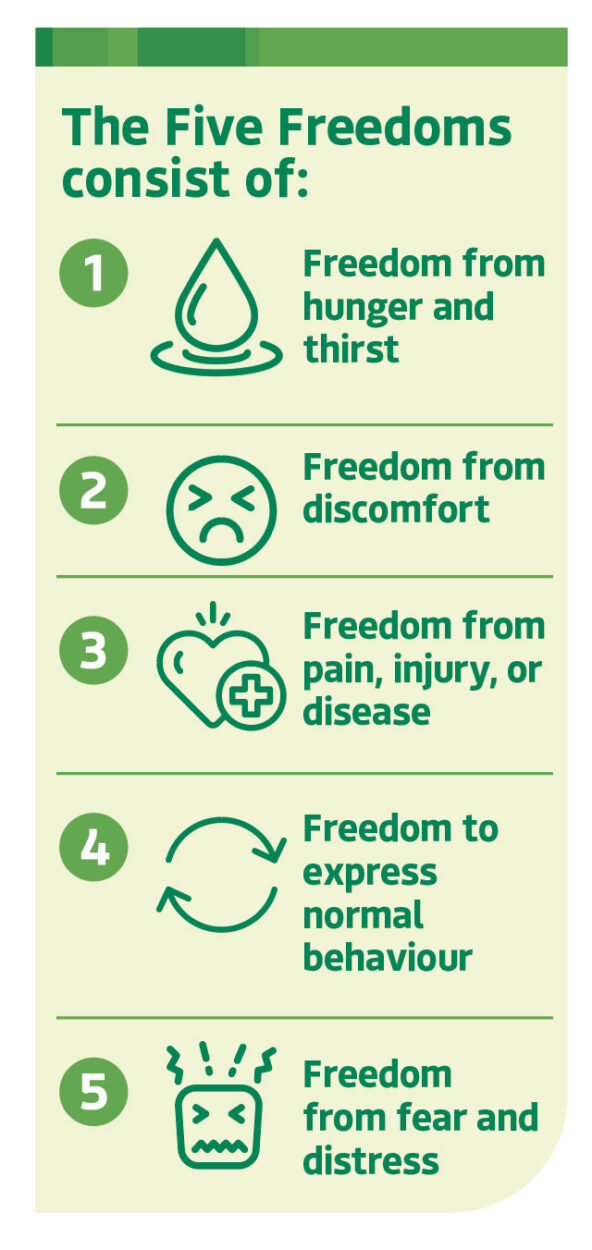
The Five Freedoms
The Five Freedoms are an internationally accepted standard of care, affirming the rights of living beings to human treatment.
The Five Freedoms transformed how people thought about animal welfare because they provided a clear and practical framework, explains Kevin. “They remain an excellent guide for identifying poor welfare and have shaped training, regulation and welfare auditing for decades.”
But there is one important limitation, he continues.
“Some situations, particularly transport and slaughter, are naturally stressful for animals. It is unrealistic to expect animals to be completely free from discomfort or fear during these events. Instead, the goal is to minimise these experiences and ensure animals are handled as calmly and humanely as possible.”
The Five Freedoms also focus mainly on preventing negative experiences. They do not fully consider how different factors combine to influence an animal’s overall welfare or what the animal may actually be experiencing.
Introducing the Five Domains
The Five Domains model was developed to provide a more complete picture of animal welfare.
Rather than asking simply whether an animal is free from pain or fear, it considers how four physical areas influence the animal’s likely mental experience.
The four physical domains are:
- Nutrition,
- Physical Environment,
- Health,
- Behavioural Interactions.
Together, these determine the fifth domain, Mental State, which reflects the animal’s likely experiences, such as comfort, fear, pain or calmness.
This approach recognises that good welfare depends not only on physical health but also on the animal’s emotional experiences.
Applying the model
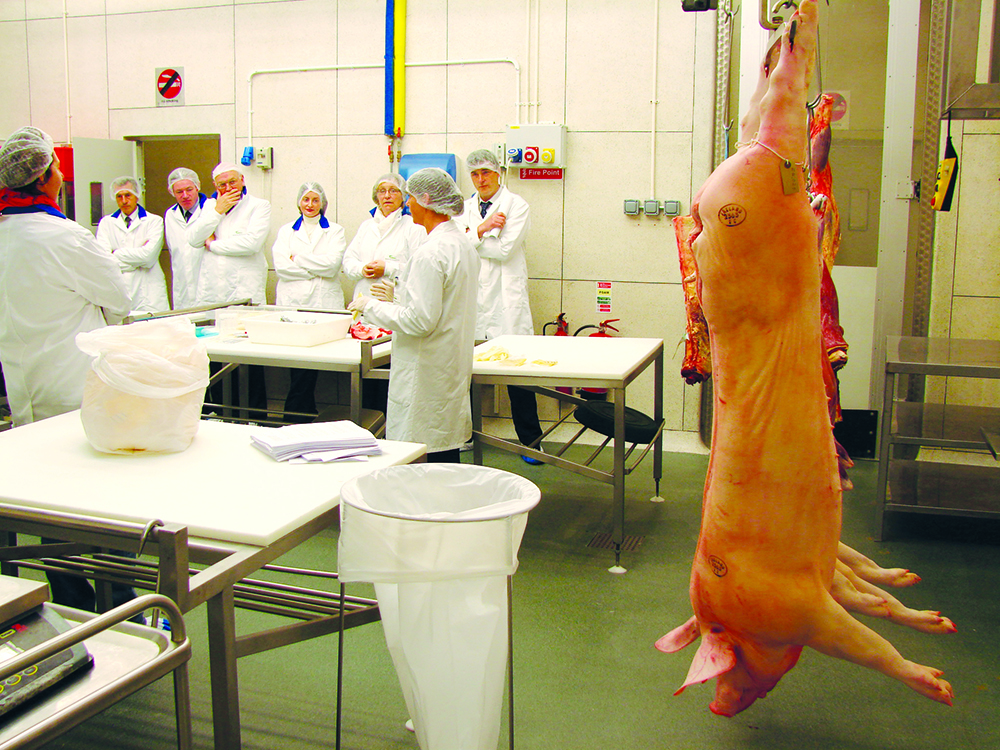
What does this mean in an abattoir setting? The Five Domains model has particular value during the final stages of an animal’s life.
When animals arrive at an abattoir, assessors can evaluate the physical environment by looking at ventilation, lighting, flooring and stocking density. These factors influence how comfortable animals are and whether they experience unnecessary stress.
The Behavioural Interactions domain focuses on how animals are handled. Calm stockmanship, maintaining social groups where possible and reducing unnecessary noise all contribute to lower stress levels.
Health assessments include checking for injuries, lameness and, most importantly, ensuring stunning is effective so animals remain unconscious before slaughter.
“Looking at these areas together gives a much clearer understanding of likely animal welfare than relying on a simple checklist alone,” Kevin says.
Supporting continuous improvement
“One of the biggest strengths of the Five Domains model is that it encourages continuous improvement,” notes Kevin. “This is a core requirement of animal welfare regulations and quality assurance standards.”
For example, poor flooring may increase the risk of slips and injuries while also making animals more fearful. Improving the surface can therefore improve welfare in several ways at once.
Similarly, investing in better stunning systems or improving staff training can reduce pain, distress and handling problems simultaneously.
The model also helps explain why good stockmanship matters. Staff can see how everyday decisions influence an animal’s experience, encouraging a welfare culture that goes beyond regulatory compliance towards genuine welfare improvement.
Looking ahead
Assessing an animal’s mental state is more challenging than measuring physical conditions because emotions cannot be observed directly. Instead, assessors use scientific evidence together with animal behaviour and physical indicators to make informed judgements.
As welfare monitoring technologies continue to improve and scientific knowledge grows, the Five Domains model is becoming an increasingly practical tool for industry.
The Five Freedoms remain an important foundation for animal welfare. However, the Five Domains provide a broader understanding by recognising that welfare depends on both physical conditions and the animal’s likely experiences, Kevin concludes.
“For abattoirs, this means better welfare assessment, more targeted improvements and greater confidence that animals are being treated as humanely as possible during the final stage of the food production chain.”
Funding
This project is funded entirely by the Irish Meat industry.
Acknowledgements
This work was informed in part by The Teagasc Standard for the Management of Animal Welfare at the Time of Slaughter and Teagasc Animal Welfare Training Courses for Abattoirs.
Contributors
Kevin Brennan, Principal Research Officer, Food Industry Development Department, Teagasc Food Research Centre, Ashtown.
Correspondence: kevin.brennan[at]teagasc.ie
Find out more about animal welfare training for the food industry here.