
Getting to grips with mushroom quality
Through the SoftGrip project, Teagasc researchers explored how grower practices and crop flushes affect white mushroom colour, helping to establish a more consistent way to assess quality.
When it comes to white button mushrooms, the brighter the better. Consumers are attracted to bright, white, clean mushroom caps. Discolouration or bruising on caps will greatly reduce the value of the produce and ultimately the profit margin for the grower.
For this reason, considerable effort is placed on optimising practices to produce high quality, unblemished mushrooms. The extent to which discolouration is a concern depends on the variety of mushroom. For example, in brown mushrooms, damaged skin is less visually obvious and therefore less of a consideration.
In contrast, the majority of white button mushrooms produced in Ireland are the strain Sylvan A15, which is valued for its naturally bright white colour. However, the outer cap tissue of these mushrooms is extremely delicate and can be irreversibly damaged with only minor physical impact.
Minimising damage
Browning is an enzymatic process that occurs when damaged tissue exposes the enzyme polyphenol oxidase (PPO). This enzyme reacts with phenolic compounds and oxygen to form quinones that polymerise into melanins, the brown pigments responsible for discolouration. This process begins almost immediately after a mushroom has been harvested, explains Donal Gernon, Mushroom Advisor at Teagasc’s Horticultural Development Department.
“To minimise damage, experienced harvesters use careful handling techniques to reduce physical contact with mushroom caps,” he explains. “Once mushrooms have been harvested, they are immediately transported to a cold-storage room to try and slow down PPO activity and preserve freshness before it is transported to the supermarket.”
These challenges were examined through SoftGrip, a European research project focused on developing innovative technologies to support the automation of mushroom harvesting. As part of the project, researchers also investigated factors affecting mushroom quality and marketability. As part of this wider research programme, researchers undertook a colour study, providing new insights into how mushroom appearance changes after harvest and how these changes can be measured objectively.
The latest research article from the SoftGrip project, ‘Colour quality assessment of commercial white Agaricus bisporus mushrooms’, has now been published in the Irish Journal of Agricultural and Food Research. This research looked at colour quality in commercial white mushrooms (Agaricus bisporus) across different growers and crop flushes. Authored by Donal, alongside Teagasc colleagues Helen Grogan and Andrea Uccello, the research aimed to determine the extent of the impact of growing practices on mushroom colour quality, and to develop a standard assessment method for this.
Harvesting flushes
Although browning is a completely natural and inevitable part of the mushroom life cycle, skilled growers can significantly slow this process down to ensure high-quality mushrooms reach supermarket shelves.
“Mushroom crops are typically harvested over 2-3 flushes. Later flushes will have different metabolic profiles due to reduced nutrient availability and water content in the substrate,” Donal explains. “This is likely to have an impact on quality and browning, with first flush mushrooms generally considered superior in quality compared to second and third flushes.”
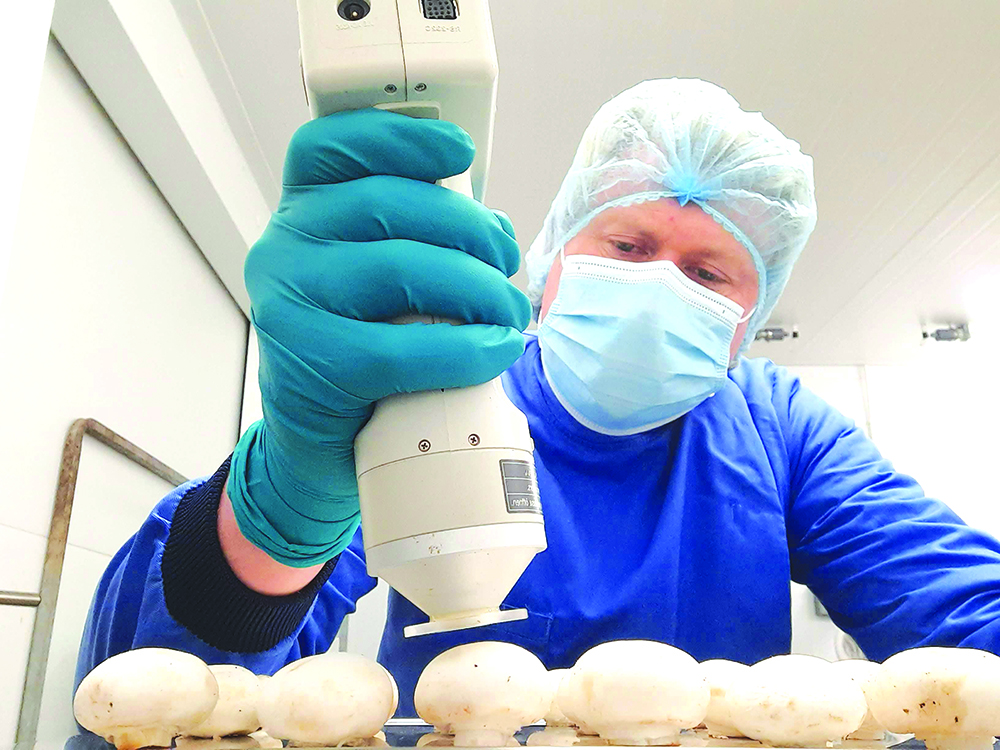
The SoftGrip team collected harvested mushrooms from the first, second and third flushes across five commercial farms, as well as from crops grown in the experimental mushroom unit at Teagasc, Ashtown. Mushroom colour was measured using a CR-400 portable chromameter which records L*, a* and b* values. Donal explains further:
“The L* value indicates how light or dark a mushroom is, with higher values representing a whiter appearance. The a* and b* values measure subtle shifts towards red/green and yellow/blue tones, allowing researchers to detect small colour changes that may not be obvious to the naked eye.”
While the L* value alone is commonly used as an indicator of colour quality, these parameters can also be incorporated into various equations to calculate the whiteness index. The use of multiple approaches can lead to inconsistency and confusion, highlighting the need to standardise the method used to report mushroom quality going forward.
Growing practices
The SoftGrip team used the measurements recorded to rank and compare mushroom quality among different growers in Ireland. A key finding was that individual growers had a strong and significant influence on the mushroom quality, notes Donal.
“While all mushrooms met acceptable commercial quality standards, some growers consistently produced higher-quality mushrooms than others. This suggests that growing practices and techniques contribute significantly to determining mushroom quality.”
Adopting the practices used by higher-performing growers could help lower-performing growers to improve the value of their product. However, other factors, such as variability in substrate batch quality must also be considered. The data were also used to evaluate differences in mushroom colour and quality across flushes.
“Although moderate variation in colour quality was observed between flushes, some growers were able to maintain consistently high colour quality throughout,” says Donal. “This indicates that reductions in colour quality over successive flushes may occur, but can be managed or mitigated through effective growing practices.”
Standardising assessment
The final objective of the study was to standardise the measurement of mushroom quality. Data from the top 25% of mushrooms, based on the highest L* values, were used to calculate average L*, a* and b* values, representative of high-quality white button mushrooms.
These were proposed as standard reference values for calculating the whiteness index. To determine the most appropriate equation for assessing colour differences, two widely used approaches ΔE*CWM and ΔE*Ajlouni were compared. The results showed that mushroom colour characteristics L* and a* correlated more strongly with ΔE*CWM than ΔE*Ajlouni. Therefore, the ΔE*CWM equation was identified as the more accurate equation for representing of colour differences in white button mushrooms.
Overall, concludes Donal, these findings contribute to the standardisation of mushroom colour assessment, improving the accuracy and comparability of quality measurements across scientific and industry applications.
“It also highlighted the significant influence of grower practices on final product quality. By identifying achievable quality benchmarks and more reliable methods of measurement, the work supports more consistent evaluation and comparison across the industry.”
Mushroom colour – at a glance
The CR-400 chromameter was used to measure three key colour values across the mushrooms sampled.
L* = an indicator of lightness/darkness. Higher values = whiter appearance
a* = a measure of red/green tone values
b* = a measure of yellow/blue tone values
Funding
This project has received funding from the European Union’s Horizon 2020 research and innovation programme under grant agreement N° 101017054 (SoftGrip).
Acknowledgements
The SoftGrip team would like to sincerely thank the mushroom growers who contributed to this work. Their collaboration and willingness to participate were essential in enabling this research and ensuring its relevance to commercial production systems. We acknowledge the support of Antonia Santos (Maynooth University) with the data analysis.
Contributors
Helen Grogan, Senior Research Officer (former), Horticulture Development Department, Teagasc Ashtown.
Donal Gernon, Mushroom Advisor, Horticulture Development Department, Teagasc Ashtown.
Correspondence: donal.gernon[at]teagasc.ie
Joy Clarke, Research Officer, Horticulture Development Department, Teagasc Ashtown.