
Going against the grain
New monitoring and laboratory evidence show that Metopolophium dirhodum, the Rose-Grain aphid, is common in Irish spring barley, where it reproduces rapidly and efficiently transmits Barley Yellow Dwarf Virus. This warrants its explicit inclusion in monitoring and Integrated Pest Management guidance.
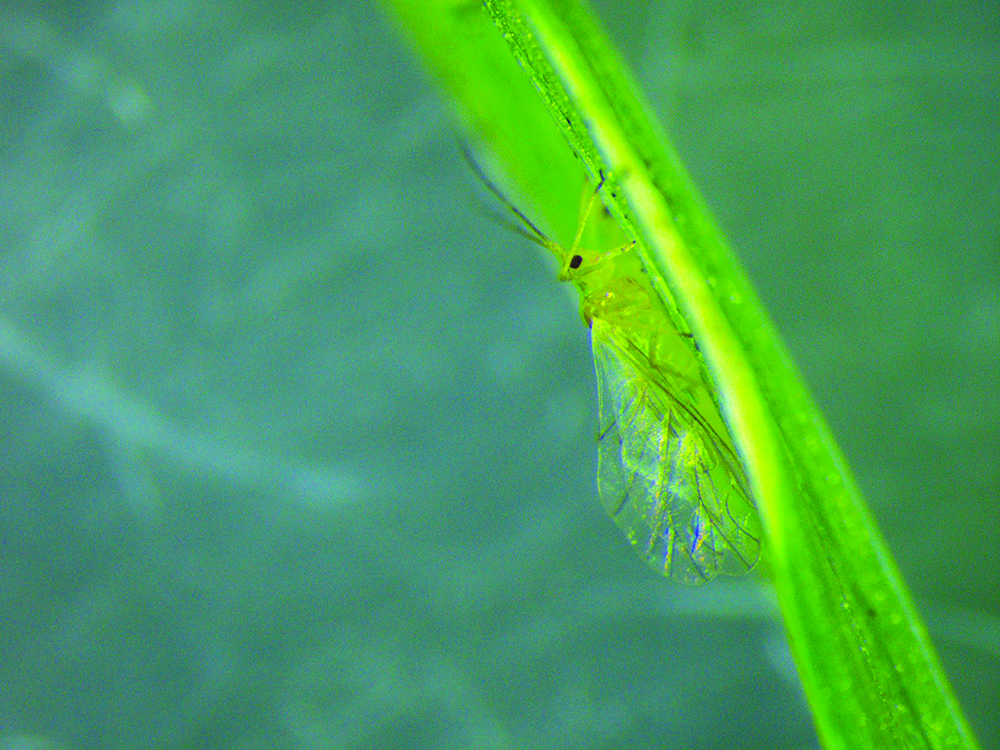
Barley Yellow Dwarf Virus (BYDV) continues to threaten cereal yields when infection occurs early in crop development. Between 2022 and 2025, researchers at Teagasc Oak Park’s Crop Research Department conducted integrated field monitoring and laboratory experiments to better understand potential threats from BYDV.
This research revealed that the Rose-grain aphid (Metopolophium dirhodum) is a regular, sometimes abundant visitor to Irish spring barley. Research Officer Louise McNamara explains more.
“The Rose-grain aphid has life-history traits that permit rapid local increases on barley crops. It also efficiently vectors the MAV strain of BYDV, which is the strain most frequently in Ireland. These results indicate that M. dirhodum should be considered explicitly within national monitoring programmes and Integrated Pest Management (IPM) advice for spring-grown cereals.”
Species-specific transmission
Current BYDV research and advice nationally and internationally have largely emphasised the English grain aphid (Sitobion avenae) and the Bird cherry-oat aphid (Rhopalosiphum padi) because of their roles in transmitting locally important virus strains and their seasonal behaviour.
However, epidemiological risk depends not only on aphid abundance but also on species-specific transmission competency and seasonal timing.
Combined studies – a national aphid survey in collaboration with growers, laboratory life-history assays and multi-clone virus transmission trials – helped paint a clearer picture of the threat from the Rose-grain aphid.
“This combined research shows that M. dirhodum frequently arrives in spring barley during the crop stages most vulnerable to BYDV infection, where it reproduces rapidly under favourable conditions and is a highly competent vector of BYDV-MAV,” Louise explains.
“Because MAV is the dominant BYDV strain in Ireland, even modest M. dirhodum populations in spring could have important epidemiological relevance.”
At a glance: Aphids and viruses
Aphids are small, sap-sucking insects. They can affect the yield of major cereal crops such as barley, wheats and oats, both directly and as disease vectors. Common species in the UK and Ireland include the Rose-grain aphid (Metopolophium dirhodum), English grain aphid (Sitobion avenae) and Bird cherry-oat aphid (Rhopalosiphum padi).Barley Yellow Dwarf Virus (BYDV) is a viral disease affecting these crops, causing stunted growth and damage and discolouration of leaves. The virus has several strains, including BYDV-MAV, BYDV-PAV and BYDV-PAS, and is mainly transmitted by aphids feeding on infected plants.
Trap samples
From 2022 to 2025, growers and researchers deployed yellow pan traps in winter and spring barley crops across multiple fields and counties. Trap samples were collected and returned to the laboratory for species identification, and parallel in field visual plant checks were made at key growth stages to record aphid colonisation and abundance.
In controlled environment chambers, the researchers reared clonal lineages of M. dirhodum and recorded daily development, survival and reproduction to produce age-stage life tables.
Finally, transmission experiments run at University of Liverpool and Teagasc used multiple aphid clones and BYDV isolates to quantify vector competency for BYDV-MAV, BYDV-PAV and BYDV-PAS.
Field monitoring
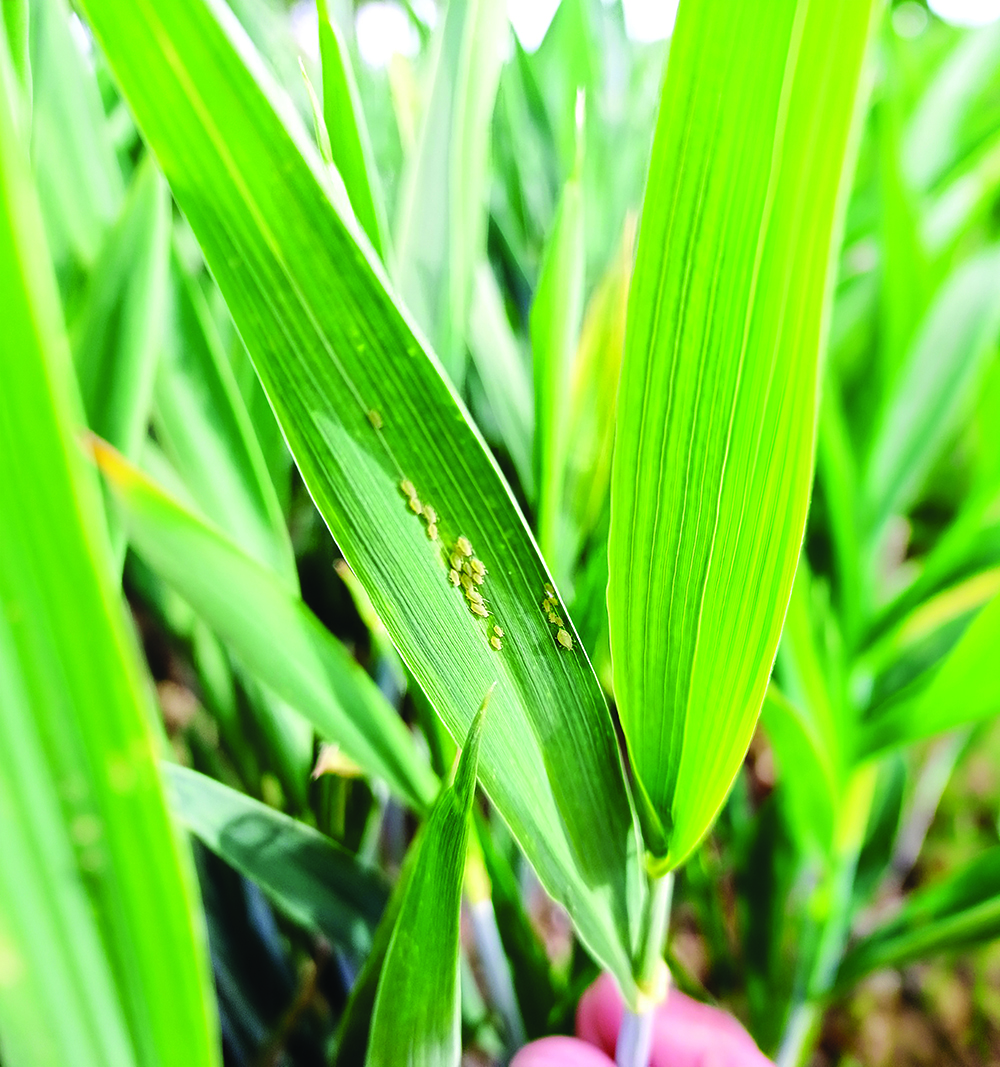
The field monitoring showed presence of M. dirhodum in spring barley traps every year that spring trapping was undertaken. Across the programme, the total number of M. dirhodum captured in traps exceeded that of S. avenae. In-field tiller checks found M. dirhodum most often during tillering and early stem extension during growth stage (GS) 21–31, part of the important window for BYDV damage (emergence up to GS31).
“Winter barley was less consistently colonised by M. dirhodum during the winter sampling windows, reflecting a clear seasonal phenology with peak activity in spring and early summer,” Louise notes.
Laboratory life-history assays showed all three clones completed four nymphal instars (development stages) in about 7.9–8.1 days and had long adult lifespans (27–34 days). Lifetime fecundity ranged from about 47.5 to 65.8 nymphs per female and intrinsic rates of increase (r) were approximately 0.27–0.29 per day, corresponding to population doubling times near 2.4–2.5 days under the controlled conditions used.
These traits combine to give M. dirhodum both a substantial individual transmission window (adults remain viruliferous for life once infected) and a capacity for rapid local population growth under favourable conditions on barley.
Transmission assays demonstrated that virus species was the dominant predictor of transmission success by M. dirhodum. Across the clones and isolates tested, BYDV MAV was transmitted at significantly higher rates than BYDV PAV and BYDV PAS.
In Ireland, MAV is common, and M. dirhodum is an efficient MAV vector, Louise adds.
“The combined field timing, life history potential and MAV competency indicate that M. dirhodum can contribute meaningfully to BYDV epidemics in spring barley.”
Targeted interventions
These findings hold several implications for monitoring and management, Louise explains.
For spring sown cereals, monitoring programmes and advisory messages should explicitly include M. dirhodum.
“Integrating species data into decision support and risk models will enable more nuanced, evidence-based advice that targets interventions when and where they are most needed,” she concludes.
“Practically, growers should prioritise timely monitoring of spring barley in the vulnerable window and consider cultural measures – such as early sowing dates – to limit early colonisation.”
Funding
This work has received funding from the European Union’s Horizon Europe Research and Innovation programme under the Marie Skłodowska-Curie grant agreement no. 101106698 – MONET. The work has also emanated in part from research conducted with the financial support of Taighde Éireann – Research Ireland under grant agreement 22/FFP-A/11049 and with support from the Teagasc Walsh Scholars Programme.
Acknowledgements
We would like to acknowledge Daniel Leybourne (University of Liverpool), Tom Pope, Joe Roberts (Harper Adams University), Maximilian Schughart, Antoine Pichon, and Gerry Nolan (Teagasc) for their collaboration on this project.
Contributors
Louise McNamara, Research Officer, Crop Science Department, Teagasc Oak Park.
Correspodence: louise.mcnamara[at]teagasc.ie
Munir Mostafiz, Postdoctoral Fellow, Crop Science Department, Teagasc Oak Park.
Jack Perry, Teagasc Walsh Scholar, Crop Science Department, Teagasc Oak Park.
Stephen Byrne, Research Officer, Crop Science Department, Teagasc Oak Park.