Growth of the soil science
Soil health is an increasingly multidisciplinary field, moving from the purely agronomic to cover policy, biodiversity and industry upskilling. Karen Daly, Department Head and Research Officer at Johnstown Castle, reflects on its growing influence.
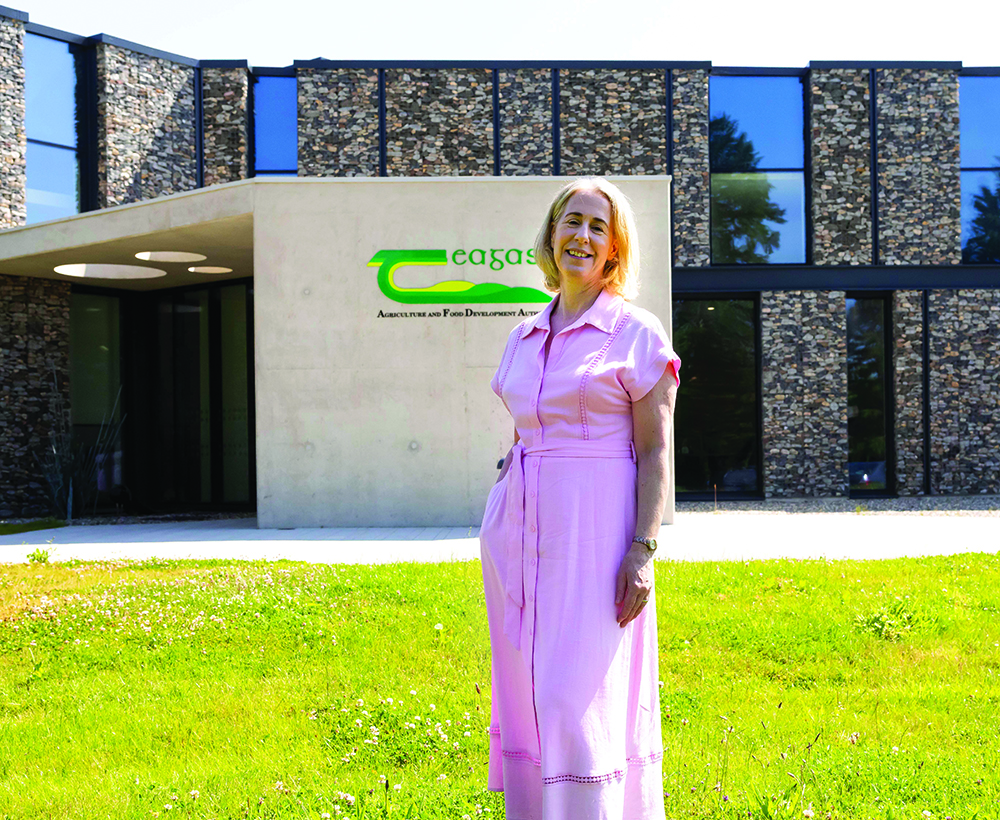
As Head of Teagasc’s Department of Environment, Soils and Land Use (ESLU) at Johnstown Castle, Karen Daly has witnessed first-hand the expansion of the soil science discipline. What was once a primarily agronomic concern now encompasses agricultural, environmental, technical and political concerns. While still an active Research Officer and PhD supervisor, Karen’s expertise has seen her attend a UN summit this year as an expert scientific advisor to the Irish government.
Could you tell us about how you got started in research?
I didn’t come into this from an agricultural background, which may be a bit unusual. I studied Chemistry at Trinity College, followed by a Masters in Synthetic and Organic Chemistry. I always enjoyed the practical and experimental nature of chemistry at the workbench, delving into the equipment and instrumentation.
After graduating, I took a job with Dublin City Council as an Environmental Chemist, which taught me a lot about accuracy and precision, and industry compliance for topics like water quality regulation. A few years later I decided to return to research, applying for a PhD at Johnstown Castle through the Teagasc Walsh Scholars Programme, focusing on a blend of water quality and soil quality. I’ve stayed at Johnstown Castle since then, continuing to work primarily at this intersection of water and soil quality.
I joined the ESLU as an early-stage Research Officer in 1999. I felt like a fish out of water for a while, as the age of my colleagues veered older, and I was the only female researcher on the permanent staff! I’ve seen the department undergo a lot of regeneration, and today we have 20 permanent research officers, including myself. Over time, I grew my own research team, focusing on soils, with soil health being the most prominent topic.
What is the relevance of this topic?
Soil health is the topic building the most momentum, and which we’re most asked to look at. Generally, our departmental focus is: where can agriculture and the environment intersect, how can our research help build environmental actions into farms?
For the first time, there’s now a cross-EU legislative framework and directive for protecting soil: the Soil Monitoring and Resilience law. All EU member states have to monitor soil health and report it to the EU Commission. It’s at the forefront of understanding what soil health means, which research has been building towards over the past 10 to 15 years: the extent to which healthy soil furnishes further properties, e.g. habitat for biodiversity, carbon storage, water filtering, food production and climate resilience.
How has this field developed over time?
Johnstown Castle is the home of the soil survey. The first soil survey was run out of Wexford under An Foras Talúntais (the predecessor of Teagasc), with the original soil maps and characterisation starting there in the 1950s. That was done with a defined purpose: understanding how soil could help agriculture grow food.
Today, it’s much more holistic. Bringing in the idea of soil health addresses all these other topics – carbon and water storage, nutrient cycling, biodiversity. What was once a linear purpose – fertility and drainage for soil as a growth medium – now poses so many more research questions. This allows a greater diversity of collaborations with other disciplines, making the subject area much more multidisciplinary.
What are the challenges surrounding this topic?
As the subject area has widened, so too have data gaps. Compared to topics like soil drainage, agronomy, soil chemistry and physics, we don’t have as much national data on soil biodiversity. A research group at Johnstown Castle, alongside our university partners, are examining this. We’d like to know more about how soil biological functions affect plant growth, difference in seed covers, and above-ground/below-ground relationships. Partly, this is a capacity-building challenge, to meet a set of questions previously less considered.
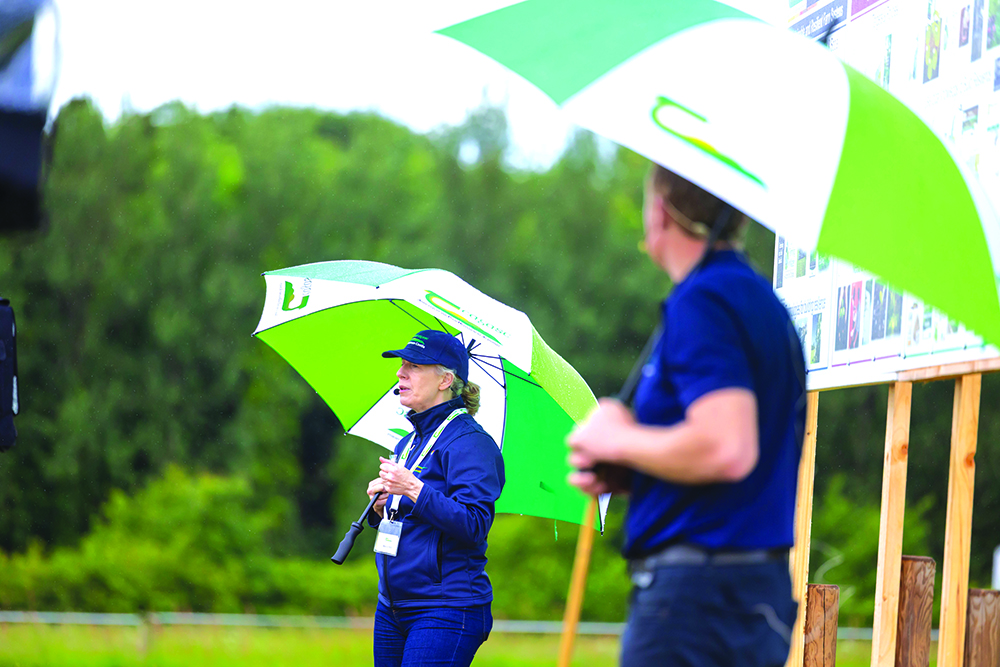
Another challenge is increasing awareness among farmers and the public around the importance of soil health. The public are increasingly concerned with where their food comes from, so bringing this issue to light would be a natural next step. We’ve had good engagement with citizen science projects such as the recent GroundTruth project, and at our Open Day in June focussing on healthy soils and clean water. I was also fortunate to write on the topic for RTÉ Brainstorm, which then made it into a leaving certificate biology paper. So, it’s great to know word is spreading!
What research have you been doing in this field?
In my own research, I still use a lot of my chemistry background, and one of our big things as a department is innovation and developing new methods for soil analysis. Teagasc and Johnstown Castle are at the forefront of soil spectroscopy analysis in Ireland.
Spectroscopy is a form of infrared light measurement; you shine light at a material, this generates radiation which in turn creates a spectra of peaks and troughs. This is valuable chemical and physical information regarding soil composition, allowing you to make a prediction of 12 parameters such as concentrations of carbon, clay, sand, carbonates and pH values. When paired with machine learning and data analytics, spectroscopy gives you a powerful tool for soil health predictions.
What benefits does this research have?
One of the key benefits of spectroscopy is the extent to which it replaces wet chemistry. Before, you would have to send a sample through six to seven different labs to test all parameters, which would be a month’s work for 100 samples. Spectroscopy lets you process 100 samples a day, which hugely reduces time, cost and chemical waste.
We’re building a huge library of soil spectral models, currently over 10,000 samples. You still get an occasional ‘wild card’ not in the library, for which you still need wet chemistry. Over time, though, the library will become increasingly comprehensive and applicable for predictions.
We also use mid-infrared (mIR) technology for particle size analysis, which was previously very laborious. Each sample fraction – sand, silt, clay – would have to be separated, and you’d be lucky to do 10 samples in a week. Transitioning to in-house mIR at Johnstown Castle substantially reduces sample waiting time, so researchers can act more quickly on making decisions for their trials.
What impact is this topic having?
Crucially, it’s nice to see results of our early research now making impacts on policy measures and as advice to farmers on topics like reducing nutrient losses into water and agri-soil management.
On the policy front, I serve as a national expert for the EU Soil Monitoring Law implementation group, providing scientific and technical advice to the government. As part of this, the Department for Climate, Energy & the Environment invited me to join their UNCCD-COP17 delegation as its soil science expert. It was an honour to be invited, with lots of exciting work to do in the run-up, folding science into policy, focused on the main topic of this year’s summit: drought, desertification and land degradation.
It’s like science diplomacy; it makes you alter perspective, thinking about wider policy implications and balancing the positions of the different member states to formulate a shared position for the EU. There’s lots of interesting relationship-building, almost like a diplomatic mission. So, it’s great to get that recognition of the value and international impact of our work in science.
The EU Soil Monitoring Law
Directive (EU) 2025/2360, the Directive on Soil Monitoring and Resilience, is commonly known as the EU Soil Monitoring Law. It establishes the EU’s first common framework for monitoring and assessing soil health, addressing soil degradation and supporting healthier, more resilient soils by 2050.
What has the wider response been?
We’ve recently signed a memorandum of understanding with the Geological Survey of Ireland (GSI). We’re granted access to its national database of physical soil samples, which we’re scanning with our spectroscopy and mIR technology. Teagasc has traditionally focused on agricultural soils, while GSI’s archive covers the whole country, giving us a wider picture of soil health, bringing in additional properties such as spatial distribution of particles, of chemicals like phosphorous and nitrogen, and of soil carbon.
As the topic of soil health grows in visibility, our stakeholders are asking us to develop materials on it. Hence a large part of our industry engagement being around upskilling. Teagasc Specialist Advisors have put together soil health training courses, as well as topics like emissions, farmland biodiversity, water quality and soil fertility. We’ve had good engagement so far when disseminating this work, thanks to the great work done by the specialists and Teagasc’s Knowledge Transfer directorate. Beyond this, our expertise gives industry insight into topics like fertiliser development, emissions reduction, nitrogen leaching and seed technologies.
UNCCD-COP17
COP17 is the 17th meeting of the countries signed up to the United Nations Convention to Combat Desertification (UNCCD), a global coalition for addressing desertification, land degradation and drought. Hosted in Ulaanbaatar, Mongolia, in August 2026, it brought together representatives from 197 parties to accelerate action under the theme “Restoring Land, Restoring Hope”
What’s next?
We need to continue addressing knowledge and data gaps at a wider, national scale. We have lots of good data so far, and this is increasing quickly thanks to the use of spectroscopy, and our engagement with GSI and industry.
The ongoing task is to get soil health data aligned with related topics, such as biodiversity and water quality, to ensure it is correctly factored into decision-making at both policy level and farm level.
Up close and personal
What’s your favourite animal?
Dogs: they’re so fun to have around, give you so much joy and become such a part of your family.
If you hadn’t ended up in research, what other job would you have wanted to give a go?
Sometimes in science you work alone a lot, but I enjoy working with other people. I will say I’m enjoying this diplomatic work – so maybe something like an attaché in a nice country!
What are you most proud of professionally?
With PhD students, you’re guiding someone through years of not just professional but personal development, so I’m always very proud of them when they pass their viva. Seeing some of my writing on a biology paper for the leaving certificate was a highlight too!