
Mission Oink-possible: Beating Salmonella on Irish pig farms
Salmonella is one of the world’s leading causes of food poisoning, and EU regulatory changes in the use of zinc oxide have made outbreaks more common in Irish pig farms. Understanding and mitigating Salmonella risks is crucial to reducing instances of salmonellosis.
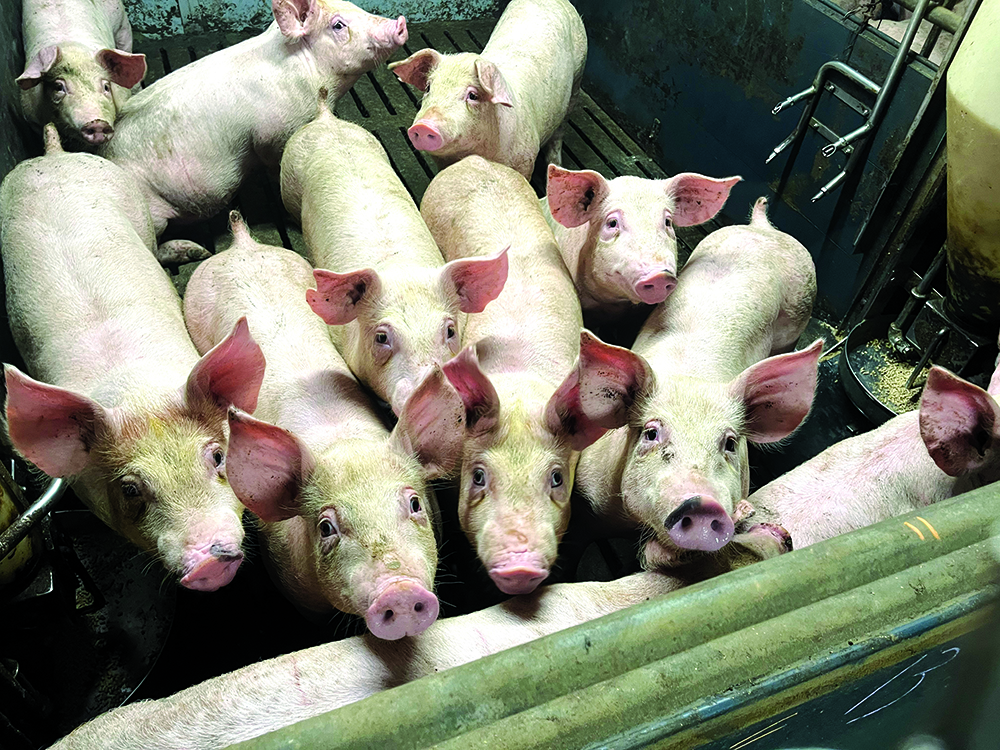
Photo credit: Teagasc
Salmonella infects humans through the consumption of contaminated foods, such as eggs and raw or undercooked meat, causing the symptomatic infection salmonellosis, the most common disease to be known as food poisoning. Symptoms of salmonellosis include fever and diarrhoea; if sepsis occurs, in which the infection spreads to the bloodstream, it can become life-threatening. More than €2 billion are spent annually on hospital treatments for salmonellosis.
For many pig farmers, a positive Salmonella diagnosis on the farm is usually not a cause for immediate concern, as long as Salmonella infection in pigs is subclinical, with animals appearing healthy and fit. When symptoms do arise, they are generally non-specific, such as diarrhoea and reduced growth, making it challenging to definitively link them to Salmonella infection until cases become severe.
In the EU, monitoring of Salmonella is mandatory for poultry farms. This is not the case for pigs, where there is a country-specific approach, often with voluntary Salmonella monitoring schemes. This leads to gaps in researchers’ and farmers’ ability to monitor and control the spread of this pathogen and the disease.
On-farm reduction
In Ireland, Salmonella from pigs remains a notable source of domestically acquired salmonellosis. A new project, led by University College Dublin in collaboration with Teagasc, Animal Health Ireland, the Department of Agriculture, Food and the Marine and the Agri-Food Biosciences Institute, is currently exploring ways to improve Salmonella control on pig farms.
‘Transdisciplinary Interventions to Control Salmonella in Irish Pig Farms (TICSalmPIG)’ aims to support and encourage farmers to select appropriate control measures for their farm in collaboration with their veterinarians and other key stakeholders.
Years of research have improved our understanding of Salmonella in pigs, explains Bárbara M.C. Terezo, a Teagasc Walsh Scholar working on the project.
“Researchers now have a good grasp of how to prevent Salmonella from entering farms and of the multiple measures available to control the bacteria effectively. Yet, this knowledge has led to limited progress in reducing Salmonella levels on Irish pig farms.”
There has been little consideration of the perspectives of the people who look after the pigs – nor of practical, achievable ways for them to reduce Salmonella on their farms.
The TICSalmPIG project was developed to fill this gap, continues Bárbara. There are 27 pig farms enrolled in the project: 20 in the Republic of Ireland and 7 in Northern Ireland.
“By working with Irish pig farmers on their own farms, we can determine what feasible, evidence-based actions they can take to reduce, or ultimately eliminate, Salmonella on their farms. The goal is to identify effective combinations of measures on each farm, to create a shared set of best practices that other Irish pig farmers can learn from in the future.”
Tailoring action plans
Baseline faecal samples were collected on each farm to test for Salmonella and other common bacteria that can live in pigs’ guts, causing diarrhoea, and interact with Salmonella. Examples include Lawsonia intracellularis, responsible for Ileitis (inflammation of the small intestine), and Brachyspira species, responsible for dysentery.
Additionally, farmers were asked for their opinions on Salmonella, what they have done to control it in the past, and about any support they might need to encourage them to do more to reduce and control Salmonella on their farms in the future.
Based on the results of the initial sampling and interviews, half of the farmers were invited to implement Salmonella control measures as part of the project. The other half will also be monitored doing business
as usual.
A carefully tailored action plan is co-designed with each farmer and other actors they wish to have present, such as their veterinarian, advisor, nutritionist, and other farm staff, Bárbara explains.
“These plans evolve over time, with measures being modified and added based on farmers’ experiences and the observed impact on Salmonella levels.”
Range of measures
Of the 27 farms sampled, between 4% and 58% of faecal samples tested positive for Salmonella. All the farms in the study tested positive for Lawsonia intracellularis, and 21 of 27 tested positive for Brachyspira species.
Farmers’ initial action plans to control Salmonella incorporate a range of measures. These include improving the cleaning and disinfection of equipment and pig housing, adding organic acids to feed or water, vaccinating pigs against Salmonella and other pathogens that interact with Salmonella, improving water quality to optimise pig health, and strengthening biosecurity measures to reduce the risk of disease transmission between pigs.
Over the next two years, supporting farmers in implementing new strategies will remain central in this project,
concludes Bárbara.
“Insights from the project will help design a roadmap to extend effective interventions to all commercial pig farms in Ireland and help reduce the number of Salmonella-positive farms.”
Funding
The TICSalmPIG project is funded by the Department of Agriculture, Food and the Marine under the grant award 2023RP940 and supported by the Teagasc Walsh Scholars Programme.
Acknowledgements
The authors acknowledge all the pig farmers, veterinarians and other stakeholders participating in this project. They also thank Edgar Garcia Manzanilla, Head of Pig and Poultry Research and Knowledge Transfer Department, for his support and guidance during this project.
Contributors
Bárbara M.C. Terezo, Walsh Scholar, Teagasc Moorepark.
Contact: barbara.terezo [at] teagasc.ie
Molly Harrison, PhD Student, University College Dublin.
María Bernad Roche, Postdoctoral Researcher, Teagasc Moorepark.
Finola Leonard, Emeritus Professor, School of Veterinary Medicine, University College Dublin.