Parasite surveillance
Despite the benefits of grass-based grazing systems, livestock run the risk of developing parasitic infections. As antiparasitic resistance grows, researchers at Teagasc Grange are investigating new methods of resistance surveillance.
The Irish agricultural sector represents a major source of income nationally. Ireland is well known for exporting some of the best meat and dairy products in the world. A key to this success is the use of a grass-based system, with animals grazing for the majority of the year. This offers a huge benefit to farmers and livestock, reducing the cost of feed and improving the welfare of the animals. Despite these benefits, a major consequence of this system is the development of parasitic infections that animals can acquire while grazing.
Common parasite types in Irish livestock include roundworms, flatworms and tapeworms. One of the most common types to impact livestock is a group of roundworms affecting the gastrointestinal tract, known as gastrointestinal nematodes (GINs).
Infection with these parasites occurs when grazing animals eat infective larvae, which, once inside the animal, travel to the intestinal tract where they mature and lay eggs. Animals then excrete these eggs back onto the pasture through their dung, where under moist warm conditions (like the Irish summer climate), the eggs then hatch and the cycle continues once more.
This can pose substantial risks to livestock herds, explains Stephanie O’Donoghue, Postdoctoral Researcher at Teagasc Grange.
“These parasites can be hugely problematic if present in high numbers within the animal, causing clinical signs such as reduced feed intake, failure to thrive and in severe cases diarrhoea. For farmers, issues such as reduced animal performance – i.e. reduced weight gain or milk yield – and increases in veterinary and treatment costs can arise as a result of infections.”
In the 1960s, the first safe, broad-spectrum antiparasitic drugs became available and since have been the common method used to treat these infections.
However, similar to antibiotics, the overuse and incorrect use of these agents means antiparasitic drug resistance (the ability of the parasite to survive doses of drugs that would usually kill it) is now a huge problem.
Understanding resistance
Antiparasitic resistance occurs when parasites acquire genetic changes that enable them to survive the drug treatment. Resistant worms lay eggs that are then released by the host animal, making their way onto the pasture.
“When these worms are eaten by grazing livestock, and these livestock are subsequently treated with a drug the worms are resistant to, they once again survive and lay eggs which are released onto pasture and develop into larvae,” explains Stephanie.
“As the number of resistant worms on pasture rises, it is increasingly difficult to control these infections as the population is no longer susceptible to the drugs.”
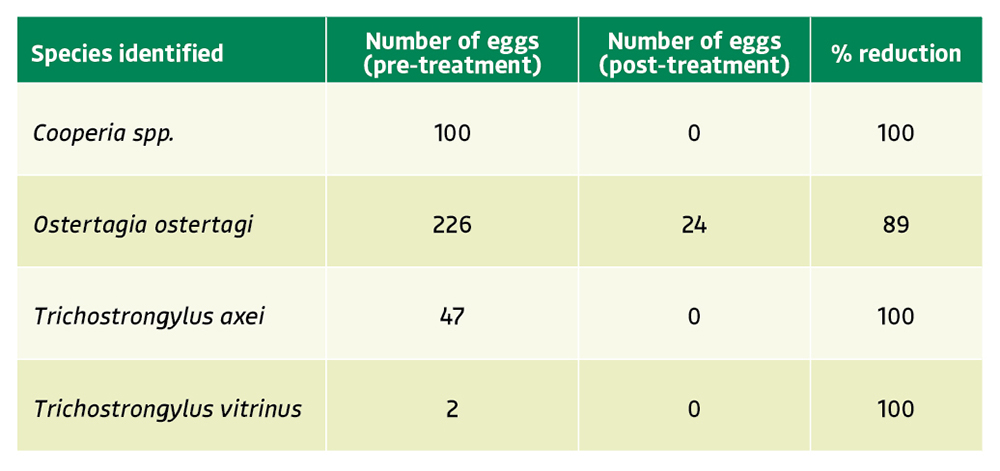
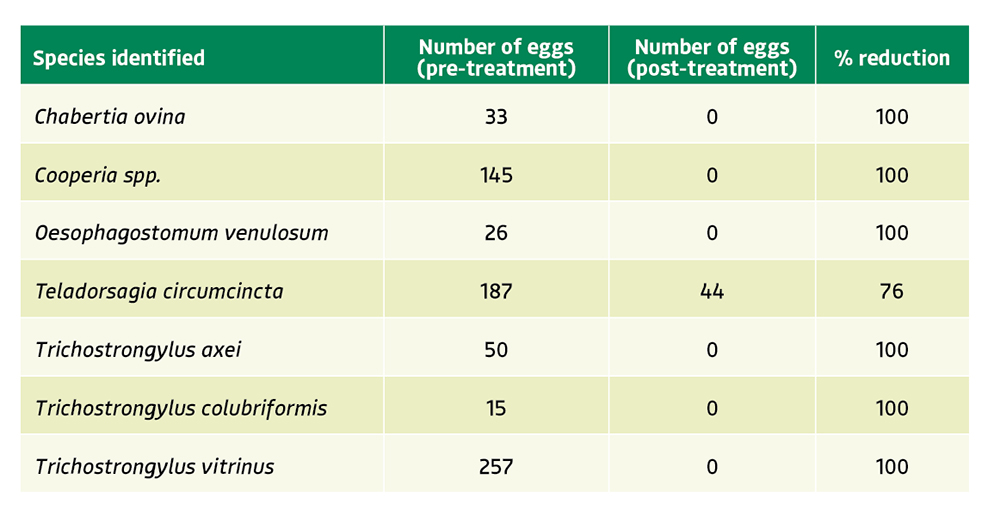
In Ireland, resistance to many of the drug classes exists among worm populations, yet the full extent is not fully known. Faecal egg count reduction tests (FECRT) are the most commonly implemented method to monitor resistance, involving the counting of eggs in a dung sample from animals before and after treatment.
From this information, a reduction in egg count can be calculated; an FEC reduction of less than 95% is taken as a sign of resistance to anthelmintics (a group of antiparasitic drugs).
However, the ability to identify the species of worm based on the appearance of the eggs is a difficult task, with it being near impossible for many species. To overcome this difficulty, research has turned to the use of molecular-based approaches to identify species through use of next-generation sequencing, commonly termed ‘nemabiome’ sequencing.
Specific treatments
“Although we know anthelmintic resistance is a problem on Irish farms, we don’t know the full extent of the issue and what specific worm species are resistant to each drug class,” Stephanie notes.
To help fill this knowledge gap, researchers across Teagasc Research Centres in Grange and Athenry have applied a molecular-based approach to identify worm species resistant to various anthelmintics across both cattle and sheep farming systems (snapshots of these results are provided as tables in this article).
As illustrated in these findings, nemabiome sequencing data holds major potential for resistance surveillance when integrated alongside more common methods like FECRT, allowing for the identification of resistance at the species level, concludes Stephanie.
“The application of this approach could provide more specific information required for the choice of drug at the individual farm level, allowing for the selection of a treatment option that is suited to the resistance situation on a particular farm.”
Funding
This work is funded by the Department of Agriculture, Food and the Marine (Grant no: 2023RP946).
Contributors
Stephanie O’Donoghue, Postdoctoral Researcher, Teagasc Grange
Correspondence: stephanie.odonoghue[at]teagasc.ie
Orla Keane, Senior Research Officer, Teagasc Grange
Sorcha Clark, Technician, Teagasc Grange
Amanda McEvoy, Technologist, Teagasc Athenry