
Synchronising bloom
Fluctuating spring weather conditions pose a challenge to apple pollination in Ireland. Teagasc research into phenology characterisation of apple cultivars is supporting suitable polliniser selection and improved flowering synchrony, helping growers to optimise fruit set, quality, and yield.
In apple cultivation, inadequate pollination reduces fruit set, leading to economic losses for growers. Ireland’s maritime climate presents challenges for successful pollination; cool, wet, or windy spring conditions often limit insect activity during flowering and reduce pollination efficiency. Crops dependent on pollination can show variable performance, especially when flowering windows are short or poorly aligned with favourable weather conditions for pollination.
Ahmad Hassan Chaudhry, a Teagasc Walsh Scholar, explains that apple (Malus x domestica) production is primarily dependent on successful pollination.
“Poor pollination reduces fruit set, leading to smaller, uneven or misshapen fruit and directly affecting yield and market value. Previous studies have demonstrated that pollination affects fruit number and quality traits, which directly impact economic returns,” he says.
In Ireland, orchards are primarily based on a limited number of well-established commercial cultivars. Yet, inconsistent pollination remains a recurring issue, due to adverse weather conditions, insufficient pollinisers (apple trees that provide pollen for cross-fertilisation), uneven distribution or suboptimal flowering synchrony.
To address this, Teagasc is gathering detailed flowering phenology data on more than 50 apple cultivars under Irish conditions, extending beyond commercial varieties to support growers in selecting pollinisers and managing flowering under Ireland’s challenging spring conditions.
Setting the stage
Apple fruit set begins with fertilisation and seed formation. Most apple cultivars are self-incompatible, meaning pollen must come from a genetically compatible cultivar rather than from the same tree or same cultivar, Ahmad explains.
“Compatible pollen germinates on the stigma and extends a pollen tube towards the ovary. Subsequently, successful fertilisation results in viable seeds that produce the hormonal signals needed for early fruit growth. Flowers receiving insufficient pollen are more likely to abort.”
Some crops, such as pears, can form fruit without seeds through parthenocarpy – a process by which fruit develops without fertilisation, he adds.
“In apples, though, this is rare and unreliable; seed formation remains the primary trigger for fruit set. Triploid cultivars, such as Bramley and many Jonagold types, produce little or no viable pollen. They can set fruit when adequately pollinated, but they cannot serve as pollinators.”
Success factors
Successful pollination depends on the alignment of biological needs and weather conditions. Flowering dates can shift by more than a week between seasons, creating mismatches between cultivars and reducing pollen availability. Poor flowering overlap or limited pollen supply reduces both fruit set and fruit size, lowering crop value. Orchard layout also matters, Ahmad notes.
“Gaps in compatible cultivars or unevenly distributed pollinisers can cause localised poor fruit set, even when most of the orchard flowers well. Having multiple compatible pollinisers with overlapping bloom maintains a continuous pollen supply.”
Apple growers typically use 2-3 honeybee hives per hectare, increasing to 3-5 if wild pollinators are scarce or the weather is unfavourable. Wild pollinators – bumblebees and solitary bees – often outperform honeybees in cool, wet, or windy conditions, so supporting diverse communities and strategically placing hives are essential.
Weather dominates pollination success. Warm, calm, dry conditions encourage insect activity and pollen transfer, while cool, wet, or windy weather limits pollinators, increasing the risk of poor fertilisation. Orchards combining good flowering overlap, diverse pollinisers, and robust pollinator populations maintain more reliable pollination.
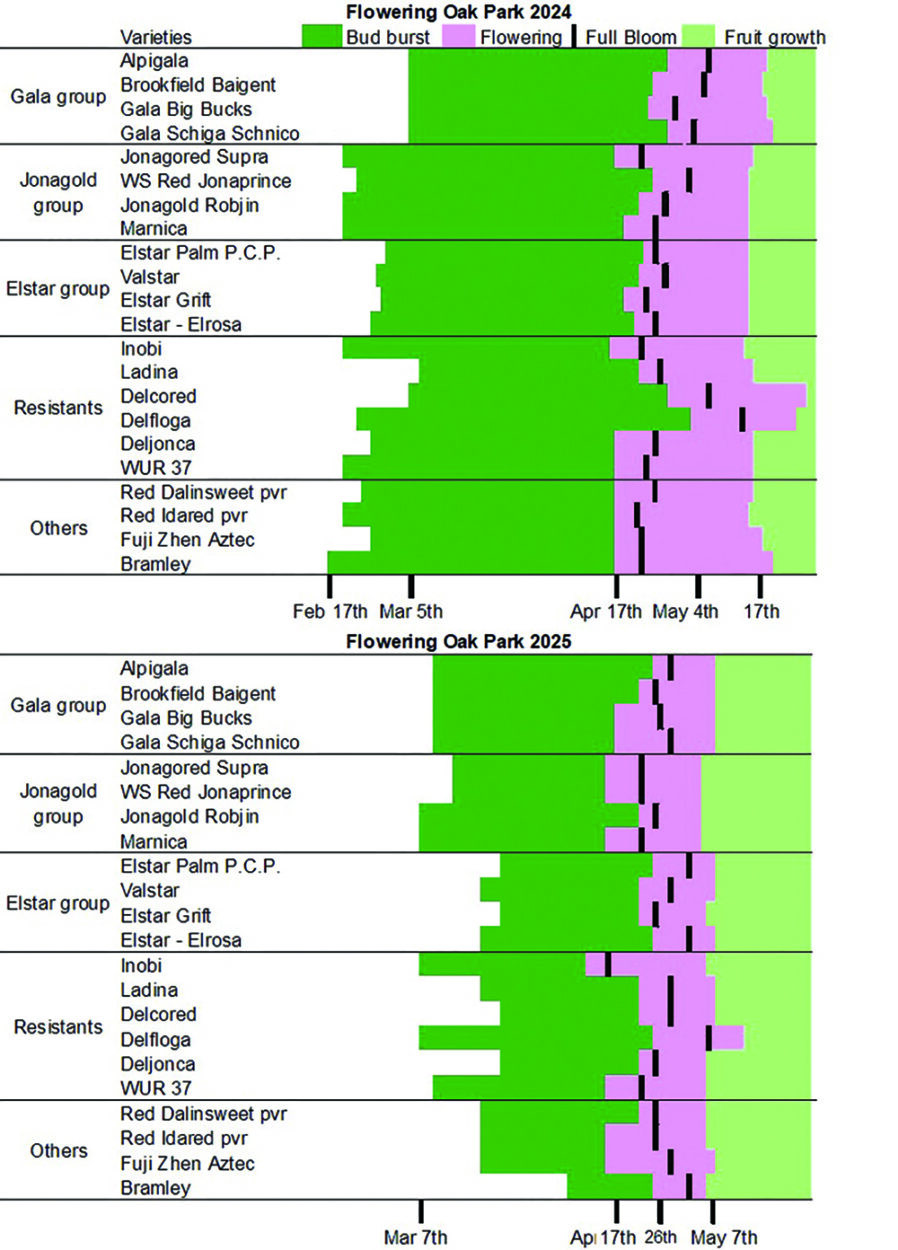
Image credit: Teagasc.
Contrasting seasons
Flowering phenology at Teagasc Oak Park across different apple cultivars revealed apparent differences in timing and synchrony between seasons. In 2024, a cool and wet spring led to early-, mid-, and late-flowering groups, with bud burst varying by 5-20 days and overall flowering lasting 21-31 days, Ahmad says.
“While total flowering overlapped, the early-to-full bloom phase – the most critical window for pollination – was spread across varieties, increasing the risk of incomplete pollination, especially with limited pollinisers.”
In 2025, a warm, dry spring produced later but much more synchronous flowering, with bud burst and early-to-full bloom occurring in a narrow window lasting just 14-21 days. Blossoms across major cultivars – Gala, Jonagold, Elstar, and other genotypes – converged closely, creating optimal conditions for cross-pollination. This favourable season was reflected in higher fruit set, larger fruit, and increased yields compared with 2024.
“These contrasting seasons highlight the strong influence of weather fluctuation on flowering behaviour,” Ahmad concludes.
“Observations from just two seasons are insufficient for long-term planning; continuous monitoring at research sites and in growers’ orchards is essential to understand cultivar behaviour.”
Ensuring reliable pollination in your orchard
- Ensure at least one polliniser blooms at the beginning of the main cultivar’s flowering to support early seed set and fruit size.
- Ensure a second polliniser overlapping with the main cultivar’s full bloom to maximise seed number and fruit quality.
- When using semi-compatible pollinators or when flowering overlap is uncertain, use three to four pollinisers rather than a single variety.
- Distribute pollinators evenly to avoid long gaps without pollen sources.
- Consider non-commercial cultivars as pollinisers if they provide reliable flowering overlap.
- Monitor flowering annually, as Irish spring weather can shift timing and synchrony.
- Support active pollinators using honeybee hives or bumblebee colonies and encourage wild pollinators, including bumblebees and solitary bees, which are often more efficient in cool, wet, or windy conditions.
- Review polliniser choices when replanting or restructuring blocks, using multiyear flowering data where available.
Funding
Teagasc core funding
Contributors
Ahmad Hassan Chaudhry, Walsh Scholar (Efficient Orchard Project), Horticulture Development Department, Teagasc Oak Park, and School of Agriculture and Food Science, University College Dublin.
Jean do Prado
Walsh Scholar (Smart Apples Project), Horticulture Development Department, Teagasc Oak Park, and Atlantic Technological University.
Syed Bilal Hussain, Assistant Professor, School of Agriculture and Food Science, University College Dublin.
Alberto Ramos Luz, Fruit Research Officer, Institution: Horticulture Development Department, Teagasc Oak Park.
Contact: alberto.ramosluz [at] teagasc.ie