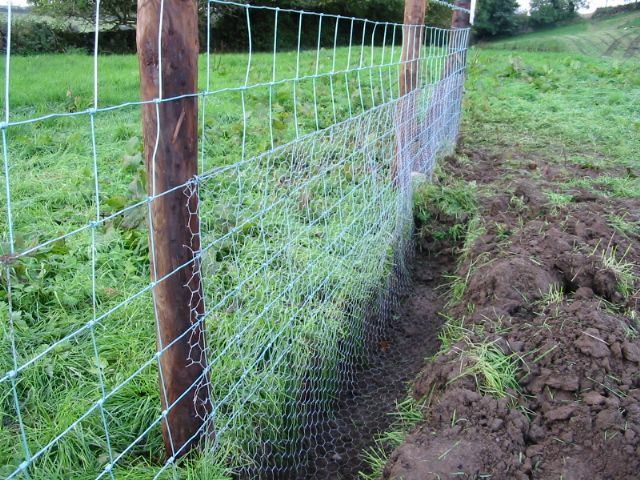
Fencing
All grant-aided forests must be fully protected from the time of planting. All fencing materials including posts and wire must meet standards required by the Forest Service (DAFM). Fencing grants are only applicable where there is a genuine need for fencing, e.g. where hedgerows are not tall or sufficiently strong enough, or where ditches in situ are not stock proof
- Cattle: Three strands of barbed wire, plain wire along public roads
- Cattle/Sheep: Ordinary sheep netting or rectangular mesh sheep netting with one strand of barbed wire.
- Cattle/Rabbit: Rabbit netting with three strands of barbed wire.
- Rabbit/Hare: Rabbit netting with two strands of barbed wire.
- Deer: Rectangular wire mesh, 1.9m high or two lengths of sheep wire, one over the other. do not use barbed wire along the top
There is no requirement to duplicate existing stockproof fences such as rivers, substantial walls, or other stockproof boundaries with additional fencing. Adequate access to plantations for management purposes should be provided using styles and or secured temporary openings in fence lines.
Where there is a serious risk of deer damage to broadleaf trees, additional funding may be available for the erection of a deer-proof fence. All deer fencing allowances must be approved in advance and will be based on the area enclosed and protected by the deer fence.
The Deer Tree Shelter Scheme is available to provide support for the establishment of broadleaves for in Forest Type 12, which occur in areas of high deer pressure, to protect enable the successful establishment for this Forest Type.
Agroforestry plots must be fenced with appropriate stock-proof fencing. Where an agroforestry plot forms part of a larger afforestation project, it must be fully fenced to prevent animal trespass into the adjacent forest plots. Plants must be protected by tree shelters for the first 6 – 8 years (this can vary with tree species and soil quality). Tree shelters will be replaced with plastic mesh (geotextile) immediately thereafter, depending on tree
growth.
IS436 Standard
Fencing must be to the Irish Standard 436:2007 to claim the higher rates of grant aid. This standard aims to give an anticipated service life of 15 years where timber posts are in contact with the ground. The IS436:2007 covers a number of technical specifications which include;
- Permitted timber species
- Post sizes and diameters
- Timber preservatives
- Pre-treatment drying requirements
- Labelling and traceability of the end product
Information above is an introduction to fencing requirements for afforestation. Further details on fencing requirements are outlined in the Forest Standards Manual (DAFM website)