
Nutrient requirements in Forestry
The nutrient requirements of trees are low in comparison with agricultural crops. Trees planted on certain soil types however can develop nutrient deficiencies resulting in slower growth and reduced timber yields in the future.
The most important nutrients in forestry are phosphorus, nitrogen and potassium. Phosphorus is of fundamental importance from an early stage for good root development. Both nitrogen and potassium are important for photosynthesis.
All land being considered for planting should undergo a preliminary soil assessment by a registered forester. This investigation should determine if the soil is suitable for tree growth and if so, can proceed in line with environmental requirements. In general, broadleaf trees are more site demanding and have higher nutrient requirements.
Nutrient deficiencies in a growing forest can show up gradually over time, usually in isolated areas of a site. Any recommended fertiliser application should be timely, focussed and with strict adherence to environmental and water quality guidelines. Remember that other factors can produce symptoms in trees similar to those caused by nutrient deficiencies such as poor drainage, exposure, frost and vermin damage. Always identify the cause of a growth problem before trying to rectifying it!
Walk your forest regularly and check for common symptoms of nutrient problems:
- Changes in tree colour
- Reduction in shoot growth
- Reduction in needle length/leaf size
- Die-back of top or side shoots
- General reduction in vigour
It is important to note that fertiliser application to FT8 agroforestry parcels is governed by the Nitrates Regulations
Phosphorus deficiency
Typical phosphate deficiency symptoms include: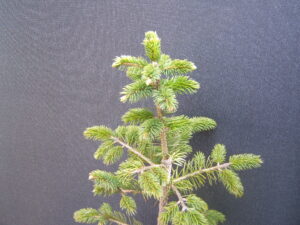
- Poor height / leader growth
- Dull foliage colour
- Possible necrosis of older needles in severe cases
- Needles growing parallel to branches
Phosphate applications in forestry must ensure that, while trees have sufficient phosphorus for sustainable growth, water quality and aquatic habitats are not damaged by phosphorous eutrophication. Application of all phosphate fertiliser should be broadcast and evenly applied, taking care to avoid drains and silt traps.
Nitrogen deficiency
Trees growing on soils of low fertility may sometime lose vigour a few years after planting due to limited soil nitrogen resulting in the following symptoms:
- Decrease in growth
- Light-green or yellowing of foliage
- Uniform yellowing over the whole tree
- Smaller needles/leaves
It is important to confirm the specific nutrient requirement by foliar analysis and apply nitrogen if required focussing on specific affected trees. Nitrogen (Urea) should be applied in April/May so that trees take it up and can benefit immediately. Application should be made around the effective rooting area, about 1 square metre around each tree.
Potassium deficiency
Typical symptoms of potassium deficiency may include:
- Partial yellowing of needles (base of needle remains green and top is yellow)
- Complete yellowing of needles at the ends of the shoots (Douglas fir, spruces and larches only, not pines)
- Pronounced symptoms towards end of winter
Foliar analysis
Where symptoms occur, foliar analysis is recommended to determine the nature and the extent of a possible nutrient problem.
Approved forestry laboratories provide written reports that identify deficiencies and recommend corrective fertiliser applications.
The appropriate time to take samples is December for conifers and August for broadleaves and larch.
Here are guidelines how to collect samples for foliar analysis: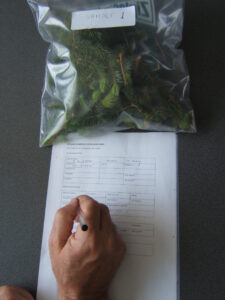
- Collect from branches from the top half of the tree (never collect main shoot).
- Collect 1 branch per tree from 25-30 different trees: do not mix different species (do not mix Norway spruce with Sitka spruce for instance) and take samples from trees with the same symptoms. Dead branches/foliage is not useful for analysis.
- Put samples in a clean freezer bag punctured with numerous small holes for aeration.
- Clearly label the bag with date, location and surname and keep the samples cool (at bottom of fridge) and make a note for yourself where that sample was taken.
- Fill in a foliar sampling form if available from laboratory.
- Send off immediately in a strong envelope to the laboratory (avoid holidays/weekends).
The following laboratories are in a position to carry out foliar sampling:
- Southern Scientific Services Ltd, Dunrine, Killarney, Co Kerry
Further information
The Department of Agriculture, Food and Marine have many resource guiding landowners and foresters about
- Land types for Afforestation
- Environmental Requirements for afforestation
- Forest Schemes Manual
The above documents can be found on the DAFM website