
Ground preparation and Planting
Ground preparation
Effective ground preparation is vital for successful forest establishment. Its main function is to provide an ideal planting environment and encourage strong tree growth.
When a new forest is being planned, it is important that consideration is given to how the site will be harvested in the years to come. The choice of ground preparation and location of drains and other site infrastructure can have a huge positive (or negative) impact on future harvesting operations. At forest design stage and without compromising early development where possible the general site layout and development should both encourage forest establishment but also facilitate and optimise the effectiveness of future harvesting operations.
Soil type and local environmental sensitivities are the most important factors when deciding the method of ground preparation. The inappropriate choice of ground preparation and unnecessary drainage can have cost implications at planting, possible negative environmental issue and reduce the efficiency of future harvesting operations.
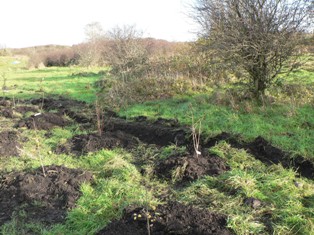
Mechanical mounding
Particularly effective on poorly draining heavy sites, mechanical mounding is the most popular form of ground preparation. It involves an excavator digging drains at regular intervals and heaping the soil in mounds. On freer draining soils mounds can be formed without installing drains. The trees are then planted into the mounds which provides an elevated vegetation free zone.
Ripping
Ripping is primarily used on more fertile mineral soils sites where drainage is impeded by a compacted layer such as an iron pan or cultivation pan, beneath the surface. A machine pulls a tine behind it to a depth of 45 cm, shattering the pan layer. The trees are planted approximately 10 cm from the centre of the rip channel.
Pit planting
Pit planting, slit planting or angle notch planting may be suitable for mineral or old woodland sites. No drainage or soil cultivation is required. It may also be appropriate on steep slopes where soil cultivation may lead to sediment runoff. These planting techniques are also suitable for planting single or small groups of native riparian trees within an aquatic setback is required.
Plant Quality and handling
Trees should only be bought from a recognised forest nursery and should be ordered well in advance of planting. The trees should have a strong fibrous root system, a straight stem and meet the size specifications as described in the afforestation grant approval. The nursery can provide a provenance certificate which shows the origin of the trees.
Good plant handling is as important as plant quality. The bags of trees should be handled carefully and ideally the trees should be planted immediately. If stored, the bags should be kept upright in a shaded place or shed and planted as soon as possible.
Planting
Trees must be planted with care to provide the best conditions for successful establishment. The principles of good planting are:
- Ensure the tree is planted upright
- Plant tree to correct depth (i.e. root collar)
- Carefully place roots into the soil by hand
- Cover all roots with soil and firm in well
The planting season normally runs from November to March when trees are dormant and can be safely planted as bare-rooted trees. The planting season can be extended by using plants from cold storage.
Tree spacing and stocking
Generally, trees are spaced at 2m by 2m giving a stocking rate of 2500 trees per ha. Agroforestry however will have approximately 400 trees per ha with spacing set out depending on desired layout and farming system.