Reforestation
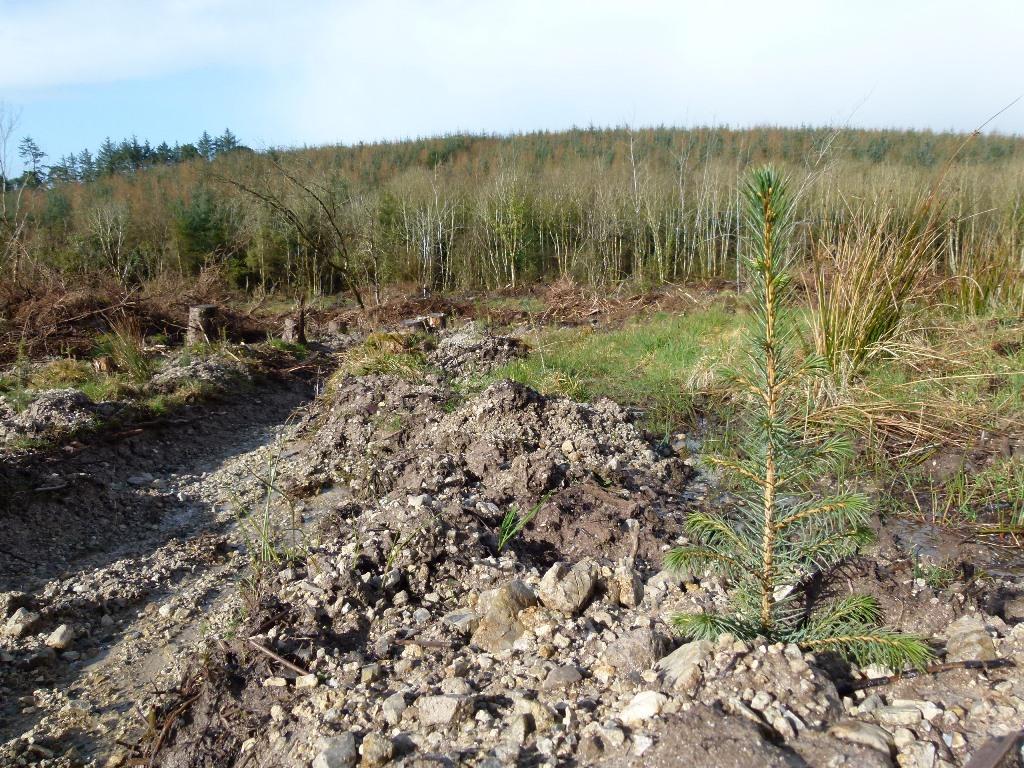
Once a forest has been clearfelled, the same area needs to be replanted. This operation tends to take place within two years of clearfelling. The focus of reforestation operations is to provide an ideal planting environment, to encourage strong growth of the most suitable trees and to minimise losses or delays due to vegetation competition, livestock or insect damage.
Activities and costs
The following table gives a brief overview of the activities (and costs) associated with reforestation:
| Timeline | Operation | Costs (€/ha) |
|---|---|---|
| Year 1 | Ground preparation including windrowing | 850-950 |
| Ground preparation – windrow only | 500 | |
| Plants | 875-1375 | |
| Plants dipped for weevil (conifers) | 225 | |
| Planting dipped plants | 450 | |
| plant distribution on site | 60 | |
| Fertiliser + application (if required) | 180 | |
| Fencing (100 m/ha) | 180 + materials | |
| Weed control (2ha /day) | 170 | |
| Weevil control | 250-280 | |
| Year 2 | Filling in (500 plants/ha) | 270 |
| Spray for Weevil x2 | 280 | |
| Vegetation control (2ha/day) | 170 | |
| Year 3 | Filling in (5%) | 100 |
| Spot spraying / manual cleaning | 170 | |
| weevil control if required | 280 |
NB: The above figures should be seen as a guide only as costs will vary, especially when overheads and supervision costs are factored in.
These prices are net of VAT (if the owner is VAT registered). If VAT has to be included, the rate is 13.5% on all items except the plants, which are rated at 23%. .
Ground preparation
The successful reforestation of a clearfelled site begins at the ground preparation stage. The type of ground preparation will be dependent on a range of site factors including soil type, slope and drainage status. Brash mats and post-harvest branching are normally tidied up into windrows typically 10 to 12 metres apart. This work is usually carried out by tracked excavator, with additional drainage or ground preparation such as mounding being carried out between rows, according to the demands of the site.
Bundling and removal of brash from site may be an option but only on better sites where existing site nutrition, ground conditions and environmental conditions allow. The target weight for brash bundling is 20 tonnes/ha, but this figure can range from 16 to 24 tonnes/ha. A landowner should aim to remove 75% of the brash, with the remaining 25% consumed by extraction racks, waste, etc. While brash bundling operations may be cost-neutral, the main benefit is the resultant tidier nature of the reforestation area, leading to lower site preparation costs.
Plants and planting
Trees should only be bought from a registered forest nursery and should be ordered, where possible well in advance of planting. The trees should have a strong fibrous root system and a straight stem. While more expensive and of limited availability, genetically improved planting stock have been proven to boost growth, stem form and wood properties.
The table below outlines the stocking and spacing requirements which apply equally to afforestation and reforestation sites.
| Species | Number of trees required per hectare | Plant spacing (in metres) |
|---|---|---|
| All conifers | 2,500 | 2.0 x 2.0 |
| All broadleaves | 2,500 | 2.0 x 2.0 |
| Oak and nurse mix | 2,500 – 10 lines of oak and 1 line of nurse | 2.0 x 2.o |
| Beech and nurse | 2,500 – 10 lines of beech and 1 line of nurse | 2.0 x 2.0 |
| Native forest | 2,500 | 2.0 x 2.0 |
Fertiliser
Phosphorus is the most commonly applied fertiliser on newly planted trees to promote early tree growth, usually in the form of Ground Rock Phosphate (GRP). Fertiliser must be applied between the months of April and August. This is to maximise fertiliser uptake and to minimise the risk of environmental damage. It is highly unlikely that an application of Nitrogen will be needed on a site that formerly grew a successful forest crop.
Weevil risk
In 2016, cases of up to 30% tree plant mortality in reforestation sites were reported. These losses were attributed mainly to Hylobius abietis (Large Pine Weevil) damage. This will increase the re-establishment costs substantially through the cost of insecticide application, replacing plants and additional weeding. Felling a coniferous crop produces a large increase in breeding material for pine weevil, whilst plant material suitable for adult feeding is reduced. Young trees used for restocking are liable to be heavily attacked by adult pine weevils feeding on the stem from the root collar upwards. Heavy damage can completely girdle stems and cause plant death.
No successful means of controlling the population in the stumps is currently available. It is therefore necessary to protect the plants directly through dipping and/or spraying with the insecticide Cypermethrin. It is important to note that the knapsack application of Cypermethrin is only effective for approx. 6 weeks, so predicting the optimum time of application is critical.
Relevant publications
- Farm Forestry Series No. 20: Reforestation following Clearfell (PDF)
- Managing Pine Weevil Methods and Options (PDF)
- DAFM Standards and Policy on Felling and Reforestation (DAFM website)
Relevant Supports