
Dairy Farmer with Upgraded Farm Infrastructure
 John Macnamara, Knockainey, Co. Limerick
 Padraig Fitzgerald
Summary
- There are several easy fixes that a farmer can do to pass a NAIP inspection.
- Keep clean rainwater separated from dirty yard areas using intact gutters and downpipes.
- Farms must provide adequate leak-proof storage for all slurry, silage effluent, and farmyard manure runoff, avoiding leaks into clean drains.
- Finally, farmers must strictly follow fertiliser spreading rules, observing mandatory winter closed periods and maintain required buffer zones from rivers.
In Ireland, the National Agricultural Inspection Programme (NAIP) was established in 2022 to solve a specific problem: declining water quality across Ireland and inconsistent environmental enforcement. Both the EU Nitrates Directive and Water Framework Directive are implemented in Ireland and across all European countries. The NAIP inspections which come from these EU directives mandate that Ireland, as a member state, must reduce water pollution caused by agricultural nutrients (like nitrogen and phosphorus). Previously, local councils managed farm inspections independently, leading to massive variations in how rules were enforced from county to county. To correct this, the government granted enhanced oversight powers to the Environmental Protection Agency (EPA). The EPA formed a national working group in 2022, creating the NAIP to build a nationally consistent, unified framework for every local authority. The Water Action Plan set out a target of 4,500 farms to be inspected on an annual basis by 2025. This is the target the EPA assigned to local authorities. In County Limerick these inspections are conducted by Limerick City and County Councils. They had a target to carry out 194 NAIP farm inspections in 2025.
John Macnamara alongside his wife, Olivia, farm in Knockainey Co. Limerick, with their four children, Caoimhe, Conor, Ailbhe and Padraic, who all contribute to the running of the farm. He is milking 230 spring calving dairy cows on a 76 ha milking platform, with an additional 38 ha on an out-farm, 6 miles from home, used for silage-making and grazing heifers. John places a huge focus on grass production which is achieved through excellent grassland management, maintaining optimal soil fertility, the incorporation of clover through consistent reseeding and over-sowing, and aligning chemical nitrogen use. In 2025 the farm produced >15t DM/ha, feeding less than 550 kg of concentrates per cow with 165 kg of chemical N/ha spread, all while maintaining production at over 520kg of milk solids/cow. The farm grew >14.8 t DM/ha of grass on average over the previous 5 years.
John’s home farm (milking platform) is located alongside the Morningstar_040 waterbody which is at good ecological status under the most recent WFD Status reporting period 2019-2024.
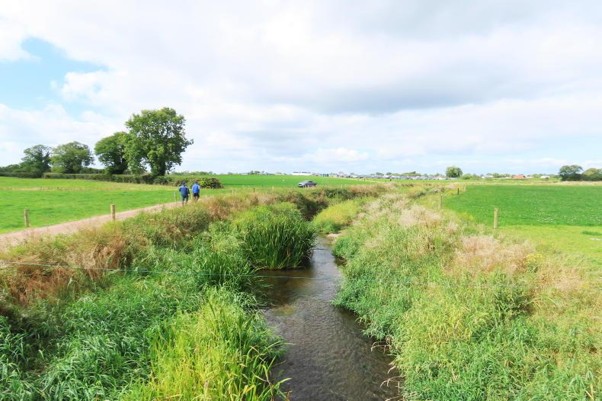
Source: James Hanly Irish Farmers Journal.
On June 9th 2026, The Environmental Protection Agency (EPA) released the NAIP report for 2025 which detailed farm inspections completed by local authorities in this period. The report stated that these inspections found a non-compliance rate of 43% due to poor farming practices or management.
The main reasons for the non-compliances identified during these inspections relate to the control of soiled water, discharges with potential to impact water quality, management of farmyard manure and slurry collection and storage.
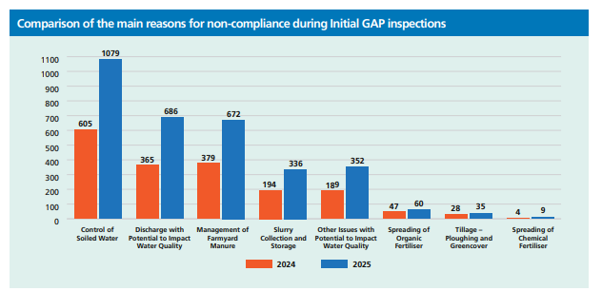
Source: The National Agricultural Inspection Programme Summary Report 2025.
Some of the specific issues identified in this report were:
- Runoff from farmyard manure (FYM) not controlled
- Inadequate gutters and downpipes
- Clean water not properly segregated
- Inadequate management of silage pit
- Inadequate storage capacity for slurry
- Silage effluent discharging to groundwater
On his farm John has continuously developed the farmyard over many years. In doing so he is conscious of making time to get the small details right and to future-proof the farm for any farm inspections such as NAIP inspections.
Runoff from farmyard manure (FYM) not controlled
John’s farm does not produce a large amount of FYM, but he has a designated area for its collection and a tank to collect the seepage. It is critical to collect Farmyard Manure (FYM) runoff because FYM effluent is a highly concentrated pollutant that severely damages water quality and aquatic ecosystems.
While solid FYM appears stable stored in a heap on concrete or a field position, rain falling on an open FYM heap quickly washes out nutrient-rich liquid. Under Good Agricultural Practice Regulations, this runoff must be treated with the same strict containment rules as raw slurry. It needs to be collected, stored and land spread appropriately. To pass a NAIP inspection, FYM must either be stored in a fully roofed shed or on a designated concrete slab sloped toward a collection channel. This channel must direct 100% of the seepage into a leak-proof underground slurry or soiled water tank for collection.
Inadequate gutters and downpipes
Walking into John’s farmyard it is evident how clear and clean the yard is. All roofs of sheds and farm buildings have working gutters and downpipes. It is one of the easy fixes that a farmer can do to ensure that inadequate, broken, or missing gutters and downpipes are repaired or replaced on buildings.
When a roof lacks functional gutters, clean rainwater pours directly onto open yard areas where livestock walk, feed, or stand. The moment clean rain touches a yard surface contaminated with manure, urine, or feed residue, 100% of that water legally becomes “soiled water” and must be collected. This in turn reduces a farmer’s slurry storage capacity on the farm.
During an inspection if a farmer is seen to fail in separating clean water from dirty water it can lead to a sanction. It is one of the top reasons farms fail NAIP inspections.
Divert soiled water to suitable storage
When assessing soiled water compliance, a NAIP inspector will check that the farm storage tanks are structurally sound, leak-proof, and have enough storage capacity for soiled water collection. Most importantly, inspectors will trace the yard channels to ensure that no soiled water is escaping into clean surface water drains, stone shores, or open ditches.
The main areas for soiled water production on John’s farm are from the milking parlour, collecting yard areas and dairy washings. Through many years of development on his farm, John now has all soiled water collected in tanks in the milking parlour area. The roofed collecting yard greatly reduces the amount of soiled water produced. For John it is important that he knows where all pipes go in his yard and if a pipe is channelling clean water or soiled water. Misconnections in the farmyard can lead to soiled water being directed to a drain instead of being collected.
Divert/convey runoff from roadway to a suitable area
One area of that farm that John puts a lot of emphasis on because of the value of it to his cows, is farm roadway infrastructure. In developing his farm John has installed an under-pass, bridge, and many kilometres of farm roads. Heavily soiled farm roads have the potential to deliver sediment and nutrient-rich runoff if allowed to flow into nearby drains, streams, and rivers. To pass a NAIP inspection it is important when building or upgrading internal farm tracks, to ensure the road surface is sloped (cambered) away from the farmyard and from any watercourses and drains.
The above was produced as part of Teagasc Water Quality Conference 2026. For more information and additional reading from the Teagasc Water Quality Conference, visit here.