
Effects of Nutrition and Genetics on Improving Pork Carcass Leanness

Summary
- The pork industry has spent decades moving toward pigs that grow rapidly, convert feed efficiently, and produce a high percentage of lean carcass tissue.
- Improvements in both genetics and nutrition have made today’s pigs substantially more capable of depositing lean tissue at heavier market weights than in the past.
- However, the challenge for producers is that maximizing carcass leanness is not always the same as maximizing total profitability or pork quality.
- Carcass value and therefore profitability depend on the interaction among feed costs, lean percentage, carcass weight, and primal value.
- Yet there is a potential problem, from the consumer standpoint, excessive emphasis on leanness may also reduce desirable good meat quality characteristics such as marbling, juiciness, and eating quality.
Genetic Effects on Carcass Lean
While this is a presentation on the nutritional effects on carcass lean, it is impossible to discuss improving lean value without mentioning genetics. Genetic selection is one of the most powerful tools for changing carcass composition. Genetic selection for lean pigs has the greatest influence on carcass lean content and feed efficiency. Backfat thickness is one of the most important drivers in calculating carcass lean. Backfat thickness is moderately to highly heritable, with most estimates typically ranging near 0.40–0.50. Consequently, selection for reduced backfat thickness has been an effective means of increasing carcass leanness.
Pietrain vs. Duroc Sired Pigs
Genetic lines differ in both the rate at which protein is deposited and the body weight at which maximum protein deposition is reached. In the U.S., terminal boar lines have been heavily based on Pietrain composites. Pietrain influenced sires excel in growth rate, feed efficiency and carcass leanness. However, in the last three to five years, breeding stock companies and producers have been shifting more towards Duroc composite sire lines for perceived pork quality advantages. Some genetic comparisons would suggest that Duroc-sired pigs will grow as- or slightly faster than Pietrain-sired pigs, but be 0.10 to 0.12 units less efficient, have less loin depth and more backfat thickness. Because backfat depth and loin depth are the two primary drivers of calculating percentage lean, based on U.S. equations for estimating carcass lean, Duroc-sired pigs will have approximately 1% unit less carcass lean at an approximate hot carcass weight of 100 kg. hot carcass weight (Table 1).
Table 1. Effects of sire line on carcass leanness
| Item | Pietrain sire line | Duroc sire line |
| Hot carcass weight, kg | 100.4 | 100.3 |
| Backfat, mm | 15.27 | 16.02 |
| Loin depth, mm | 70.68 | 66.67 |
| Carcass lean, % | 56.31 | 55.36 |
| Adapted from PIC 2025 | ||
These differences illustrate why genetic decisions must be evaluated on an integrated basis. A sire line that produces greater percentage lean may also improve feed conversion and carcass yield, compounding its economic advantage, yet with potential negative effects on marbling, juiciness, and eating characteristics.
Nutritional Effects on Carcass Lean
Nutrition should not be viewed simply as a means of producing the leanest possible pig. Feeding programs should allow the pig’s genetic potential for lean growth to be expressed. This is particularly important because approximately 75 to 80% of the feed required to produce a pig is consumed during the grow-finish period, giving finishing nutrition a major influence on production cost.
Dietary Energy Density
Energy is the most expensive component of the diet and changing energy density will affect average daily gain, feed efficiency, and percentage lean. The optimum energy concentration should therefore be selected based on the relative economics of the grain and fat sources available. Increasing dietary energy density can have negative effects on carcass lean; once the pig’s capacity for protein deposition is maximized, excess energy is deposited as fat. In the U.S., we feed higher energy diets based almost entirely on corn- vs. the wheat- or barley-based diets fed in Europe. Therefore, Irish pigs should have slightly poorer feed efficiency but inherently have greater carcass lean than U.S. pigs who are fed relatively high energy diets.
Dietary Lysine and the Lysine-to-NE Ratio
Lysine is generally the first limiting amino acid in practical swine diets and is a key driver of protein deposition. Once an economical dietary energy level is established, diets should be formulated according to a lysine-to-energy ratio. If energy intake increases, amino acid intake must increase proportionally so the pig can use the additional energy for lean tissue deposition. Conversely if energy density increases and lysine intake does not, a pig will become fatter. Figure 1 presents standardized ileal digestible lysine requirement estimates for boars and gilts fed a wheat-based diet.
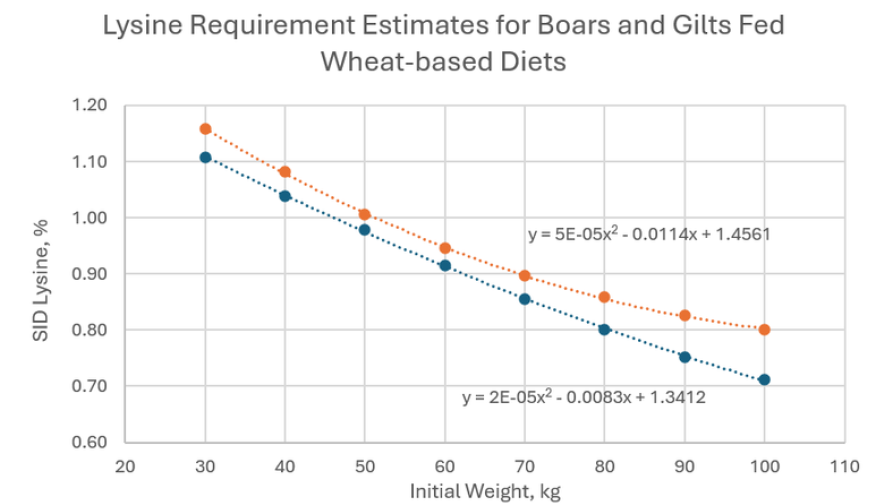
Figure 1. Standardized ileal digestible lysine requirement estimates for boars (top, orange line) and gilts (bottom, blue line), fed wheat-based diets. (Adapted from PIC, 2021).
Amino Acid Ratios to Lysine
Once the appropriate lysine level is established, other essential amino acids should be supplied relative to lysine (Table 2). Increasing dietary lysine alone without a proportional increase in the other amino acids will result in one of these secondary amino acids becoming deficient and result in decreased growth, feed efficiency and carcass lean. A common misinterpretation of the data looking at increasing dietary lysine to increase carcass lean is that only lysine needs to be provided, or practically just adding more L-lysine HCl to the diet.
Table. 2 Minimum ratios of other amino acids relative to lysine
| Weight range, kg | ||||
| 25-50kg | 50-75kg | 75-100kg | 100-135kg | |
| Isoleucinea | 56 | 56 | 56 | 56 |
| Leucine | 100 | 100 | 100 | 100 |
| Methionine & Cystine | 56 | 56 | 58 | 60 |
| Threonine | 63 | 63 | 64 | 65 |
| Tryptophanb | 18-21 | 18-2 | 18-21 | 19-21 |
| Valine | 69 | 69 | 69 | 69 |
| aDiets with high leucine (ex. > 140% of Lys) require higher isoleucine (ex. 60% of lysine). bOptimal tryptophan:lysine ratio depends on value of weight gain. |
||||
Lysine-to-Crude-Protein Ratios
Increasing use of crystalline amino acids allows diets to contain lower crude protein while still meeting essential amino acid requirements. However, crude protein cannot necessarily be reduced indefinitely. There is concern with minimum crude protein concentrations for heavy finishing pigs and suggests that pigs over 100 kg should receive at least approximately 13% crude protein to prevent reductions in performance.
Consequently, formulating solely to a lysine specification can become problematic when crude protein falls too low. An excessive lysine-to-crude-protein ratio can indicate that the diet is becoming deficient in nonessential amino acids. The goal should be to reduce unnecessary crude protein while maintaining adequate lysine, essential amino-acid ratios, and overall crude protein supply for maximum economically efficient lean gain.
Split-Sex and Phase Feeding
Sex is another important source of variation in lean-growth potential. Gilts generally have lower protein deposition and percentage carcass lean, while having more backfat than boars. These biological differences provide the basis for split-sex feeding. Rather than feeding a different set of diets, from a practical management and feed milling standpoint, we can feed the same diets to gilts and boars but change the feed budget to keep boars on a higher lysine diet longer than gilts. Split-sex feeding may also allow different marketing strategies, because the sexes may reach optimum carcass specifications at different weights or ages. As for feeding multiple diets over the finishing period, or phase feeding, there is considerable opportunity for potential savings per head when advancing from 1 to 2, or 2 to 3 dietary phases. In general, there is potentially greater opportunity in economic justification to adding a 3 phase diet vs split sex-feeding only 2 phases.
Concluding Thoughts – Negative Effects of Producing Pigs That Are Too Lean – What’s Happened in the U.S.
Leaner pigs have advantages in feed conversion and may receive processor premiums on a carcass merit buying program. However, the leanest carcass is not necessarily the most desirable pork product. In the past, U.S. packing plants mandated carcass lean and weight buying grids. These implemented incentives resulted in decreasing back fat depth and increased carcass leanness. However, as pork producers raised leaner pigs, today, packers will consider pigs are lean enough and there is little incentive to further increase carcass leanness. Therefore, much of the packer buying programs are now more heavily based on carcass weight. Pork quality research continues to evaluate marbling, colour, pH, tenderness, juiciness, water-holding capacity, and other traits important to consumers. Therefore, genetic and nutritional programs that aggressively minimize fat should be balanced against the need to maintain a positive eating experience. Reducing marbling may create pork that meets a lean specification but is less consistently juicy and flavourful. In the U.S., this issue is particularly important for the loin. The loin’s contribution relative to the total carcass cutout decreased relative to other primal cuts. Pork quality ultimately requires a meaningful economic signal, similar to the signal that has historically driven increased leanness.