
‘Every Day is a School Day’


Summary
- Across the country, farmers are continually adapting their systems to meet changing demands around performance, profitability, welfare and sustainability.
- Some of the most valuable learning does not necessarily come from research trials, but from seeing what is happening on commercial farms and asking what can be learned from those experiences.
This paper highlights four areas where recent experiences on Irish pig farms provide useful learning points for others: better profitability through older weaning, identifying the optimum sale weight, challenges of rearing pigs with intact tails and designing loose lactation systems.
1). Better profitability from older weaning age
The farrowing house is the foundation for pig performance, health and ultimately farm profitability. While much of the focus in recent years has been on increasing litter size and the number of pigs weaned per sow, it is important that we do not lose sight of another key measure of performance: the effect of weaning age & weight on pig lifetime performance.
Most units have a standard 5 weeks farrowing accommodation (1 week pre-farrow and 4 weeks post-farrow) which delivers an average piglet weaning age of 26-27 days. At this stage the piglets starch digestive enzymes are increasing in concentration, and these are vital to enable the pig to breakdown the nutrients in solid food. The older the pig becomes the higher the level of digestive enzymes and therefore better digestion/performance. If piglets have lower levels of digestive enzymes at weaning, due to the piglet being younger/weaker, then a higher proportion of the nutrients are not digested in the small intestine and will be passed into the large intestine. These nutrients will then provide energy for the bacteria we don’t want – E.coli, salmonella etc. This in turn can cause scours, oedema and higher mortality in these piglets.
If you can delay the weaning age until 31-32 days then the piglet has more time to consume dry creep in the farrowing house, which in-turn stimulates more enzyme production. This higher enzyme level means less undigested nutrients are escaping to feed the harmful bacteria in the large intestine. An additional benefit is that the pig’s immune system is developing rapidly day-by day and an extra five days gives the pig a much better defence against diseases (fig.1).
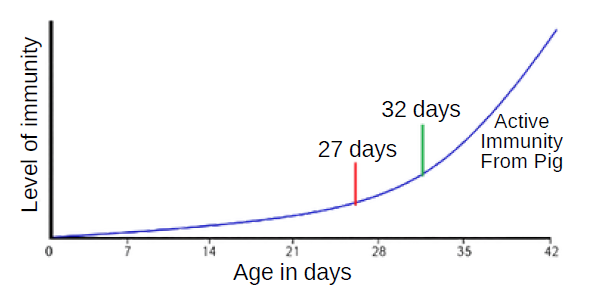
Fig 1 Correlation between age and active immunity
A case study was undertaken on a pig unit that built an extra week’s farrowing accommodation (34 crates). The cost of this extra accommodation was €210,000. Their weaning age increased from an average of 27 days to 32 days, and the weaning weight rose from 7.2kgs to 8.7 kgs (See table 1).
Even though the litters/sow/year dropped from 2.35 to 2.30 as weaning age increased, there was a reduced mortality rate in weaners and finishers (by 1.0% and 0.5% respectively) in the older pigs. Therefore, the number of pigs sold /sow/year were nearly identical at 30.2 vs 30.1. However, the big difference / gain was the superior efficiency of the older pigs.
This translated into lowering the cost of production in these older pigs by 5.7 c/kg dwt. or €5.10 per pig – this figure included the capital costs of the new farrowing house, spread over 10 years.
However, increasing weaning age across the whole herd can be challenging for some units due to their layout. In these situations, a portacabin could provide additional farrowing accommodation, allowing the selection of nurse sows and 20% of the piglets (lightest/youngest) to continue for another week. If these sow & litters are moved into this house, the normal weeks washing can still be accomplished in the main farrowing house. This could provide an opportunity to increase the weaning age & weight of the most ‘at-risk’ piglets, thereby reducing mortality and increasing profitability.
Ultimately, an increased potential profitability per year of €108,000 for an average sized herd needs to be explored. This is even more pertinent in the light of recent grading changes having reduced sale-weights, thereby increasing the cost of production.
Table 1. Financial comparison of 27 day and 32 day weaning age
| Average weaning age (days) | 27 | 32 |
| Sow herd size | 700 | 700 |
| Pigs/sold/sow/year | 30.2 | 30.1 |
| Average weaning weight (kg) | 7.2 | 8.7 |
| Weaner weight at transfer (kg) | 35.6 | 39.4 |
| Weaner ADG (g) | 450 | 488 |
| Finisher FCE (g) | 2.6 | 2.42 |
| Finisher ADG (g) | 1020 | 1075 |
| Cost of production comparison | ||
| Cost saving per kg dwt | 5.7 cent | |
| Cost saving per pig | €5.11 | |
| Cost saving per year | €107,667 | |
2). Finding the Optimum Sale Weight
The introduction of the new pig grading system has significantly changed how farmers approach sale weight. For many producers, the practical target has moved towards approximately 118–120 kg live weight, with the aim of maximising the proportion of pigs falling within the Golden Box for both weight (80 to 94.99kg dead weight) and lean meat (>60%). Achieving the Golden Box is clearly important, but the question for farmers is whether it should be the only consideration when deciding when to sell pigs.
The new grading system means that weight and lean meat percentage need to be considered together. Where pigs are consistently falling outside the Golden Box, there is an opportunity to improve returns through changes to genetics, nutrition, health or management. Bringing sale weight back towards 118–120 kg has been an appropriate response on many farms, but achieving the desired grading result does not automatically mean that this is the most profitable sale point for every farm. The important question is: what happens to the cost of production when pigs are sold lighter?
Analysis of slaughter data from several farms provides an interesting perspective. In some cases, reducing sale weight has resulted in an increase % of pigs getting into the golden box. However, as the average sale weight falls the non-feed costs per pig remains the same, therefore the non-feed cost per kg dwt increases. Where is your sale weight sweet spot, whereby you maximise the net pig price while minimising the non-feed cost per kg.
Space and stocking density are also important. Reducing sale weight allows pigs to leave the farm sooner and may help relieve stocking pressure. On a farm operating close to capacity, getting pigs away earlier can have a significant benefit by improving throughput and reducing pressure on accommodation. Where space is not limiting however, the economics of carrying pigs for additional kilograms may be very different.
Equally, simply keeping pigs to heavier weights is not necessarily the answer. Once pigs move beyond their optimum point, feed conversion can deteriorate and the cost of producing each additional kilogram can increase. If heavier pigs move outside the most favourable area of the grading grid, the additional carcass weight may not generate sufficient income to compensate for poorer grading and the cost of keeping the pig for longer. The challenge is therefore to find the economic optimum for each individual farm.
Farmers should use their own data to assess sale weight alongside:
- Feed cost and feed efficiency
- Non-feed costs
- Available housing space
- Stocking density
- Growth rate
- Grading results
- Days on farm
- Overall throughput
What is optimal on one farm may not be optimal on another. A farm with high nonfeed costs and limited space may place greater value on reducing days on farm, while a farm with lower costs and sufficient accommodation may benefit from carrying pigs for additional kilograms.
The Golden Box remains a critical target, but it should be viewed as part of the decision rather than the entire decision. Farmers need to know not only how many pigs are achieving the target, but also what it costs to get them there.
The more useful question is therefore not simply, “What weight should I sell my pigs at?”, but “At what weight does selling another kilogram give me the best return on my farm?”. AI apps can help to rapidly identify the optimum weight but it is important to include your monthly nonfeed cost and monthly pigs sales in this calculation. A more detailed analysis can be obtained from your pig adviser as per the table 2.
3). Learning from Farmers Rearing Pigs with Intact Tails
The move towards rearing pigs with intact tails is an important step in improving pig welfare, but the experience of farmers who have already implemented the system demonstrates that it is not without challenges.
One of the clearest messages from commercial experience has been the association between intact-tail production and increased carcass condemnations, particularly those associated with multiple abscessations. On one farm that was studied, the records showed a clear relationship between the time periods when long-tailed pigs were being supplied and the resultant increase in condemnations. During periods of heavier long-tailed pig production in 2024 and 2025, whole-carcass condemnations due to multiple abscessations increased substantially, with additional partial condemnations also recorded. At their highest, total condemnations associated with long tailed pigs tripled.
Importantly, the farm did not simply accept this outcome. The data were monitored continuously, and different interventions were trialled e.g. straw racks, toys etc. Following a return to tail docking as the general policy, whole-carcass condemnations fell and is currently running at 0.3%.
These figures are based on a relatively small volume of pigs and should not be interpreted as definitive industry-level results. However, they demonstrate the value of monitoring slaughterhouse data and using it to assess the practical consequences of management decisions. It also highlights the importance of getting the post-mortem data system in use in slaughter plants into widespread operation. This would give continuous weekly/monthly reports for each farm.
Factory condemnations may also represent only part of the problem. Pigs identified on-farm with tail-related or other abscesses may not reach the factory at all. In some cases, post-mortem examinations and veterinary investigations identified spinal or other abscesses in pigs that had already been removed from the production system. Consequently, relying solely on factory condemnation data may underestimate the overall impact.
Table 2: Optimum sale weight calculator
| Live weight at sale | 115 | 117 | 119 | 122 | 125 | 128 | 131 | 134 | 137 |
| Dead weight at sale | 88 | 89.5 | 91 | 93.3 | 95.6 | 97.9 | 100.2 | 102.5 | 104.8 |
| Weight gain 30kgs – sale | 85 | 87 | 89 | 92 | 95 | 98 | 101 | 104 | 107 |
| Finisher FCE | 2.36 | 2.365 | 2.37 | 2.39 | 2.41 | 2.44 | 2.48 | 2.52 | 2.56 |
| Finisher feed usage kg/pig | 200.6 | 205.755 | 210.93 | 219.88 | 228.95 | 239.12 | 250.48 | 262.08 | 273.92 |
| Finisher feed cost / tonne | €318 | €318 | €318 | €318 | €318 | €318 | €318 | €318 | €318 |
| Finisher feed cost / pig | €63.79 | €65.43 | €67.08 | €69.92 | €72.81 | €76.04 | €79.65 | €83.34 | €87.11 |
| Weaner feed – cost/pig (creep/link/weaner) | €19.00 | €19.00 | €19.00 | €19.00 | €19.00 | €19.00 | €19.00 | €19.00 | €19.00 |
| Feed cost sow – cost /pig | €17.88 | €17.88 | €17.88 | €17.88 | €17.88 | €17.88 | €17.88 | €17.88 | €17.88 |
| Total feed cost / pig | €100.67 | €102.31 | €103.96 | €106.80 | €109.69 | €112.92 | €116.53 | €120.22 | €123.99 |
| Total feed cost / kg dwt | €1.14 | €1.14 | €1.14 | €1.14 | €1.15 | €1.15 | €1.16 | €1.17 | €1.18 |
| Non feed cost / week | €27,000 | €27,000 | €27,000 | €27,000 | €27,000 | €27,000 | €27,000 | €27,000 | €27,000 |
| Pigs sold / week | 500 | 500 | 500 | 500 | 500 | 500 | 500 | 500 | 500 |
| Non feed cost / pig | €54.00 | €54.00 | €54.00 | €54.00 | €54.00 | €54.00 | €54.00 | €54.00 | €54.00 |
| Non feed cost /kg dwt | €0.61 | €0.60 | €0.59 | €0.58 | €0.56 | €0.55 | €0.54 | €0.53 | €0.52 |
| Total cost per kg dwt (feed + non-feed) | €1.76 | €1.75 | €1.74 | €1.72 | €1.71 | €1.70 | €1.70 | €1.70 | €1.70 |
| Average Net Pig Price c/kg | 1.81 | 1.8 | 1.78 | 1.76 | 1.74 | 1.72 | 1.7 | 1.68 | 1.66 |
| Net Margin (Pig Price – Total cost) c/kg | €0.05 | €0.05 | €0.04 | €0.04 | €0.03 | €0.02 | €0.00 | -€0.02 | -€0.04 |
Another important learning point concerns environmental enrichment. Farm experience demonstrated that providing straw, hay and other forms of enrichment does not necessarily eliminate tail-related problems. In some groups, pigs had access to substantial enrichment, yet tail-related health problems still occurred. This does not mean that enrichment is ineffective or unimportant. Rather, it demonstrates that tail biting is a multifactorial problem, and no single intervention can be expected to prevent it in every situation.
There is also an important human welfare consideration. When tail damage becomes common within a group, farm staff can potentially become accustomed to seeing it. A problem that initially appears obvious can become normalised simply because it is seen repeatedly. Recognising that a problem has become common must not mean that it becomes acceptable.
Regular observation, early identification of tail damage and appropriate intervention remain essential. Successful intact-tail production will require close monitoring of the pigs, environmental conditions, enrichment, health outcomes and slaughter data, together with a willingness to change management when problems arise. If there is a higher cost with intact tail production then this cost must be recognised and quantified.
The objective is not to present intact-tail production as either a success or a failure, but to learn from those already doing it and to use the evidence generated on commercial farms to improve future systems.
4). Learnings from pig units using ‘Loose Lactation’ systems
The move towards loose lactation systems represents a significant change in how farrowing accommodation is designed and managed. While research and technical specifications provide important guidance, some of the most valuable lessons are coming from farmers who have already installed and operate these systems under commercial conditions.
The first message is that there is no one-size-fits-all system. Building dimensions, pen size and existing infrastructure can have a major influence on the final design. In one system, restricted pen dimensions resulted in the crate being positioned at an angle to maximise usable space, particularly behind the sow. A larger pen may not require the same approach. The dimensions of the existing building therefore need to be considered carefully before a system is selected. It should not be assumed that a particular crate will simply fit into an existing room and function effectively.
Farmers have also highlighted the importance of looking beyond the initial installation and considering how the system will perform over many years. One farmer was very positive about the crate being used, describing it as solid and robust, but concerns were raised about its relatively small turning circle and the legs of the crate sitting directly on the floor. Over time, these legs may be susceptible to corrosion, potentially weakening the structure and the slats underneath. This raises an important question for anyone making a significant investment: what will this component look like after 10 or 15 years of use?
The sow’s turning circle is another important consideration. Sows have increased in size over time, and breeding programmes are likely to continue influencing mature body size. A turning area that appears adequate for today’s sow may not provide the same level of freedom for the sow of the future.
Another system discussed by farmers provided a 1.8 m turning circle and had no legs sitting directly on the floor. The crate could also be opened outwards, and the crate sides could be lifted into a vertical position – this is future proofing in-case of a move to towards fully loose farrowing in the future. However, flexibility can introduce new design considerations. A low wall was required at the rear to anchor the crate, potentially creating challenges where crates are installed back-to-back. Bars across the top of the crate were also identified as potentially useful to prevent gilts from flipping backwards when first introduced. If the crate is positioned near a pen division will the sow pin piglets against the wall. Many new crate designs are placing the crate at a 45-degree angle to the passage to prevent this happening.
Commercial experience has also demonstrated the importance of refinement. Features such as anti-crush bars, solid areas and drinker position were reviewed and modified once systems were being used. These changes should not necessarily be seen as criticism of the original design; they are responses to what farmers observe in practice. The interaction between the sow and piglets is particularly important. Changes to walls, solid lying areas and the position of the heated nest can alter where piglets choose to lie and consequently where potential risks occur. Observing animal behaviour is therefore essential. A design change may solve one problem while creating another.
Cost is another major consideration. Loose lactation systems represent a substantial investment, particularly where existing accommodation needs to be modified or rebuilt. Farmers need to consider not only the purchase price of the crate but also alterations to buildings, floors, ventilation and other infrastructure. The experiences from these farms are early learning points rather than definitive recommendations.
Farmers considering investment should ask:
- Will the system fit my building?
- Are the floor supports and ventilation system sufficient
- Is it durable?
- Is there sufficient space for today’s sow and the sow of the future?
- How will the sow and piglets use the space?
- Can the system be adapted in the future?
- What refinements might be required?
- What is the total investment?
Perhaps the most important lesson is that the finished system may not be the same as the system you start with. Continued observation, farmer feedback and refinement will be essential as commercial experience with loose lactation develops.
Conclusion
The common message across all four areas is simple: ‘every day is a school day’. Whether it is producing an older weaned pig, finding the most profitable sale weight, managing pigs with intact tails or investing in loose lactation, there is no single answer that will suit every farm. The farms that will adapt best are those that monitor their own data, observe their animals closely, question whether current practices remain appropriate and are prepared to learn and change. The objective is not simply to produce more pigs, but to produce better pigs, manage them effectively and make decisions that deliver sustainable performance, welfare and profitability for the individual farm.