
Improving Sow Livability

Summary
- Sow livability has become one of the most important biological, economic, and welfare challenges facing modern pork production.
- Genetic progress has produced females that are leaner, faster growing, larger framed, and substantially more productive than previous generations, but the modern sow is also being asked to remain reproductively efficient through repeated cycles of gestation, farrowing, and lactation.
Sow livability has become one of the most important biological, economic, and welfare challenges facing modern pork production.
Genetic progress has produced females that are leaner, faster growing, larger framed, and substantially more productive than previous generations, but the modern sow is also being asked to remain reproductively efficient through repeated cycles of gestation, farrowing, and lactation.
At the same time, commercial systems are operating with larger herds, tighter labour supplies, and greater expectations for individual-animal care.
As an unintended consequence, sow mortality rates in the U.S., Ireland, Spain, and Denmark have gradually increased over time (Figure 1). Mortality rates in the U.S are at approximately 14% with some individual herds experiencing levels up to 20%.
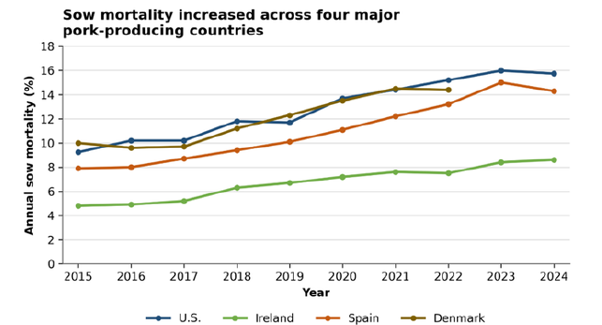
Figure 1. Annual sow mortality in the U.S., Ireland, Spain, and Danish herds from 2015 to 2024 (Denmark 2015 to 2022; Chat GPT).
Fortunately, recent benchmarking suggests some stabilization as a result of concerted efforts on breeding herd management, feeding programs, and genetics. Yet breeding herd mortality remains well above historical levels. Improving livability requires coordinated attention to gilt development, body condition, locomotion, health, reproduction, and early identification of compromised females.
Causes of Sow Mortality
Trends over time
Rising sow mortality is not caused by a single disease. Rather, the profile of removals reflects the interaction of reproduction, locomotion, acute disease, farrowing complications, pelvic organ prolapse (POP), and management decisions. MetaFarms’ 2025 database grouped more than 600 individual death and euthanasia codes into six categories (Figure 2). These classifications include: Performance (due to difficulty farrowing, parity, or old age); Reproduction (due to abortions, not in pig, returns, and prolapses); Locomotion (due to lameness, broken bones, and feet/legs injuries); Intestinal (due to ulcers and gut related issues); Disease/Health (due to C-section, ileitis, sickness, twisted gut, stress) and Other (due to unknown causes).
Retained pigs, prolapses, reproduction, lameness, and other causes
Farrowing-associated problems deserve special attention because risk is concentrated around late gestation, parturition, and early lactation. Difficult farrowing, retained piglets, uterine infection, mastitis, anorexia, and acute metabolic or gastrointestinal disorders can progress rapidly. Management records frequently classify these cases simply as ‘other,’ ‘sudden death,’ or ‘farrowing difficulty,’ which is why routine necropsy of a representative subset of deaths is critical.
Pelvic organ prolapse remains a major, multifactorial cause of loss. Potential contributors investigated in U.S. work include body condition, perineal score, genetics, housing, feed particle size, mycotoxins, water quality, induction and obstetrical procedures, and health status. Research has found meaningful genetic variation with across-parity heritability of approximately 0.35. This does not mean POP can be solved genetically; rather, it establishes that genetic selection can be one component of a broader prevention program.
Table 1: Sow mortality reasons between 2024 and 2025, MetaFarms, 2025
| Category | 2024 | 2025 |
| Disease/health | 31.1% | 25.1% |
| Intestinal | 0.9% | 1.0% |
| Locomotion | 17.9% | 22.4% |
| Other | 25.5% | 21.4% |
| Performance | 20.1% | 5.5% |
| Reproduction | 4.6% | 24.6% |
| Total | 100.0% | 100% |
| *Prolapse moved from Performance to Reproduction Category | ||
Lameness remains a leading reason for euthanasia and premature removal. Poor feet and leg structure should be selected against before gilts enter the breeding herd. Once a sow is severely lame or down, treatment success is limited and welfare concerns may require euthanasia. Therefore, prevention through proper flooring, nutrition, hoof integrity, and appropriate body weight are key factors.
Porcine reproductive and respiratory syndrome
Herd health changes the background risk against which all other mortality factors operate. PRRS is especially important because it reduces reproductive performance, alters feed intake, increases secondary disease pressure, and consumes labour that would otherwise be available for routine sow care. A recent U.S. industry estimate placed 30% of the U.S. herds with active PRRS outbreaks with another 20% PRRS positive but stable. Only 40% of the herds in the U.S. were PRRS negative. It is estimated that the annual economic cost of PRRS at approximately $1.2 billion USD, including $380.8 million USD in the breeding herd. Even when PRRS is not listed as the direct cause of sow death, outbreaks can increase abortions, fever, anorexia, respiratory compromise, and the number of animals requiring individual care.
Improving Sow Longevity
Gilt development and management
The most effective longevity program starts with gilts before first mating. The goal should include successful development of a parity-1 female that is structurally sound, reproductively mature, and likely to remain through at least parity 3. Data indicate that gilts bred before 225 days of age had greater retention and more pigs born through parity 3, whereas females bred above approximately 160 kg had lower retention, particularly from parity 1 to parity 2 (Canavate and Dritz, 2025). Producers should therefore track age and weight at first service, estrus number, structural soundness, parity-1 lactation performance, wean-to-service interval, and reasons for P1-to-P2 removal.
Gestation feeding and body condition: using the caliper
Gestation nutrition should restore condition lost in the previous lactation without creating an over-conditioned sow. This is increasingly important because modern females have more lean tissue and less backfat than older genetic lines. Over-conditioned sows tend to consume less feed in lactation, lose more weight, and have poorer longevity and subsequent reproductive performance. Conversely, thin sows enter lactation with inadequate reserves and may experience excessive tissue mobilization which can lead to welfare concerns and increased mortality.
The sow caliper provides a practical way to make feeding decisions more objective. The value of the caliper is not the device itself but the consistency it creates. Caliper scoring around the time of weaning (or breeding) can be used to make feeding or culling decisions. For example, weaned sows with a caliper score less than 7, will likely not recover regardless of feeding program and should be culled. Caliper readings between 7 and 10 should be skipped and mated on the following estrus. Sows with caliper scores of 10 to 13 should be, provided extra feed during gestation and readings greater than 13 should be fed the normal herd’s feed allowance.
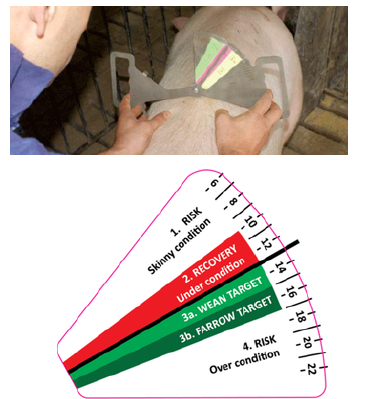
Figure 2: Use of a sow body-condition caliper to objectively assess body condition (Knauer and Baitinger, 2015). The caliper is positioned over the sow’s last rib to quantify topline angularity and help guide gestation feeding.
Lactation management: feed intake and early intervention
Lactation is where multiple risks converge: high milk demand, rapid changes in nutrient requirements, large litters, farrowing stress, and the possibility of uterine disease, lameness, or anorexia. The nutritional objective is to drive feed intake while minimizing unnecessary body condition loss.
Daily feed intake is also one of the most useful health-monitoring tools available. The Iowa State early-intervention program used lactation feeding time as the observation window. Staff are encouraged to walk the farrowing rooms while animals are being fed, flag any sow that is not eating or not at the feeder, and return later to examine and treat her according to the farm’s standard operating protocol. Lack of appetite was the most useful early signal, often appearing before a sow was obviously ill. The program’s central lesson was that by the time a compromised sow is recumbent or severely affected, treatment may be too late.
Conclusions
Improving sow livability requires a shift from viewing mortality as an unavoidable endpoint to treating retention as a measurable production process. The goal is to reduce avoidable losses, especially before the sow has recovered her development cost and before the most productive middle parities. International comparisons show that high productivity does not guarantee low mortality: Denmark produces exceptionally high numbers of pigs per sow while mortality remains near U.S. levels, whereas Ireland currently operates at lower mortality but has also experienced an upward trend.
The most practical opportunities are consistent across systems: develop structurally sound gilts and mate them within appropriate age and weight targets; manage body condition throughout gestation with objective tools such as the caliper; encourage feed intake and limit excessive tissue loss in lactation; aggressively manage lameness and farrowing-associated disease; maintain strong herd-health and PRRS-control programs; and make daily observation of appetite and behaviour a formal job responsibility. Finally, accurate cause of death records and periodic necropsies are essential. A farm cannot improve what it does not measure, and mortality codes that collapse complex biological failures into ‘other’ provide little direction for prevention.