
NAIP inspections – What issues are being identified on farms

Summary
- Only 52% of waterbodies are at good or better ecological status.
- 70% of transitional waters are at unsatisfactory status primarily due to excessive nutrients.
- Agriculture is the most significant pressure on water quality nationally.
- Water quality improvements can be achieved where positive, targeted action is taken.
- The Water Action Plan 2024 set a target of 4,500 farm inspections per annum.
- The National Agricultural Inspection Programme (NAIP) prioritises inspections in areas where agricultural activity poses the greatest risk to water quality.
- The NAIP is a nationally consistent risk-based framework for agricultural inspections across all local authorities.
- IN 2025 local authorities carried out 4,315 initial NAIP farm inspections. The non-compliance rat, (with GAP Regulations), for these inspections was 43%.
- The predominant non-compliances relate to the control of soiled water, discharges with potential to impact water quality, management of farmyard manure and slurry collection and storage.
The latest Water Quality in Ireland report, (2019-2024), published in October 2025, is based on the assessment of over 4,000 surface water bodies and 514 groundwater bodies through monitoring or extrapolation. The report highlighted that 52% of surface water bodies are at good or better ecological status, a decline from 54% in the preceding reporting period. Transitional waters, which includes estuaries and coastal lagoons, are in the poorest condition, with 70% unsatisfactory. The report highlights that there have been improvements in phosphorus levels in priority areas for action, and reductions in nitrogen were detected in a number of rivers, but more needs to be done, as many improvements are being offset by declines elsewhere.
The report demonstrates that improvements can be achieved where positive, targeted action is taken.
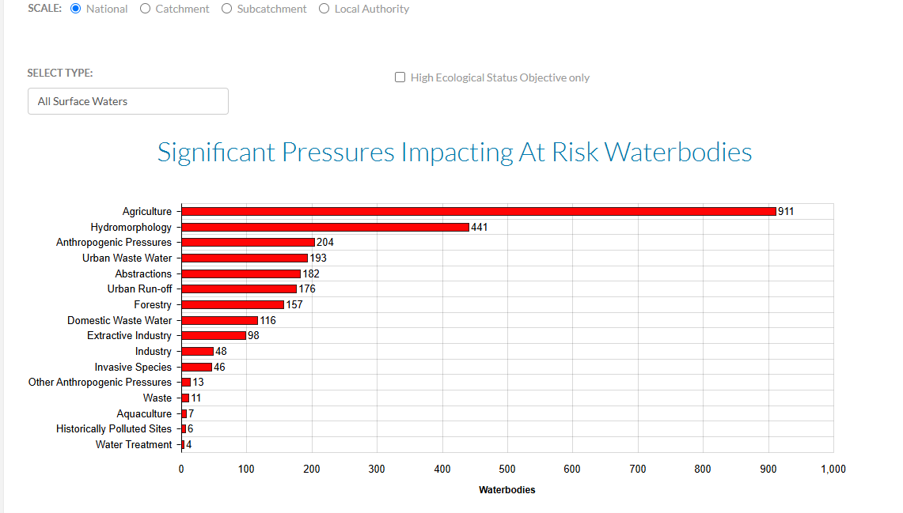
Source; Catchments.ie
National Agricultural Inspection Programme
The Nitrates Action Programme (NAP) forms a central pillar of Ireland’s approach to protecting water quality from agricultural pressures. A core element of the NAP is the National Agricultural Inspection Programme, (NAIP), which was established in 2023. The NAIP is a nationally consistent risk-based framework for agricultural inspections across all local authorities, which is overseen by the Environmental Protection Agency, (EPA).
The NAIP prioritises areas where agricultural activity poses the greatest risk to water quality. Through the NAIP, local authorities are expected to increase the number of initial Good Agricultural Practice (GAP) inspections undertaken, with the aim of reaching the target of 4,500 farm inspections per annum nationally as set out in the Water Action Plan 2024, (587 inspections/annum for Co. Cork).
An increased rate of farm inspections, undertaken in this targeted manner, not only increases the likelihood of identifying issues in at-risk catchments, but also promotes compliance with the Good Agricultural Practice Regulations.
57 new temporary Assistant Scientist posts have been allocated to local authorities to implement the NAIP. Delivery of the NAIP is supported through targeted training, guidance, and resources for local authority inspectors, ensuring inspections are effective, consistent, and focused on environmental risk.
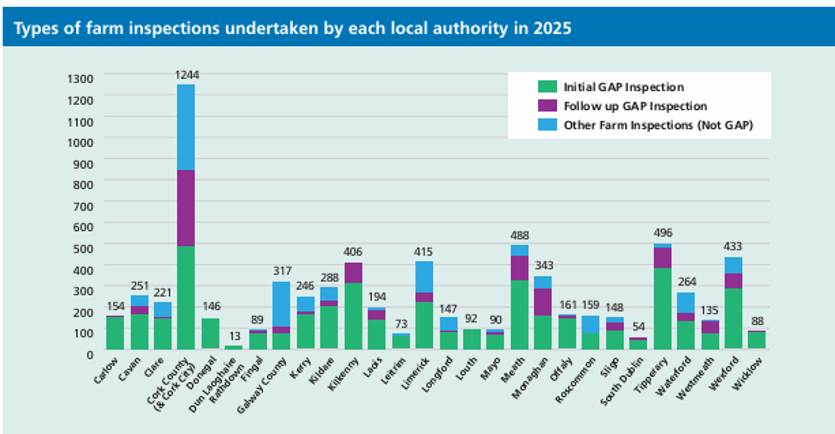
Figure 1; Number and type of farm inspections undertaken by each local authority in 2025 Source NAIP Summary Report 2025
Farm inspection process
During a farm inspection, the NAIP inspector will check:
- Is the farmer minimising soiled water? How is it collected?
- How are silage bales stored, and are they stored away from watercourses? How is silage effluent managed?
- Measures and checks to ensure all manure/slurry storage facilities are fit for purpose
- How is farmyard manure (FYM) stored and managed?
- Evidence of direct or indirect discharges of livestock manures to waters.
- Land spreading/buffer zones of chemical and organic fertilisers.
- Run-off of nutrients and sediment from farmyard and farmlands.
Inspection findings
In 2025 local authorities carried out 4,315 initial NAIP inspections, representing a significant increase of 66% compared with the 2,598 inspections completed in 2024 and indicating continued expansion of inspection capacity nationwide. Total farm inspection activity also rose sharply, with 7,150 inspections conducted across all categories in 2025, up from 4,408 for the same period in 2024.
Initial NAIP inspections continued to account for the majority of inspection activity, supported by steady levels of follow up NAIP inspections and a substantial number of other (non-NAIP) agricultural inspections undertaken in response to environmental incidents, planning applications, and public complaints.
In 2025, the non‑compliance rate for initial NAIP inspections was 43%. The number of follow‑up NAIP inspections doubled to 1,280 compared with the previous year, with 48% achieving compliance.
While inspection levels varied considerably between local authorities, the overall rise in activity demonstrates the strengthening of local operational capacity and an increased focus on regulatory oversight.
The NAIP Summary Report is published annually and available on the EPA website
Main reasons for non-compliance
The main reasons for non-compliance identified during local authority GAP inspections remained broadly consistent between 2024 and 2025. The predominant issues continue to relate to the control of soiled water, discharges with potential to impact water quality, management of farmyard manure and slurry collection and storage, which collectively account for the majority of risks to water quality. As shown in Figure 2, notable increases occurred across all major categories in 2025, with the most significant rise observed in non‑compliances relating to the control of soiled water.
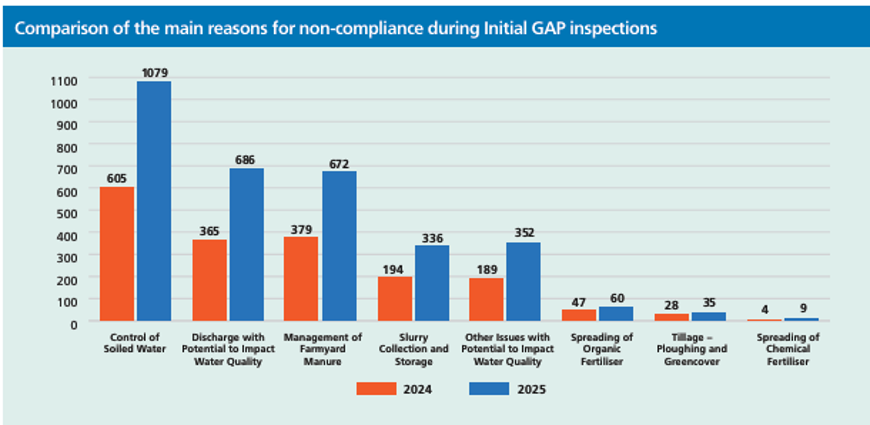
Figure 2; Comparison of the main reasons for non‑compliance in 2024 and 2025
Priorities for 2026 (from NAIP Summary Report 2025)
- Local authorities must sustain the increased level of farm-inspection activity achieved in 2025. Any local authority that did not meet its inspection target must prioritise actions to ensure full delivery of their 2026 inspection targets.
- Non-compliance rates remain unacceptably high, and local authorities should increase follow-up inspections to close out outstanding cases and ensure full compliance with the GAP Regulations. In parallel, local authorities, advisory services, and industry stakeholders must also strengthen compliance-promotion and awareness-raising activities to support farmers in meeting their regulatory obligations.
- Local authorities must adopt a stronger enforcement approach to implementing the GAP Regulations. This should include increased cross-reporting to DAFM and the use of prosecutions where necessary to restore compliance. The EPA will continue to monitor and assess how local authorities utilise the full range of enforcement powers available to them.
Conclusions
- Good Agricultural Practice Regulations are in place since 2006.
- NAIP inspections are finding 43% non-compliance with GAP Regs.
- Management and control of rainwater and soiled water is a major issue.
- Review slurry/soiled water storage requirements v existing capacity, (make provision for rainwater on soiled yards).
- Get the most out of your storage facilities;
- Minimise clean water entering soiled yards and tanks.
- Empty tanks early in growing season, don’t wait until September.
- Empty tanks fully well before closed period.
- Check your nearest watercourse or drain regularly for signs of pollution.
- Good farmyard management is essential.
- Farm inspections will continue with increased emphasis on enforcement of GAP Regulations including Cross Reporting and Prosecutions.
The above was produced as part of Teagasc Water Quality Conference 2026. For more information and additional reading from the Teagasc Water Quality Conference, visit here.