
The Closed Period for Slurry Spreading – its Crucial Role in Preventing Nutrient Loss


Summary
- A closed period for spreading organic manures was introduced to maximise the uptake of nutrients and to minimise pollution risk.
- Storage capacity requirements were introduced at the same time to allow flexibility when spreading organic manures to avoid unfavourable conditions.
- Teagasc’s Agricultural Catchments Programme has been monitoring the weather, river nutrient concentration and discharge (flow) in six small catchments at a high resolution (every 10 minutes) for 18 years.
- Grass growth in Ireland takes place almost all the year but is very seasonal.
- Background supply of nitrogen from the soil alone is adequate to support grass growth without additional sources at times of the year when growth rates are low.
- Two conditions are required for nitrate leaching, (a) water moving down through the soil profile and (b) surplus nitrate in the soil at that time.
- Hydrological connectivity and the portion of rainfall generating river discharge is also very seasonal.
- Up to 8 times more nitrogen and 5 times more P is lost in months during the closed period when compared with the summer.
The purpose of the closed period is to align the application of organic manures to land with growth patterns and crop demand, maximising the uptake of nutrients to minimise pollution risks. It was first introduced into policy in July 1996, with the “Code of Good Agricultural Practice to Protect Waters from Pollution by Nitrates” and was given legal effect in February 2006, with the first GAP regulations, S.I. number 788 of 2005. The current closed period for slurry spreading is from the beginning of October to mid-January, (or the end of January in counties Donegal, Leitrim, Cavan and Monaghan).
Storage capacity requirements were introduced at the same time, and while the volumes required are often associated with the closed period, they are not the same thing. Cattle housing typically occurs in early to mid-November, and the 16, 18, 20 or 22 week storage capacity required (depending on where in the country), should allow flexibility to hold off from spreading until early to mid-March, should conditions be unfavourable. Other restrictions introduced with the same GAP regulations prohibit the spreading of slurry when heavy rain is forecast and on waterlogged, flooded or frozen land.
Monitoring programme
Since 2009, Teagasc’s Agricultural Catchments Programme has been monitoring water in six small but intensive agricultural catchments representative of different soil types and farming systems. This DAFM-funded programme measures nutrient concentration and river flow at a high resolution, taking automated readings every ten minutes, continuously for the last18 years. This sampling frequency ensures that all nutrient loss to water from the landscape is captured, including short “pulses” carried by flood events in a “flashy” catchment. In addition to monitoring N and P concentration within the catchment itself, measuring the river flow (volume) enables the calculation of total nutrient load leaving the catchment, which is delivered into a receiving water body further downstream. This detail informs the “Source – Pathway – Receptor” framework used extensively in environmental research.
Each of the catchments are also equipped with a weather station, recording rainfall, temperature, soil temperature, wind speed and direction and sunlight. Alongside these parameters, potential evapotranspiration is also calculated and recorded.
Grass Growth
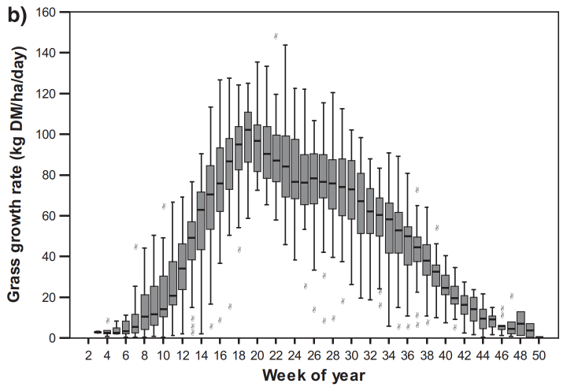
Figure 1. Weekly Grass Growth Rate (kg DM/ha/day) at Moorepark, 1982 to 2010 Deirdre Hennessy et al., 2013, Teagasc
Conditions in Ireland favour grass growth throughout most of the year, however it is very seasonal, with little taking place over the winter period due to low temperature and low levels of sunlight. Peak growth rates occur in late spring and early summer, with rates exceeding 100 kg dry matter / hectare / day taking place in the month of May. For much of the year there is an adequate supply of nitrogen from the soil, and from clover if present, to support grass growth rates. Soil temperature and moisture content will influence the amount of nitrogen supplied naturally, with additional nitrogen required to maximise growth, only needed from March to September.
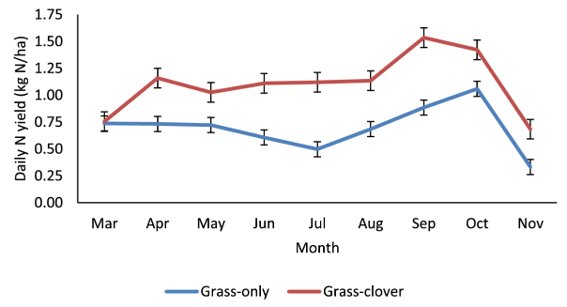
Figure 2. Mean daily nitrogen yield by rotation for grass-only and grass-clover cutting swards receiving zero nitrogen over three site-years (2020–2021)
Áine Murray et al., 2026, Teagasc
Nitrate Leaching and the Nitrogen Cycle
Considering nitrate leaching at its simplest, there are only two conditions required for it to take place, (a) water leaching down through the soil profile and (b) surplus nitrate in the soil, above crop requirement, at that time. It is nitrogen in the form of nitrate (NO₃⁻) that is susceptible to leaching. There is little if anything that can be done from a day-to-day farming perspective to influence the amount of water leaching. It’s dependent on the soil type, rainfall and evapotranspiration. Surplus nitrogen in the soil, on the other hand, is determined by the various pools that exist, the different transformation processes nitrogen goes through, and additional sources applied to the soil.
There are many different forms of nitrogen, and it can change from one to another numerous times in a single growing season, or it can remain very stable and not undergo any change for many decades. These processes are referred to as the Nitrogen Cycle and are influenced by environmental conditions such as temperature, moisture and pH. A lot of changes take place due to microbial activity and include mineralisation, immobilisation, de-nitrification and nitrogen fixation. All of these processes are influenced by farming practice and are seasonal. It is this aspect that offers most scope for actions to minimise the amount of nitrate leached.
Rainfall, River-flow and Nutrient Load
The high-resolution monitoring undertaken in the ACP over a long time-period enables us to work out what portion of each month’s rainfall contributes to river flow. Typically, in Ireland we get close to one metre of rainfall in a year, but only half of this gets to the river. The other half metre either evaporates or is taken up by plant growth – evapotranspiration. Evapotranspiration is very seasonal, with little or none taking place mid-winter and over 100 mm in June and July. When the rates of evapotranspiration exceed rainfall, soils will dry out and river flow is fed by ground water. This results in a lowering of the ground water table, and the age of water in rivers increases. Some groundwater contributing to river flow could be decades old. Typically, in the month of September, ground water tables are at their lowest, resulting in small river flows and nitrate concentrations at a minimum. This double-impact results in a low portion of the total annual nitrate loss at that time. Conversely, in mid-winter, following the groundwater recharge, the ground water table is closer to the surface, land drains are flowing once again and river flow is higher. At this time a much greater portion of the water in the river is quite young, haven fallen as rain in recent days, weeks or months. This “more connected” setting results in an increase in nitrate concentration, on top of higher river flow levels. The example given in figure 3 below shows that there are on average 8 times more nitrogen and 5 times more P lost in the months during the closed period when compared with the summer.
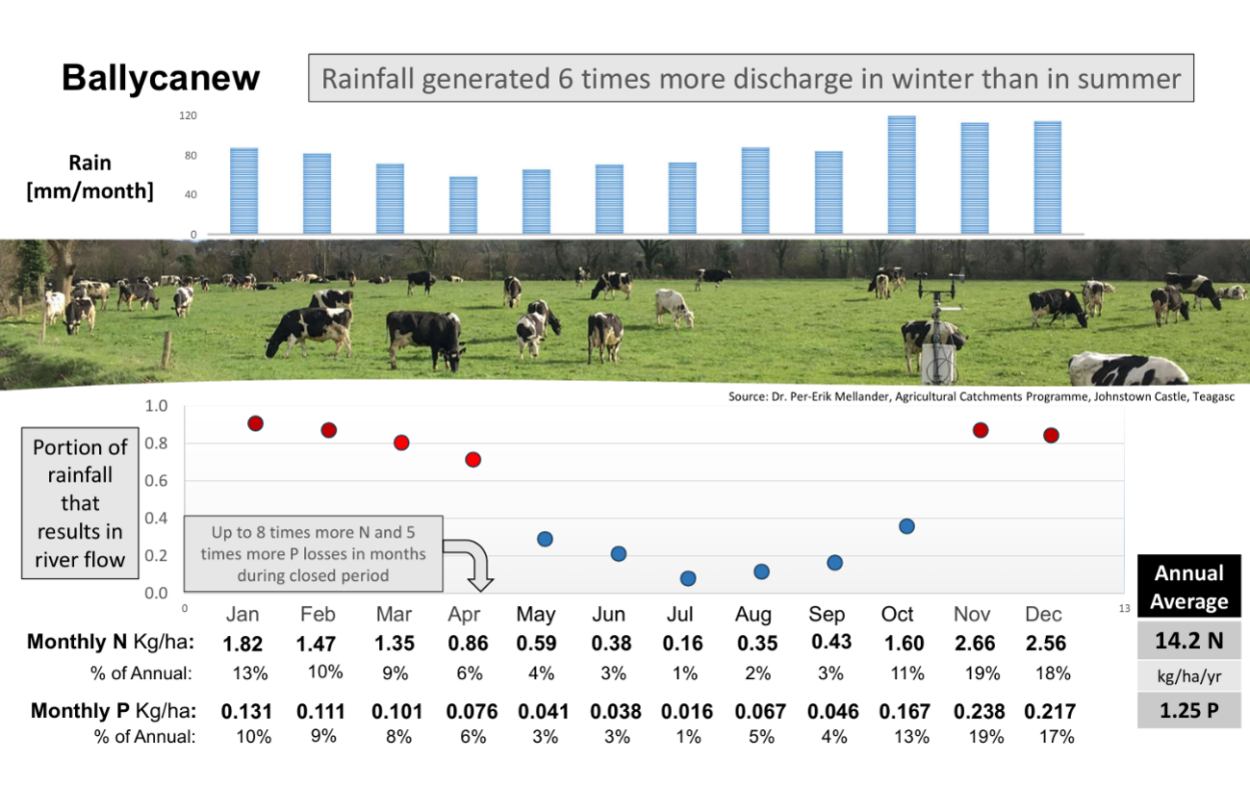
Figure 3. Average monthly rainfall, resulting river flow and nutrient load for the Ballycanew catchment over a 15-year period, 2009 – 2024
Dr. Per-Erik Mellander, Agricultural Catchments Programme, 2025 Teagasc
Conclusions
Both hydrological pathways and crop growth patterns are seasonal and influence the risk of nutrient loss to water from an agricultural landscape. While rainfall amounts can be very variable, evapotranspiration, soil temperature, daily sunlight amount, growth rates and response to fertiliser all follow a seasonal pattern and are closely linked with the risk of nutrient loss, for both nitrogen and phosphorous. Adding to this risk, by applying surplus nutrient, at a time that it is not required by the growing crop, and when the soil is well connected hydrologically to the river, contributes to the total amount being lost. Not all the nutrient leaving a catchment in a given month was applied to the land in that month but adding surplus nutrient at times of the year when growth rates are low and soils are wet will further increase the total amount being lost. Sufficient storage capacity provides flexibility to apply organic manures at a time more likely to have favourable weather conditions.
The above was produced as part of Teagasc Water Quality Conference 2026. For more information additional reading from the Teagasc Water Quality Conference, visit here.