
The contribution of both soil health and cover crops to water quality
 John Pettit
 Stuart Fitzgerald, Arable Farmer
Stuart Fitzgerald farms approximately 700 hectares of owned, leased and share farmed land in Avoca, Co. Wicklow. His diverse arable rotation includes winter wheat, winter barley, winter oats, winter oilseed rape, spring beans and spring barley, with approximately 60% of the farm sown to winter crops annually. Stuart has operated a minimum-tillage system since 2014, with soil health and sustainable crop production central to his farm management strategy.
A key priority on the farm is maintaining and improving soil fertility. All fields are soil sampled, with an annual Nutrient Management Plan developed to reflect changes in cropping and land use. Straw is chopped and incorporated under the Straw Incorporation Measure (SIM), returning valuable organic matter and carbon to the soil. Imported organic manures are targeted towards fields with sub-optimum phosphorus and potassium levels. These practices, combined with minimum tillage, have contributed to improving soil organic matter and building long-term soil health and resilience.
Cover crops are an integral part of this approach. Stuart has been establishing cover crops since 2014, ensuring that all land has either a growing winter crop or a cover crop in place over the winter months. Despite the majority of Stuarts cover crops being grown without financial support, he firmly believes his investment is justified by the benefits observed on the farm.
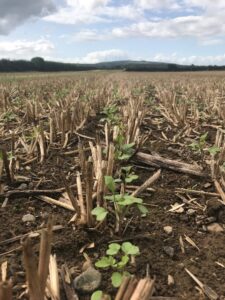
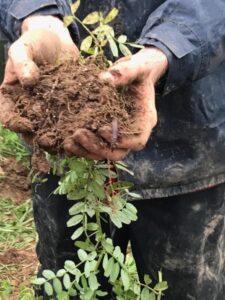
Nutrient management is further supported through the farm’s crop rotation. Early establishment of winter oilseed rape maximises the uptake of residual soil nitrogen during autumn, producing strong crop canopies before winter while reducing the requirement for spring nitrogen applications. Spring beans also provide an important rotational benefit, requiring no nitrogen fertiliser and allowing nitrogen applications to following crops to be reduced by approximately 30 kg/ha.
The farm’s topography presents challenges, with land rising to approximately 700 feet above sea level and many fields having significant slopes. These conditions increase the risk of soil erosion and sediment loss. Cover crops play an important role in protecting the soil surface, reducing sediment movement and helping to retain nutrients within the farm.
Stuart has observed several additional benefits from cover cropping, including:
- Improved soil structure and water infiltration, helping to reduce localised flooding and improve conditions for subsequent crops.
- Increased organic matter and carbon inputs, providing a valuable food source for soil microbial activity.
- Reduced nitrate losses through nutrient capture during the winter in these green cover crops and the subsequent availability of these green manures to incorporate back into the soil.
- Improved soil stability and resilience, particularly in fields under long-term tillage.
- Reduced cultivation requirements and fewer machinery passes ahead of the following crop.
Cover crop establishment and species selection are carefully managed to complement the farm’s rotation. Stuart has adapted cover crop mixtures over time and currently excludes brassica species. Rather than purchasing pre-mixed seed, he buys individual species and prepares his own mixtures, allowing greater control over species selection. Particular attention is also given to seed quality and farm biosecurity, with strict measures in place to minimise the risk of introducing grass weeds through contaminated seed.
Looking ahead, Stuart remains committed to cover cropping as a key component of sustainable arable farming.
His experience demonstrates how the integration of balanced nutrient management, diverse crop rotations, straw incorporation and cover cropping can deliver practical agronomic benefits while helping to protect water quality through mitigating the loss of sediment and nutrients.
The above was produced as part of Teagasc Water Quality Conference 2026. For more information and additional reading from the Teagasc Water Quality Conference, visit here.