WelFarmers: European pig farmers sharing practical solutions for the welfare challenges ahead


Summary
- European pig production is entering a period of change. The European Commission is currently preparing a targeted revision of EU pig-welfare legislation, with a proposal expected by the second quarter of 2027.
- Among the issues identified are the transition from sow crates towards pen systems and the development of practical on-farm welfare indicators.
- The Commission has also stated that the revision will consider the economic, social and environmental impacts of potential changes.
For pig farmers, however, the challenge is not simply identifying what could improve animal welfare. The more difficult question is: what can actually work on a commercial farm?
This is the question at the centre of the EU-funded WelFarmers project. Rather than starting with theoretical solutions and asking farmers to implement them, WelFarmers has taken a bottom-up approach: identify practices that farmers are already using, evaluate them with different stakeholders, and share those that demonstrate potential to improve pig welfare while remaining technically and practically feasible.
Bringing European pig farmers together
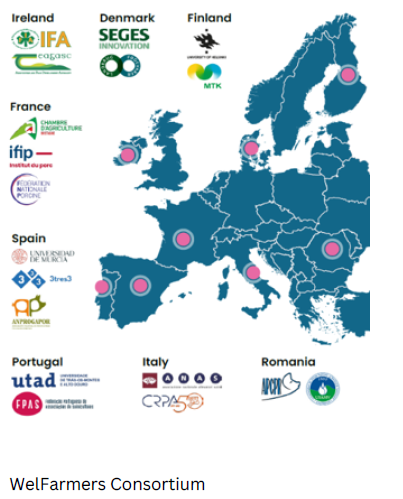
WelFarmers established regional innovation networks in eight European countries: Denmark, Finland, France, Ireland, Italy, Portugal, Romania and Spain. Together, these countries represent more than half of EU pig production. The consortium deliberately brings together different types of expertise and production realities, including research organisations, advisory services and farmer organisations from the different countries.
Farms differ in climate, herd size, housing systems, labour availability, markets, premium schemes, infrastructure and manure-management systems. A practice that is relatively straightforward in one country may be much more difficult to implement in another.
The project therefore did not set out to identify a single European “gold standard”. Instead, it aimed to identify real examples of what farmers are already doing and what lessons can be transferred to other production systems.
WelFarmers focuses on four major themes:
- Ban of cages: opportunities and solutions for loose housing of lactating sows.
- Pigs with undocked tails: practical approaches to moving towards production of pigs with intact tails.
- Avoiding pain during castration: alternatives and approaches including immunocastration, analgesia and anaesthesia, and production of entire males.
- Space allowance and flooring: opportunities to improve housing design, the pig environment and performance.
The WelFarmers project website now provides access to the collected practices and a growing library of supporting material.
From farmers’ practices to WelFarmers Champions
Across two rounds of collection, approximately 200 good practices were submitted from farms across Europe. The practices were documented using structured templates. Farmers were asked not only to describe what they do, but also to explain their farm context: housing design, pen dimensions, flooring, climate control, management practices and other factors that could influence their production. Information was also collected on economic and environmental considerations, the potential for replication elsewhere and possible improvements to the practice. The practices were then evaluated through a multi-actor process.
The thematic expert groups assessed practices against three broad criteria:
- Excellence / technical quality – Does the practice address an identified challenge? Is there scientific evidence behind it? Does it improve welfare when correctly applied? Has it been tested in an operational environment and does it represent an innovative approach?
- Impact – What could the practice contribute to the pig sector? What are the economic and environmental implications? Could it generate wider knowledge and skills?
- Exploitation / probability of success – How feasible is it to implement? Can other farmers adopt it? Can it work on different farm sizes? How quickly could it be taken up? WelFarmers Consortium
Practices were scored from 0 to 5 across these criteria and their associated sub-criteria.
The thematic groups then selected the best 5 strongest practices for each theme. These were subsequently brought back to the Regional Networks, where farmers and other stakeholders considered the practices from their own national perspective and had to vote for the winning 3 practices per theme per round. This process was an important part of the project, as it aimed to focus on the collection of comments about the practices from the different stakeholders, with a focus on the farmers.
It is important to note, that the selected practices should not be interpreted as European gold standards. Instead, they are to be considered as examples that can provide inspiration and demonstrate what is possible under real farm conditions.
What are the winning practices?
Ban of cages / Loose housing of lactating sows
The first theme addresses one of the most significant changes facing European pig production, the move from conventional farrowing crates towards systems that provide greater freedom of movement for sows. The winning practices demonstrate different ways of approaching this challenge.
Examples include keeping sows loose until only the day before expected farrowing, smart piglet nests with adaptive access, and free-farrowing systems using larger pens and carefully controlled piglet environments.
The Irish practice “Loose lactation & piglet commingling”, from Ashleigh Farms and represented by Jason McGrath, was one of the winners within this theme.
This practice is particularly relevant to Ireland because it demonstrates that loose lactation and piglet commingling are not simply theoretical concepts. The farm uses 6.5 m² lactation pens, with farrowing crates opened after four days. Piglets are subsequently allowed to co-mingle from approximately 20 days of age and are weaned at 28 days. A particularly interesting feature is that the system was developed around practical farm experience. Opening the crates earlier than four days was associated with increased piglet mortality, while the later opening point provided a balance between increased sow freedom and piglet survival. The system also allows piglets to experience social mixing while still with their mothers, potentially helping them adapt to other pigs and establish social hierarchies before weaning.
An important message should be considered that change does not necessarily mean completely rebuilding a farm from scratch. Indeed, Irish farms are already adapting farrowing facilities, including systems where crates can be opened to provide the sow with greater space and freedom.
Pigs with undocked tails
The second theme focuses on perhaps one of the most complex practical challenges, commonly discussed when talking about pig welfare – the production of pigs with intact tails while preventing tail biting. The selected practices demonstrate that there is no single intervention that solves the problem. Examples include adapting rooting material to the preferences of the pigs, providing dehydrated alfalfa, and using digital tools such as the SAPARO application to assess risks, record tail-biting indicators and develop action plans. The wider message from this theme is, that successful production of pigs with intact tails depends on the whole production environment. Feed, water, health, stocking density, climate, enrichment, flooring and management can all contribute to the risk of tail biting.
This is particularly relevant to Ireland, as most pigs are produced with docked tails, so some management techniques should be considered for local application. However, one should note, that several of the European practices rely heavily on straw as enrichment or bedding for the successful production of undocked tails. While straw can be an effective material, its availability, handling requirements and potential biosecurity implications need to be considered within Irish production systems. The question for Irish farmers is therefore not simply whether a practice works somewhere in Europe, but which parts of that practice can be adapted to Irish conditions.
Avoiding pain during castration
The third theme looks at approaches to avoiding or reducing the pain associated with surgical castration. The winning practices include avoiding castration through social management and production of entire males, immunovaccination approaches and adjustments to feeding and management around immunocastration. This theme illustrates another important feature of WelFarmers, where different European countries face very different starting points. For the case of Ireland, surgical castration is not a routine practice in commercial pig production and intact males are commonly produced. Consequently, most of the solutions identified under this theme have less immediate relevance to Irish producers. Nevertheless, the practices provide useful information about how other European production systems are addressing the issue and demonstrate why European-level knowledge exchange is valuable.
Space allowance and flooring
The final theme addresses housing design, stocking density, flooring, climate and the wider environment in which pigs are kept. The winners from the first round featured systems with drained flooring, improved space allowance and microclimate management, and examples demonstrating that both new and renovated older buildings can provide good pig environments. While the second-round also identified practices that include increased space for increased efficiency, a welfare-focused fattening barn integrated with a methanation unit, and the use of a floor plate for slatted flooring that can provide a solid surface and a location for enrichment.
For many farms, including the Irish, increasing space allowance could potentially be approached through reducing the number of pigs housed per square metre. However, this immediately creates another question: if fewer pigs are produced, can the remaining pigs be produced efficiently enough to maintain the economic viability of the enterprise?
This is why welfare improvements cannot be considered separately from production efficiency. Improvements in housing need to be considered alongside growth rate, feed conversion, mortality, health, labour and the value of the final product.
Can the identified winning practices simply be transferred?
This is perhaps the most important question raised throughout WelFarmers. The answer is: not necessarily! A practice developed in Denmark, France or Portugal may provide an excellent starting point for improving pig welfare. However, pig farmers, such as the Irish must consider the local Irish conditions that they are surrounded in. Climate, construction costs, available materials, manure-management systems, farm size, labour, disease risks, market requirements and slaughter specifications can all influence whether a practice is feasible.
There are also factors outside the farmer’s direct control. Changing a building may require planning or environmental permits. Market incentives can influence whether additional production costs can be recovered. Slaughterhouses and processors influence specifications and payment structures. Regulations influence what can be built and how animals must be managed. Therefore, improving welfare cannot be viewed as a responsibility resting solely with the individual farmer. It’s an action where the whole value chain has a role to play.
From European examples to Irish solutions
This is where the WelFarmers project can provide value to Irish pig farmers. The objective is not to tell farmers that one particular system should be adopted. It is to make practical examples available so that farmers, advisors, researchers and other stakeholders can examine what has worked elsewhere and ask how elements of those systems might be adapted locally. The collected practices and additional material are available through the WelFarmers website. Farmers can access practice abstracts, videos, infographics, podcasts and immersive 360° virtual farm tours. The winning practices are also being supported by environmental and economic assessments examining their feasibility, transferability and potential application in different countries. The website therefore provides more than a list of ideas. It allows farmers to explore the farm behind the practice and understand how the system operates.
What happens next?
The work of WelFarmers does not end with the Champions selection. The project is moving towards its final stage, with the results due to be presented in Brussels to a range of European stakeholders, including farmer organisations, representatives of the food chain, researchers, advisors and policymakers, including the European Commission. This timing is particularly important, considering that the European Commission’s current timetable is for a targeted revision of EU pig-welfare rules by the second quarter of 2027.
WelFarmers provides an opportunity to bring the experience of commercial farms into that wider discussion: not simply what society would like pig production to look like, but what farmers are already doing, what has worked, what has not worked, and what conditions are necessary to make improvements feasible.
Discussions are also ongoing around the possibility of a follow-up initiative that could continue facilitating the exchange of information and experience between pig farmers across Europe. In addition, a further analysis is being planned to examine the scoring and stakeholder information generated throughout the project in greater depth. One particularly interesting area will be understanding how different stakeholder groups viewed the practices. For example, whether farmers, researchers and other experts placed different emphasis on technical quality, impact or feasibility. That information could provide an important insight into where scientific ambition and farm-level practicality align, while also identifying where further work may be required.
Learning from farmers
Ultimately, the strength of WelFarmers lies in the concept that there are already farmers solving many of the challenges that the European pig sector is being asked to address. Across Europe, farmers are adapting housing, changing management systems, developing new approaches to enrichment, experimenting with intact-tail production, improving climate control and finding ways to provide greater freedom of movement.
These examples do not provide a single answer for the future of pig production. What they provide is something equally valuable, evidence from real farms about what is possible.
For Ireland, now the task is to take those examples and assess them through an Irish lens. Some practices may be directly transferable. Others may require modification. Some may not be appropriate at all. The important point is that the discussion can now be based increasingly on practical examples rather than assumptions.
WelFarmers is about putting those examples in the hands of farmers, advisors, researchers and policymakers, and creating a stronger European conversation about how welfare improvements can be achieved while maintaining productive, economically viable and resilient pig farms.