
2025 wild oat testing reveals new resistance types and concerning levels
Continuous use of a single herbicide is driving wild oat resistance, 2025 samples confirm. Vijaya Bhaskar, Research Officer at the Teagasc Crops Research Centre, tells us more.
Since 2019, we have been monitoring herbicide resistance in spring-germinating wild oats. Up to 2024, 123 suspect populations were tested, with 57 (46%) confirmed resistant to one or more ACCase herbicides (eg. Axial, Falcon, Stratos).
In 2025, 49 suspect wild oat populations were submitted for testing. Alarmingly, 38 (78%) were confirmed resistant (Figure 1), showing a significant increase and the emergence of new resistance patterns compared to previous years. Most resistant samples came from County Wexford (27), followed by Carlow (3). Laois, Kilkenny and Wicklow each had 2 cases, while Dublin and Cork had 1 each. Around 90% of the resistant populations originated from spring barley fields.
- WO-01-A and WO-01-B were resistant to all tested ACCase herbicides Axial, Falcon, Stratos and Centurion, representing the first confirmed cases of Centurion Max resistance in wild oats (Figure 1A).
- WO-03 to WO-12 were resistant to Axial, Falcon and Stratos, while Centurion remained effective (Figure 1A and 1B).
- WO-13 to WO-22 were resistant to Axial and Falcon, with Stratos and Centurion still effective (Figure 1B).
- WO-23 to WO-37 showed variable plant survival within and between replicates. Populations WO-23 to WO-35 showed reduced sensitivity or resistance to Axial and Falcon (Figure 1C and 1D). WO-36 was resistant to Axial, while WO-37 was resistant to Falcon. Stratos and Centurion remained effective across all populations (Figure 1C and 1D).
ALS herbicides Pacifica and Broadway were effective on all 37 ACCase-resistant populations (Figure 1).
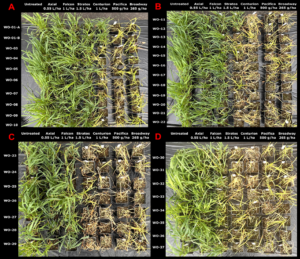
Figure 1: Overhead view of test pots showing symptoms of resistant wild oat populations (WO-01 to WO-37) 28 days post-treatment with ACCase (Axial, Falcon, Stratos Ultra, Centurion Max) and ALS (Pacifica Plus, Broadway Star) herbicides. All herbicides were applied at the recommended label rate on plants grown to the 3-4 leaf stage. Where treated-plants are absent or the foliage is yellowing, brown or desiccated, full control was achieved.
Initial testing of population WO-38 gave concerning results (Figure 2). The population was resistant to Axial and Falcon. Alarmingly, some recovering plants also survived the ALS herbicides Pacifica and Broadway. Among all the wild oat populations tested so far, this is the first case where ALS herbicides have provided insufficient control. Nevertheless, the ACCase graminicides remained effective.
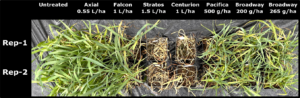
Figure 2: Symptoms of resistant wild oat population WO-38, 28 days post-treatment with ACCase (Axial, Falcon, Stratos Ultra, Centurion Max) and ALS (Pacifica Plus, Broadway Star) herbicides. All herbicides were applied at the recommended label rates on plants grown to the 3-4 leaf stage. Broadway was applied at two recommended label rates: 200 g/ha (spring wheat) and 265 g/ha (winter wheat). Where treated-plants are absent from a square full control was achieved. Two replicates (reps) are shown for each treatment.
This represents a serious crisis. Cross-resistance within individual fields limits options for changing or alternating ACCase herbicides, and the first signs of possible ALS resistance indicate that relying on herbicides alone is no longer a viable strategy.
Wild oats, like blackgrass, are noxious weeds. Cultural/non-chemical control (eg. crop rotations, stale seedbeds, hand rogueing, machine hygiene and on-farm biosecurity) should form the first line of defence. Herbicides should be used judiciously and in heavily infested fields, more drastic measures (eg. crop destruction, whole cropping or the use of grass leys) may be needed to prevent further spread.
To date, 325 resistance-suspect populations of different grass weed species have been tested, with 207 (64%) confirmed resistant (Figure 3). The increasing number of resistance cases, combined with fewer effective herbicide options, poses a serious challenge for cereal grass weed control.
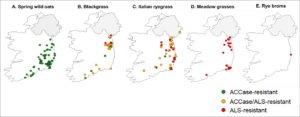
Figure 3. Maps showing the prevalence of herbicide-resistant grass weeds (2019-2025).