
02 December 2024
Preliminary findings point to more slurry and soiled water storage needs

Preliminary findings from year one of the Teagasc National Slurry Storage Monitoring Programme were shared with the gathered masses at the Teagasc National Dairy Conference on November 27.
Although still to be finalised and verified through year two repetition, the study led by Dr. Pat Tuohy, Senior Research Officer in Teagasc Moorepark, has pointed to the potential need for additional slurry and soiled water storage at farm level.
Sharing some initial insights from the interim report just published, which has taken an in-depth look at the slurry and soiled water production on dairy farms nationally, Director of Teagasc, Professor Frank O’Mara explained: “The first year of a study to provide new estimates of slurry and soiled water production on dairy farms has been completed.
“If the first year results were to be adopted, slurry storage requirements would increase by approximately 20% and soiled water requirements would increase by approximately 33% outside of the allowance for rainfall run-off.”
Further discussing the findings of this study as part of his presentation on improving water quality, Director of Research in Teagasc, Professor Pat Dillon said: “The current regulations require 0.33m3 of slurry storage per cow per week. Preliminary findings from Dr. Pat Tuohy’s work indicate a requirement of 0.41m3 per cow per week.”
To further verify these figures, Professor O’Mara told those in attendance that measurements under this “significant piece of work” would be repeated this year, before pointing to the importance of the Department of Agriculture, Food and the Marine’s proposed Nutrient Storage Investment Scheme in facilitating the provision of additional slurry storage capacity at farm level.
This proposed measure is expected to provide a 60% grant rate and a separate TAMS 3 funding ceiling of €90,000 for nutrient storage investments in 2025. Such investments include mass concrete tanks, precast tanks, geomembrane lined stores, circular slurry stores and manure pits.
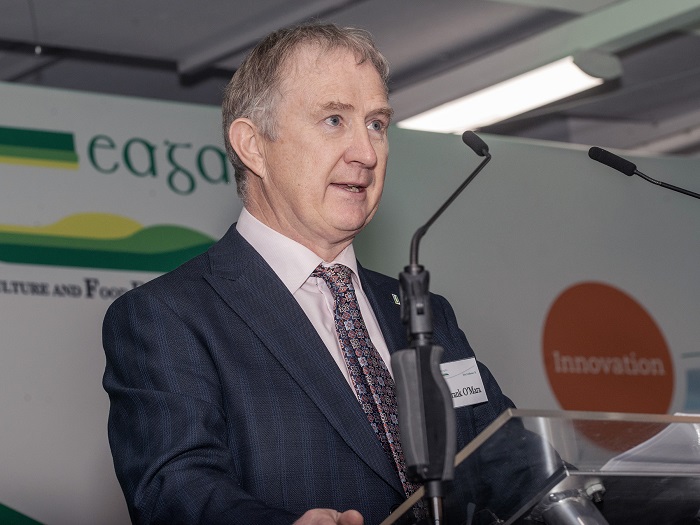
Professor Frank O’Mara, Director of Teagasc, pictured at the Teagasc National Dairy Conference
After echoing the Teagasc Director’s comments on the importance of financial support in developing additional slurry storage capacity, Professor Dillon considered some of the additional benefits that additional slurry storage capacity can bring.
He explained: “It allows us to maximise the replacement value of nitrogen, phosphorus and potassium contained within, by applying slurry to growing grass crops when conditions are conducive to nutrient uptake, thus allowing for reduced nitrogen surplus on farms by replacing chemical N fertiliser with an organic N source. Both of which are necessary in reducing nutrient losses to water.”
Although additional slurry storage may be necessary in the future, Professor O’Mara acknowledged the difficulties faced by farmers in making big investment decisions, especially given the uncertainty facing Ireland’s future farming with a Nitrates Derogation.
On this, he said: “We are very conscious of the importance of the derogation for the incomes of thousands of dairy farmers and many others working in the industry.
“We are currently working on an environmental and economic modelling study to ensure that any adjustment to the current maximum stocking rates permitted are well understood and we would hope to complete this study, which is being carried out at the request of the Department, by March next year and we will publish it then.”
Other key topics addressed by Professor Frank O’Mara at the Teagasc National Dairy Conference included progress in reducing agricultural emissions, the commissioning of an external peer review of Teagasc’s research on clover and the continued need to transition to protected urea fertilisers.