
A case of Avian Influenza confirmed in Northern Ireland
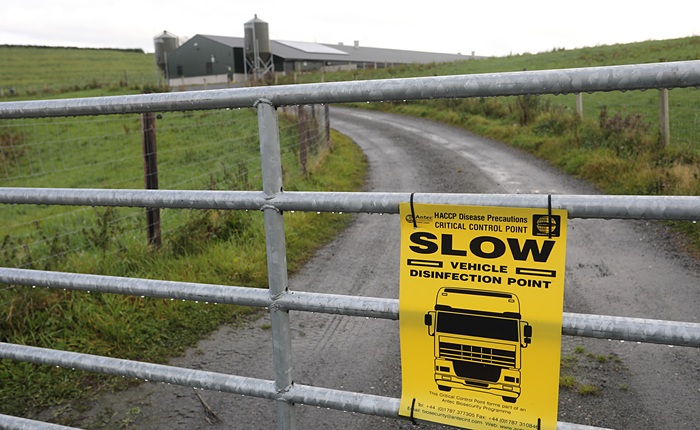
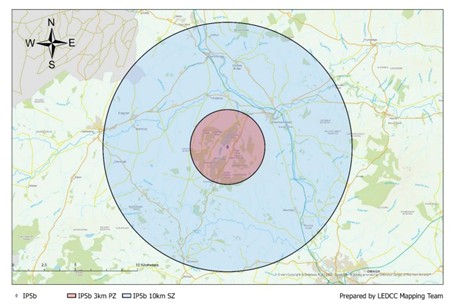
The Department of Agriculture, Environment and Rural Affairs (DAERA) has confirmed a case of Highly Pathogenic Avian Influenza (HPAI) H5N1 at a commercial poultry premises near Omagh, County Tyrone.
While this case does not have any implications for poultry in Ireland, Teagasc Poultry Advisor, Rebecca Tierney reminds us that it is very important to be aware that the virus is still circulating on the island. Therefore, it is critically important that all flock keepers, backyard flocks, smaller producers and commercial poultry producers observe all biosecurity measures set out in S.I No 520/2025 Avian Influenza (Biosecurity Measures) Regulations 2025.
The housing order, Avian Influenza (Precautionary Confinement of Birds and Restriction on Assembly of Live Birds) Regulations 2025, as directed by Department of Agriculture, Food and the Marine (DAFM) still remains in place. It is crucial that every person with poultry, regardless of the number of birds, abides by this housing order. This means all birds must be confined within a house/shed. Where this may not be possible, birds should be corralled in a pen with mesh/wire which prevents wild birds from mingling with the poultry. The pen should be covered also to prevent droppings coming in contact with the poultry.
How avian influenza spreads?
Avian influenza is introduced to Ireland through migrating wild birds which usually arrive from October onwards until April typically. These wild birds often gather on wetlands and begin mingling with resident wild birds.
Avian influenza can be introduced to a poultry flock (commercial or backyard) through wild birds mixing with the poultry; or entering a free-range area. With the introduction of a housing order, this risk is reduced.
However, the housing order does not eliminate the need for all other biosecurity measures. Bird flu can also be spread through the contamination of inputs to a poultry farm. These include feed, water and bedding. Vehicles and equipment entering or being used on the farm, need to be washed and disinfected to limit the disease entering or spreading. It is also important to be mindful of other vehicles which may come on farm for other farm types, e.g. milk collection lorries. It is best to avoid sharing equipment/vehicles between farm species (i.e. between cattle & poultry, sheep & poultry). If the sharing is necessary, the vehicle/equipment must be thoroughly washed and disinfected before using.
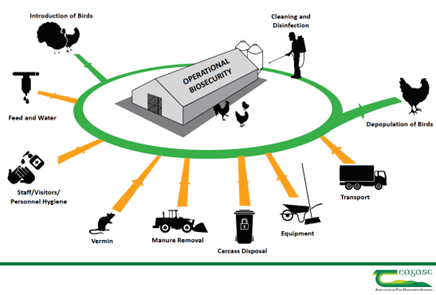
The virus can also be spread via the movement of people, on clothes, footwear or on our skin. The correct use of PPE (Personal Protection Equipment) e.g. gloves and overalls, and house specific clothing can reduce this as a risk.
Where there are multiple species on farm, it is important to have footwear and clothing dedicated to each species. That means, for poultry, you should have a pair of boots/wellies and cover-alls for the bird house; and a separate pair for wellies and cover-alls for you dairy/beef/sheep enterprise. If there are multiple bird houses, you should also have boots (at a minimum) for each bird house. This prevents spreading disease from one house to another.
Biosecurity measures
It is crucial to limit the number of visitors to the poultry site. Only essential visitors should be granted access to the site. Those who must come on site, should be fully clothed in Personal Protection Equipment (PPE). This should include disposable boot covers, cover-alls, gloves, hair net and face mask. This PPE must be left on site, to prevent spread to another site. A detailed visitor log must be kept of all visitors who come on site; this should include feed deliveries, gas deliveries. Date, name, vehicle registration, company, reason for visit, the last poultry site visited and the date of that visit should be recorded.
Staff/personnel working on farm must be fully aware of all biosecurity measures. They must not be in contact with any other poultry of any type. If this is unavoidable, they must take all ‘reasonable measures’ to prevent the transfer of avian influenza to or from a poultry unit. These measures should include the cleaning and disinfection of equipment, vehicles and footwear that may have been in contact with poultry or captive birds. Staff should be provided with house-specific clothing and footwear. Outdoor shoes should not enter the commercial poultry house.
Disinfection of vehicles should take place at the gate, a suitable method of disinfecting, with a suitable disinfectant should be available at all times for essential visitors who must come on site. There must be footdips at all entry and exit points to the unit. The disinfectant must be effective against avian influenza (Check out DAFM Approved list). This must be replenished as required. Hand washing facilities should be readily available in the store area, with antibacterial soap and hot water present. Within the store area, a step-over barrier creates distinct dirty and clean zones. This barrier is the point at which clothing must be changed/or additional boot covers put on.
Be sure to check on Teagasc’s biosecurity video below for more information on step-over barriers:
The area surrounding the poultry unit must be kept clean and tidy. Any feed spillages should be cleaned up immediately. No pools or stagnant water should be allowed to develop. All waste and rubbish material should be removed from site. These measures are to deter wild birds from landing on the site. The concrete apron at the house front should be kept cleaned and disinfected to prevent any potential disease being carried into the house by people.
The structure of the building must be examined and ensure its integrity is intact. Any damage which may allow vermin access to the house must be repaired ASAP. The rodent control points must be monitored also, to ensure no activity is taking place, as vermin could potentially carry the virus into the house.
Record keeping is very important to keep track of all movement of birds or produce on and off farm. These records must include:
- The Quantity & Description (Species of Bird/Type of Egg)
- Date of Each Movement
- Land/Premises of Destination
- Name & Address of the Person to Whom Consigned
Signs and symptoms of avian influenza
It is important that all poultry keepers are aware of the symptoms of bird flu, what they need to lookout for and when to notify their local vet or the Department of Agriculture, Food & the Marine.
The main clinical signs of Highly Pathogenic Avian Influenza (HPAI) in birds are:
- Swollen head
- Blue discoloration of the head, comb, wattles (cyanosis)
- Loss of appetite
- Difficulty breathing (gaping beak, coughing, sneezing, rales, gurgling)
- Diarrhoea
- Fewer eggs laid or eggs with watery whites
- Increased mortality
Avian Influenza is a notifiable disease. If you suspect your Avian Influenza in your birds, you must notify the Department of Agriculture, Food and the Marine (DAFM) immediately.
Contact your local Regional Veterinary Office (RVO) or the Avian Influenza Hotline on 01 607 2512 (9am-6pm).
Outside of office hours, you can ring the National Disease Emergency Hotline on 01 492 8026 (which is operational 365 days of the year) to report a suspect case.
The disease poses no food safety risk for consumers. Properly cooked poultry and poultry products, including eggs are safe to eat.