
10 March 2023
A family affair in Kildalton College suckler herd
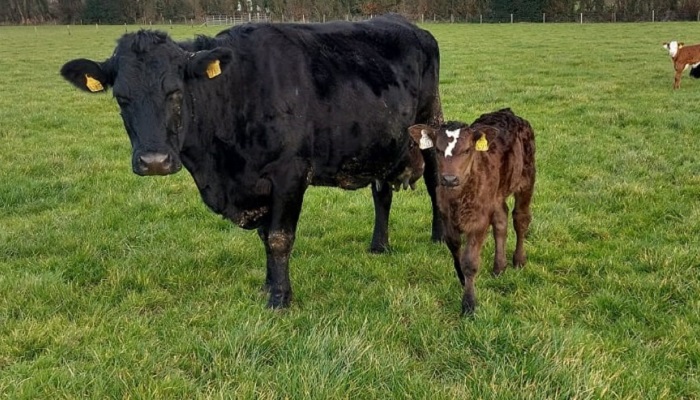
Visitors to the Teagasc stand at the National Ploughing Championships back in September may have met our special bovine guests.
As part of the beef display at the event, which focused on calving heifers at 24 months, a suckler cow and two of her offspring – one 2021-born in-calf heifer and the other a 2022-born bull – were present from the Kildalton College suckler herd.
In an update for visitors, the cow and her 2021-born daughter have since calved. Cow 788 (picture above) calved on January 10th, producing a Simmental heifer, sired by AI bull SI4147. This is her ninth calf. Cow 788 is 5-star on the Replacement Index (value of €154) and is sired by a Limousin bull out of a Holstein Friesian cow. Since her first calving on Valentine’s Day in 2015, she has produced a calf every January and her calving interval was 361 days between her two most recent calvings. Three of her daughters have also been retained as replacements within the Kildalton College herd, which means her stamp will be left in Piltown for years to come. Cow 788 is not only a producer of functional replacements, but she has delivered quality beef over the years. Since joining the college’s herd, she has produced three under 16 month bulls; these animals have achieved an average carcass weight of 422kg at U= grading.
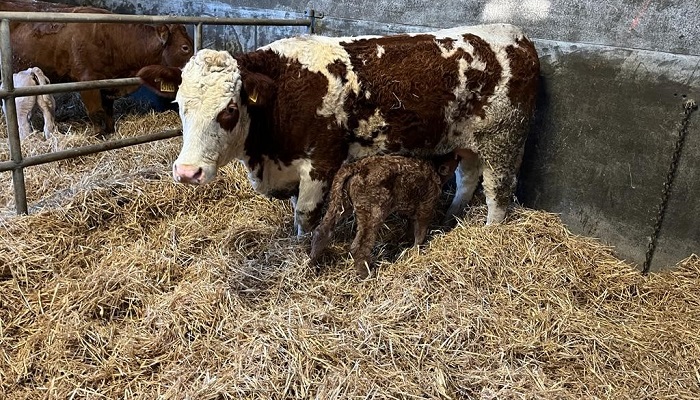
The beef team in Kildalton will be hoping her daughter, Heifer 3744 (pictured below), who stood front and centre at the ploughing display, will follow in her dam’s footsteps. Sired by SI2152, Heifer 3744 calved for the first time on January 25th, producing a Limousin heifer by AI bull LM2014. Calving at 24 months and 20 days, Heifer 3744 has a Replacement Index value of €179 (5-star also). She not only has the potential to produce beef like her dam, but she also has the genetics to produce future replacements, with an expected daughter breeding performance of 8.9kg of daughter milk and a daughter calving interval of -3.97 days. Who knows, her LM2014 daughter could be earmarked as a future replacement for the college’s herd.
Multiple benefits from calving suckler heifers at two years old
Research and farm experience shows that beef heifers who calve at 24 months deliver higher lifetime profit than those who calve at 36 months, Colin Byrne, Paul Crosson, David Hallissey, Pearse Kelly, David Kenny, Mark McGee and Alan Twomey explained in a recent edition of Today’s Farm.
The age at which farmers calve their heifers is a personal decision, with most still opting for 36 rather than 24 months calving. But beef farmers are losing very serious money as a result. The benefits of earlier calving, both financial and environmental, are proven by Teagasc research and the experience of the almost one in four beef farmers calving their heifers at 24 months.
Calving at 24 months dramatically reduces the cost of replacement heifers. Older heifers have a higher rearing cost up to the point of calving. In addition, older heifers have a larger environmental footprint, as they have higher methane output/calf produced over their lifetime.
Other benefits of calving at 24 months include reduced labour costs; there are simply fewer stock groups to manage. By switching from 36 month calving you can have more productive suckler cows or finishing animals on the farm at the same overall stocking rate.
Management and genetics are required to achieve calving at 24 months. Growth rates in early life are critical to ensuring heifers reach their target of 380-420kg at breeding time. Selecting heifers with a high Replacement Index reduces the age at first calving, as animals reach puberty sooner and are more fertile. Good management is important to ensure they have the opportunity to express their genetic potential.
The proportion of heifers calving at 24 months has remained steady for 10 years. This must be partly due to beef farmers’ preferences. Heifers may have had the potential to reach puberty and be fertile, but if they are not served, they obviously can’t calve down at 24 months. Recent research using data collected through the Department of Agriculture, Food and Marine scheme BEEP, as well as national data available from the Irish Cattle Breeding Federation (ICBF), helps dispel some of the myths around earlier calving.
Myth: ‘Calving heifers at 24 months will result in difficult calving.’
Fact: Fertility of heifers in subsequent lactations is a good indicator of a heifer’s ability to cope after calving and her ability to cycle again. Heifers that calved at 24 months had a more desirable calving interval in lactation one, compared to heifers that calved at 36 months. The age at first calving had no impact on the probability of cows surviving to subsequent lactations.
Myth: ‘Calving at 24 months will stunt growth.’
Fact: BEEP data showed heifers that calved at 24 months were lighter at first lactation, but with each new lactation cycle their weight difference decreased. By lactation five, there was no difference compared to heifers calved at 36 months. Having a lighter cow in earlier production years is actually beneficial. They eat less and have a lower environmental footprint. Overall there was a higher number of calving difficulties in heifers, irrespective of the age at first calving, when compared to mature cows. Farmers could choose a very easy calving bull to minimise the risk of a calving difficulty. Age at first calving had no effect on the risk of calving difficulties in future lactations. One performance trait that did tend to be affected by calving at 24 months was weaning weight. However, the total amount of weight weaned is more for the heifer throughout her lifetime, as she will be producing an extra calf, which negates the lighter weaning weight in the early lactations. Data shows that many of the fears around calving at 24 months are unfounded, and that it is beneficial for overall herd productivity.
If heifers are ready
Critical to implementing a 24-month calving system is maximising pre-weaning liveweight gain. Heifers achieving 1.2kg of liveweight gain per day during this period will be 300kg or more come weaning time, in many cases making them very suitable candidates for a 24-month calving system.
Factors that make this weight achievable include good grassland management, milk ability of dam, breeding and health status. Many farmers are achieving these weights with their heifers and have the hard work done. Plenty of farmers in the west Cork / south Kerry areas and across the country have their heifers at the target bulling weight of approximately 420kg and above at 15 months, but don’t take the final step to put these heifers in calf, and instead opt to wait for another year. This is an opportunity lost. For some, exclusively using a stock bull only on the farm might be a deciding factor as they don’t have the option to use easier calving bulls on young heifers. Many suckler farmers use AI giving them a wider choice of bulls to choose from, helping to avoid any calving issues.
Key goals to ensure heifers calve at 24 months
- Pre-weaning growth rate of at least 1.2kg per day are needed to ensure heifers reach puberty in time for the breeding season.
- Heifers should be 380-420 kg at breeding and 550-600kg at calving.
- Bulls with less than 8% heifer calving difficulty and 80% reliability should be used on maiden heifers.
- Calving heifers in the first 21 days of the calving season increases their fertility and lifetime productivity in the herd.
Also read: Why test colostrum on suckler farms?
Also read: Watch: Achieving compact calving with Future Beef Farmer Shane Keaveney