
30 March 2025
A good start is half the work
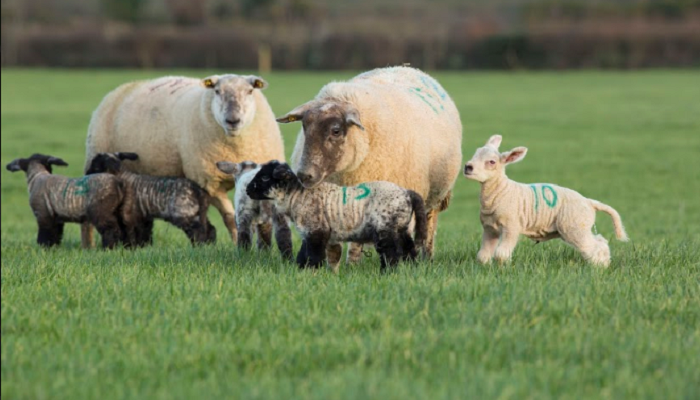
Eamon Patten, Drystock Advisor, Teagasc Ballinrobe, discusses the key challenges of lambing season as the focus shifts from ewes to lambs. From nutrition and grass availability to disease threats, managing lamb health and performance is crucial for flock success.
Lambing season is upon us and for the lucky few nearing completion. Over the next few weeks the management emphasis will shift from the ewe to the lamb, as it is lamb performance that is the main concern for flock owners. What issues can arise for the ewe and lambs?
Nutrition/Weather
The ideal is to have the ewes and lambs going onto grass covers of at least 5cm, in small groups, into sheltered fields with good weather. Initially this can be relatively easy but as numbers build it can be more difficult as there is a limit to accessible ‘nice’ clean paddocks on most farms and we can have a similar sort of pinch point when indoors – with the requirement for individual lambing pens.
The ewe is going through a huge transition from a possible all indoor diet to grass, plus trying to rear her lambs so the shepherd has to be aware of miss-mothering risks which will be more prevalent in poorer weather conditions. The risks are much higher for the first two weeks post turnout, especially with larger groups and in fields lacking shelter. The ewe is the only source of nutrition for the lamb at this stage and her milk yield should continue to increase until weeks 3-5 post lambing. This maximum yield is what can determine the lamb performance pre-weaning.
Every farm is different but grass growth over this winter and spring has been poor and grass covers are low especially if fields were not closed up in time last autumn. If a ewe’s intake is restricted she won’t have sufficient milk, so there will be cases where supplementation is required. When grass height is below 3cm (bare paddock) then intake is approximately one third of the normal requirement of 3kg DM/ewe.
Ewes rearing twins growing at 275 g/day when
grass intake is approximately one third of normal.
| Ewe Condition | Grass intake | Concentrates needed | Comments |
| Good (CS 2.75 – 3) | 1 kg DM | 1 kg 20% Protein | Appetite will not be satisfied. |
| Poor (CS 2.25 – 2.5) | 1 kg DM | 1.4 kg 15% Protein | Some poor quality roughage may fillthis. |
Ewes rearing singles growing at 300 g/day
when grass intake is approximately one third of normal.
| Ewe Condition | Grass intake | Concentrates needed | Comments |
| Good (CS 2.75 – 3) | 1 kg DM | 0.5 kg 20% Protein | Appetite will not be satisfied. |
| Poor (CS 2.25 – 2.5) | 1 kg DM | 0.75 kg 15% Protein | Some poor quality roughage may fill this. |
If ewes are in good condition, they may be allowed milk off their back, lose some body condition and therefore reduce the concentrates required. However, if ewes are already in poor condition, this is not recommended and will not work.
When lambs have reached an age of 6 weeks it is more effective to feed them rather than the ewe and give lambs preferential treatment to grass.
Disease Challenges
Hypomagnesaemia or Grass Tetany as it is more commonly known can be the disease issue with ewes. Prevention is the best medicine and involves some type of supplementation with magnesium (Mg). Incorporating in a ration is the surest way of getting the required levels (Mg) into all ewes. However, where there is an adequate grass supply ahead of the flock, it doesn’t make economic sense to feed meal. High Magnesium lick buckets, usually containing either 10% or 15% Mg are convenient where ewes are on a grass-only diet post turnout but intakes are variable. Bolus options are also available but may not supply adequate levels on a farm with known issues.
Two major parasites for young lambs are Nematodirus and Coccidia and the signs of both are very similar. Coccidiosis is usually from 3-8 weeks of age. Nematodirus is a stomach worm and occurs with lamb increasing grass intakes.
Coccidiosis can result in profuse diarrhoea that can be dark or even blood stained, with straining and weight loss. If left untreated the disease can be fatal. Even if treated, severe disease may result in damage to the gut, which prevents the lamb from thriving. Older lambs can shed large numbers of oocysts even after they develop immunity and can be a significant source of contamination for younger lambs in the flock.
Preventing faecal contamination of feeders and troughs and keeping the area around them dry helps prevent the spread of infection. Restricting younger lambs from areas previously grazed by older lambs will also reduce their exposure to the parasite.
Treatment can be in-feed medication or more commonly by drenching with products containing either diclazuril or toltrazuril. The timing of treatment is important and lambs should be treated 1-2 weeks before expected disease. Lambs treated with diclazuril may require repeat treatment approximately 3 weeks after the first treatment as this drug has no residual activity.
Nematodirosis signs are similar to coccidiosis and in severe cases causes death. Lambs can be affected by both parasites at the one time. The Department of Agriculture, Food and the Marine, in collaboration with Met Éireann produce a Nematodirus forecast that predicts when peak hatching will occur around the country.
Treatment of at risk lambs should be 2 weeks after the predicted hatch. Treatment for Nematodirus involves drenching with a product from white drenches drench class. No anthelmintic product has residual activity against Nematodirus and so repeat treatment may be required 2 to 3 weeks after initial treatment, particularly if there is a wide age range in a group of lambs.
Don’t depend on the use of Faecal Egg Counts for monitoring this parasite as the larval stage of the parasite damages the gut, therefore damage may be done before eggs appear in the faeces.