
19 July 2024
A look at the Forest Roads Scheme 2023-2027
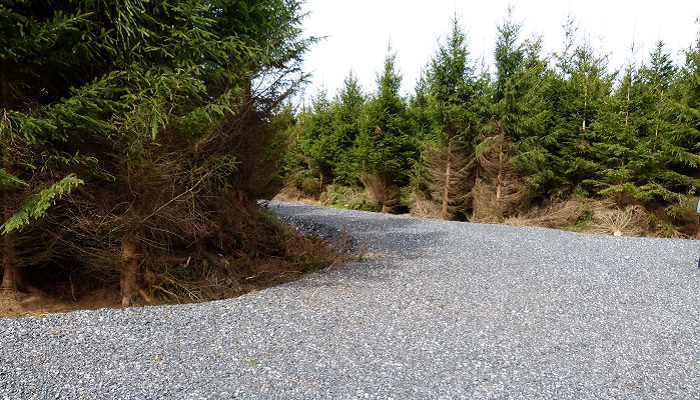
Forest roads provide crucial access to and within a forest, writes Tom Houlihan of the Teagasc Forestry Development Department, who takes a closer look at the Forest Roads Scheme.
Suitable forest roads assist inspection and management, provide and facilitate forest fire protection, permit economic and efficient timber harvesting, and provide recreational opportunities within a forest.
For forest owners approaching thinning or harvesting stage within their forest, it is very worthwhile to monitor the progress of forest development and plan in good time for the access requirements in order to facilitate future timber harvesting, transport and marketing. The availability of a forest road suitable to facilitate the loading and haulage of logs by timber lorries is therefore a key consideration. A well-planned forest road can also enhance biodiversity in the open spaces between the road and the trees.
As the loading of timber is illegal on public roads, even small plantations are likely to require some road construction to provide loading areas for timber. This may involve the construction of a new harvest road or the upgrading of an existing road to harvest road standard. The Forest Road Scheme, administered by the Forestry Section of Department of Agriculture, Food and the Marine (DAFM), aims to provide for high-quality and well-designed forest access that can accommodate a variety of forest management objectives, including environmental objectives and recreation. All private owners of forests are eligible to apply.
A Forest Road Grant may be available for forest owners subject to application through a registered forester, subsequent application assessment and the granting of a forestry road works licence. DAFM acts as the single consent authority for applications for forest road works licences, where the forest road provides access to a public road (other than a national road) or there is material widening of an existing entrance.
Financial supports
Grant support is available subject to the maxima set out in Table 1 and is paid in one single payment at First Instalment stage. Grants will be paid only when the entire road submitted for grant aid is up to the required standard.
- A full harvesting road can be supported up to a density of 25 metres per hectare and up to maximum rate of €55 per linear metre.
- An approved harvesting upgrade or extension (as defined) can be eligible up to a density of 25 metres at a maximum rate of €55 per linear metre. Other densities apply where an applicant previously received a management road grant under a previous forest road scheme (see Table 1)
- A Special Construction Works (SCW) provision is aimed at facilitating the construction of forest roads in challenging or environmentally sensitive sites to limit any potential adverse impact from road construction harvesting activities. Special construction works (SCW) will be eligible for grant aid to a maximum value of €10,000 per application or 50% of the cost of the SCW, whichever is the smaller. All proposals to fund special construction works must adequately demonstrate in the application that the works are required to facilitate the harvesting and extraction of timber on routes that minimise the potential adverse environmental impact.
Table 1: DAFM Supports for Forest Roads
| Category |
Maximum rate (€/linear metre, excl. VAT) |
Maximum road density (metres/ha) |
|---|---|---|
| Harvesting road | €55 | 25 |
| Harvesting upgrade or extension as defined | €40 | 25/13/10% |
| Special construction works | Up to €10,000 | |
*13m applies where the applicant previously received a management road grant for 7m per ha or 10m applies where the applicant previously received a management road grant for 10 m per ha under a previous forest road scheme
Planning and design
It is important to plan the best possible access for the extraction and loading of timber before a forest road is developed. Once constructed, a road should also be given an adequate period of time (1 or 2 years) to settle before any harvesting operations commence.
Proper design will ensure that a long-lasting harvesting road is produced. Impediments such as rock outcrop, aquatic zones and man-made obstacles – for instance ESB wires and gas pipelines – will influence the route of the road.
Design methods will depend on the soil type present. Peat sites usually require building on top, while a mineral-based soil may be dug out. Roadside drains and a degree of camber on the road will improve the overall drainage and the control of run-off water and therefore reduce erosion. The design of a forest road is dependent on the intended use. A bellmouth entrance may be the only requirement on some smaller roadside sites while additional roads and turning areas may be necessary on larger sites.
An Engineering Design Support measure may be available which can provide additional funding and support for forest owners whose roads require an entrance from a public road or the material widening of an existing entrance. Grant aid up to €1,000 per project may be available up to a maximum of 300 individual projects per annum.
Enhancing Biodiversity
Forest roads can provide additional biodiversity opportunities by increasing the amount of open space and forest edges, providing corridors for foraging and connectivity between habitats, and facilitating thinning which can open the canopy. The interface between the forest edge and the forest road provides many opportunities for additional biodiversity enhancement throughout the rotation.
An Ecologically Enhanced Forest Roads Scheme provides the opportunity for funding roads with an enhanced emphasis on biodiversity, forest protection and water management. This can be be achieved through enhanced design and construction measures and forest protection facilities. Grant aid up to €1,000 per project may be available up to a maximum of 25 projects per annum.
Further information
For further information of forest roads, log onto www.teagasc.ie/forestry, contact your local Teagasc Forestry Adviser or the Forestry Division, Department of Agriculture, Food and the Marine.