
‘A no-brainer’: Brian Nicholson’s agroforestry journey
Brian Nicholson sees agroforestry as a positive addition to his farm. In this article, Siobhan Kavanagh, Signpost Programme Communications and Engagement Specialist, Terry Carroll, Teagasc Advisor, and John Casey, Teagasc Forestry Advisor, expand on some of the benefits.
Progressive sheep farmer, Brian Nicholson from Johnstown, Co. Kilkenny planted over 6,500 trees on 19 hectares of his farm under the Department of Agriculture, Food and the Marine agroforestry scheme, enhancing the future landscape of a part of his farm and attracting a lot of interest locally.
Brian views the agroforestry option as a no brainer and complementary to his current farm enterprises. He gets income tax free premiums for 10 years and he can continue to use the land for farming.
Agroforestry grants have supported the full costs of establishing this venture. But aside from the grant and premiums, Brian can continue to draw his BISS, CRISS and Eco Scheme on this land. The land continues to count for nitrates calculation purposes up to 170kg N/ha.
Brian was able to split parcels and convert parcels from ACRES to forestry. The organic scheme parcels can be converted to agroforestry, and he benefits from organic as well as agroforestry payments on the same parcels (see below from further details on the interaction with other schemes).
Brian was also attracted to agroforestry to future proof his farming system. He can see the impact of climate change with drier summers and wetter winters.
“The agroforestry will provide a future ‘living shed’ for the shoulders of the year and provide valuable shade during the summer months,” Brian explained.
Tree selection and incorporating agroforesty
The tree selection was carefully thought out with his registered forester, Ivan Fennell. A mixture of faster and slower growing species were selected.
Birch and alder were planted in the wetter areas and oak, with other species, were more suitable for the dryer ground. Crab apple, mountain ash and cherry were selected for their flowering in late spring/ early summer (for bees etc.) and they also provide fruit for wildlife in autumn. Oak also provides acorns for wildlife in autumn.
All of this provides supports biodiversity on the farm. Trees sequester carbon and with time, these trees will contribute to offsetting the emissions from this farm.
The site selected runs alongside the river Goul, a tributary of the River Nore. Brian sees the trees as helping to reduce potential sediment and nutrient leaching into the river.
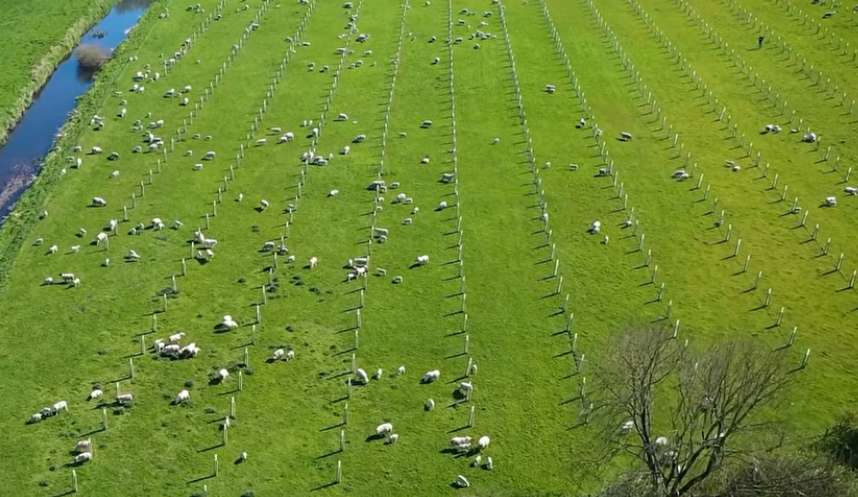
There are various ways of incorporating agroforestry into grassland. Brian decided to go with lines of trees, the lines were 7.5 meters apart with 3 meters spacing between the trees. This has given him the option to operate machinery up and down the whole length of the field as required for grassland management.
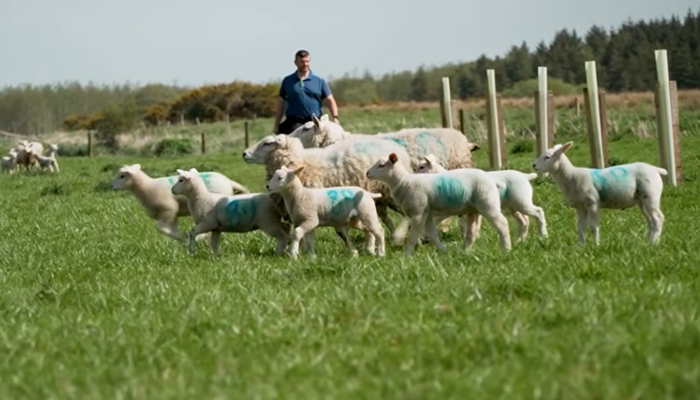
Brian thinks that a group of trees completely fenced off would probably work best for cattle farms, reducing the risk of damage to the trees. Brian will leave the tree guards around these trees for up to 7-10 years.
Local interest
There has been a lot of interest locally in what Brian was doing. It’s not every day you see tree planting at this scale and in that formation. Brian’s plantation borders the road between Rathdowney and Johnstown so lots of people watched with interest as the site progressed from being a grassland field to being a grassland field with widely spaced rows of trees incorporated.
As Brian says himself: “it has certainly given food for thought locally”. As one neighbour remarked, having built a new house recently, the agroforestry has done the landscaping around his house for him!
On-farm diversification
Interestingly, this farm is a great example of on-farm diversification. Normally, when we think of diversifying a farming system we think of agri tourism or developing a food business like directly selling or producing yoghurt or cheese etc. That type of diversification is not for everyone and requires, in most cases, learning a completely new skillset and in many cases a significant capital investment.
Brian is diversifying his farm business, and he is doing so without capital investment and within his skillset as a farmer. He has converted 70ha of the 100ha to organic production, completing conversion in January of this year. Brian would say that his sheep enterprise was close to organic anyway, as he had incorporated many of the technologies needed to run an organic farm including maximising soil fertility, incorporating clover, making best use of organic manures, reducing reliance on chemical fertiliser etc. Organic production on 70% of the farm has reduced his exposure to fluctuating fertiliser prices.
The split system has worked well for Brian as he can graze the conventional cattle on the organic part (sheep & tillage) of the farm for up to 180 days a year and he has access to the slurry and dung for maintaining soil fertility on the organic fields. Ewe numbers have been halved on the farm, and the organic scheme payment has facilitated the reduction in stocking rate. Work life balance has improved significantly, particularly in the summer months, something that is very important to Brian, with a young family.
For further insights, watch the video below of agroforestry in action on Brian Nicholson’s farm:
Incorporating agroforestry is part of that diversification. The agroforestry will have a minimal effect on how he manages the farm, needing relatively small adjustments in how he manages the farm and grazes the ground. Brian has a strong interest in increasing his knowledge on future management of the trees.
There are opportunities to diversify on many farms without having to significantly change how a farmer goes about their daily business. It requires taking a look at the opportunities, the skillset on the farm and marrying the two.
Brian is aware that the agroforestry option is a long-term land use change on his farm. However, he is happy that agroforestry allows him to continue farming while also reaping the benefits of the trees.
Brian sees agroforestry as a positive addition to the farm and is very much looking forward to how it will evolve over the next 15-20 years. One of the big things for the Nicholson family is that they are only minding the land for the next generation. Their aim is to improve it from a financial and environmental perspective and ensure they have a good work life balance.
How does agroforestry interact with other schemes?
Farmers that incorporate agroforestry can also be eligible for BISS, CRISS, Eco-scheme, ANC and organics on the same land once criteria are met.
- Agroforestry planted in 2026 can be eligible once parcel eligibility is met and the relevant plots gave a right to payment under BPS.
- BISS-eligible Agroforestry land can be fully eligible to draw the CRISS payment as part of the 1st 30 eligible hectares (€43/ha approx.).
- Agroforestry land can be eligible to draw the Eco Scheme payment where the applicant meets required Eco Scheme practices (€66/ha approx.)
- Agroforestry planted on new ground can be eligible for the ANC payment. Reconstituted agroforestry is not eligible for ANC.
- Land under Agroforestry can be fully eligible for nitrates (up to 170 kg organic N/ha). Also, eligible if previously under ash and now agroforestry (under Reconstitution Ash Dieback Scheme)
- Under ACRES, farmers can split parcels to accommodate new planting and can convert parcels from ACRES to forestry (min 2 years in ACRES must be completed)
- Organic scheme parcels can be converted to agroforestry and eligible applicants can benefit from both Agroforestry and Organic payments (at the drystock rate).
Example of a drystock farmer:
A drystock farmer is farming a total area of 35ha. He/she plants 10 hectares of Agroforestry (Silvopastoral system) in 2026. He/she is also an organic producer and is eligible for BISS, CRISS, Eco-Scheme, ANC (Category 2). The 10ha is agroforestry is worth €11,700 income tax free to this farm, while continuing to draw down all other payments.
| Scheme | Total |
| BISS | €5,425 |
| CRISS | €1,290 |
| Eco-scheme | €2,310 |
| ANC | €3,190 |
| Organics (drystock) | €10,500 |
| Agroforestry | €11,700 |
The above first appeared in the Farming Independent as part of a series of articles from the Teagasc Signpost Programme.