
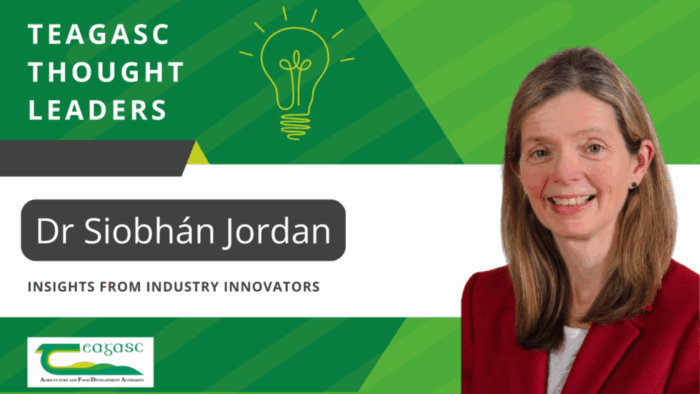
As part of the Teagasc Thought Leaders series, Catriona Boyle spoke with Dr. Siobhán Jordan about how Teagasc is supporting the bioeconomy in a way that is practical and impactful from farm to fork.
Dr Siobhán Jordan is the Head of Teagasc’s Technology Transfer Office. She leads a team that supports researchers to build meaningful collaborations with industry, commercialise intellectual property and explore entrepreneurial pathways.
Bioeconomy Ireland Week is an annual week-long event to highlight and raise awareness of Ireland’s rapidly growing bioeconomy. It takes place during October 13 to 19, 2025.
What is the bioeconomy?
The bioeconomy is all about using Ireland’s natural resources, like grass, other crops, seaweed, slurry and food by-products to create new products, and is a key part of Ireland’s pathway to addressing environmental challenges. Instead of relying on finite fossil-based inputs, the bioeconomy uses renewable biological resources.
Why is the bioeconomy so important?
The bioeconomy represents one of the most promising opportunities for sustainable development, driven by renewable biological resources, circular thinking, and innovation. Globally, demand is growing for sustainable alternatives to fossil-based inputs, driven by markets, policies and regulatory factors. Ireland is well positioned to respond. With abundant biomass, a strong agri-food base, and world-class research capacity, the Irish bioeconomy is ripe for innovation.
What supports are there to develop opportunities?
Teagasc plays a central role across applied research and demonstration, education, and industry engagement. Working collaboratively with national and international partners, Teagasc is spearheading major initiatives through funding and investment from a range of sources including the Department of Agriculture, Food and the Marine (DAFM), the Shared Island and Just Transition funds, Research Ireland, Enterprise Ireland and EU Horizon Europe. These investments are enabling the development of climate-smart farming, low-carbon bio-manufacturing and nature-based solutions for both rural and urban businesses.
Dr Siobhán Jordan discusses how Teagasc is supporting the development of the bioeconomy in the below video:
What work has Teagasc been doing in this area?
Teagasc’s leadership in the bioeconomy is visible in its cross-disciplinary and collaborative research programmes that span agriculture, marine, forestry and food systems. Across these areas, Teagasc is generating and valorising bio-based resources from new feedstocks, crop residues and animal by-products to novel microbial systems.
This work is not only improving how we produce and use biological raw materials but is also yielding new bio-based products such as fertilisers, packaging materials, functional foods, and novel bioactive ingredients that, in turn, open up new markets including nutraceuticals and pharmaceuticals. This innovation pipeline is supported by cross-disciplinary collaborations and joint projects with universities, technology centres, industry, and local communities.
The key to success is the roll out of practical demonstrators for farmers and industry designed to test and showcase solutions for widespread adoption. For example, the conversion of agri-food waste into high-value compounds, and the upcycling of grass and seaweed into animal feed supplements or bioplastics, offer tangible pathways toward climate neutrality and to see innovation in action.
For farmers and agri-food companies, this means diversification and enhanced resilience. New revenue streams from bio-based processing, participation in local biorefineries, and climate-friendly farm practices are becoming increasingly viable. Meanwhile, companies benefit from Teagasc’s collaborative expertise in pilot-scale validation, scientific insights, and regulatory navigation.
What impact will the bioeconomy have?
This future-focused work is already having impact. As highlighted in Bioeconomy Ireland Week and numerous demonstration initiatives, the sector is supporting green job creation, rural regeneration, and export potential. Importantly, these advances align directly with Ireland’s climate targets, including the emissions reduction by 2030.
Looking ahead, the bioeconomy will be central to delivering a nature-positive, climate-neutral economy. Through continued investment in research, advisory, education, training and skills, infrastructure, and cross-sector collaboration, Teagasc will remain a key driver of Ireland’s bio-based and climate-smart future.
More from Teagasc Daily: Thought Leaders: Unlocking the full potential of grassland
More from Teagasc Daily: Thought Leaders: Advancing environmental science