
Agroforestry – the forest garden option
As one of a range of actions arising from the Mid-Term review of the Forestry Programme (March 2026), the Department of Agriculture, Food and the Marine (DAFM) launched a new exciting Agroforestry (pilot) option – the Forest Garden which provides supports for eligible applicants to create new small forest holdings of up to 1 hectare, using forest gardening principles.
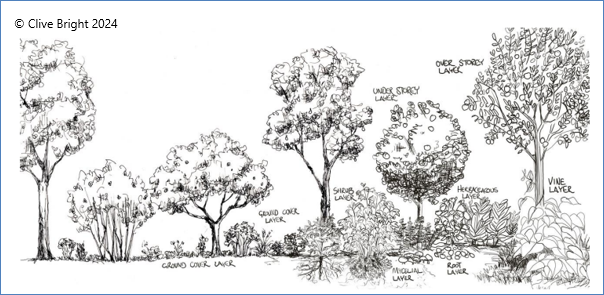
Forest Gardens (available under Forest Type 14 (FT 14) of the DAFM Afforestation Scheme) are diverse, low-maintenance systems combining a food producing understory (comprising of fruit and nut trees, shrubs, herbs and vegetables) along with a forest overstory forest layer (Figure 1).
For more information on the Mid-Term Review of the Forestry Programme, visit here.
Figure 1: Typical Forest Garden Structure © Clive Bright 2024
Forest gardens are intended to mimic the layers of plants found in natural forests, but on a smaller scale, using trees and plants, fruits, vegetables and other plant species that are useful to growers. Most importantly, forest gardens can be created at small scale to make optimal use of available space on farms, smallholdings, community owned and public lands. The choice and involvement of the owner is therefore essential in this regard.
Site type
Ideally, sites for Forest Gardens should contain free-draining mineral soils and should have no requirement for additional drainage. In general, sites suitable for agroforestry – Forest Garden -should also not require additional fertiliser for tree growth. In fact, one of the important principles is that the Forest Garden should be self-fertilising.
Species, stocking and spacing
There is a scheme requirement to develop 60% stocking of overstorey forest species (such as Oak, Sycamore, Italian Alder, Red oak, Walnut, Scots pine, Spanish chestnut, Birch and Cherry). This provides significant flexibility to owners in locating overstorey species in relation to site conditions and aspect to maximise available light. One option is to focus the overstory layer to one part of the site or else limit overstorey planting to wide spaced scattering of trees to meet the 60% requirement. Pruning and shaping trees and plants in all layers will be required to optimise yields and ensure even and effective growth.
Selection of understorey fruit trees planted is at the discretion of the forest owner, however species selected should be suited and proven under Irish conditions. Similarly, selection of understorey and ground level shrub, fruit and vegetable species is at the discretion of the forest owner.
A minimum stocking rate of 400 trees per hectare is required. Up to 40% of these trees can be fruit and nut trees. The spacing between rows of trees is up to 25m max. Alternative spacing can be proposed and will be evaluated on a case-by-case basis.
Layout, minimum area and width
The minimum plot area and width eligible under FT 14 is 0.2 hectares and 20m tree-to tree, respectively. There is a 1 hectare limit per landowner.
Table 1: Grant rates
| Forest Type
Agroforestry – Forest Garden |
Grant rates
(excluding fencing) €/ha |
Annual Premium Payments
€/ha |
Number of premiums for non-farmers | Number of premiums for farmers |
| FT14 | €6,000 | €829 | 10 | 10 |
The Forest Garden option is one of three popular Forest Types available under Agroforestry. Silvopasture and Silvoarable are also of significant interest under this scheme. A range of other Forest Types provide plenty of options for farmers and landowners, catering for all objectives.
A Forest Garden walk will be held in Louisburg, Co. May on July 24, 2026. This walk will be on an established forest garden and will look at the principles and practice involved as well as giving participants information on how to apply for supports. To register for this walk, contact Paul at 087 1999182 or paul.butler@teagasc.ie.
Further information on Forest Gardens:
Contact your Local Teagasc Forestry Advisor
Details for the Forest Garden FT14 are set out in the DAFM Forestry Standards Manual and are also covered in the DAFM booklet Agroforestry, Afforestation Scheme Forest Types 8, 13 and 14.
There is also plenty of practical information and events available through the Irish Agroforestry Forum.