An award-winning approach to reducing dairy carbon footprint
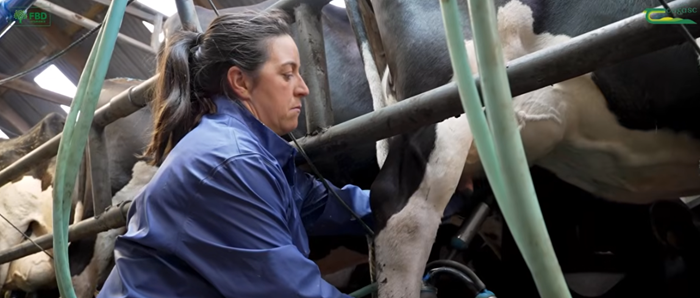
Cork dairy farmers Aileen Sheehan and Philip O’Leary are combining excellent milk solids production with a low carbon footprint. Siobhán Kavanagh, Teagasc, and Bernard Hyde, EPA, outline the practices that seen them crowned the Reducing Greenhouse Gas Emissions category winner of the Teagasc FBD Environmental Sustainability Awards 2026.
Achieving a low carbon footprint is possible while at the same time producing almost 500 kg of milk solids with 665 kg of concentrates and 14 tonnes DM/ha of grass grown. This is what has been achieved by the winners of the Reducing Greenhouse Gas Emissions category of the Teagasc FBD Environmental Sustainability Awards 2026.
Aileen Sheehan farms in partnership with her husband Philip O’Leary in Whitechurch, Co. Cork on a 100% leased block. They milk 132 cows and produced 497 kg of milk solids in 2025 from a concentrate input of 665 kg. Adrian O’Callaghan has been their local Teagasc advisor for many years.
The carbon footprint of dairy production is the total greenhouse gas emissions associated with producing milk, expressed as kilograms of carbon dioxide equivalents (kg CO₂e) per kilogram of fat and protein corrected milk (FPCM). It accounts for greenhouse gases emitted during milk production including methane, nitrous oxide and carbon dioxide.
These gases are mainly produced from digestion of feed by the cow (methane), fertiliser use and organic manure management (nitrous oxide) and energy use (carbon dioxide).
The carbon footprint for this farm (0.81 kg CO2) is considerably lower than the national average of 0.95 kg CO2e / kg fat and protein corrected milk (FPCM). In this article, we will explore what they have done to reduce this figure.
Their 132-herd produced an average of 497 kg of milk solids in 2025 from a concentrate input of 665 kg. High output is diluting the emissions from the farm.
Low meals are reducing the emissions associated with the production and transport of concentrate feeds.
The EBI of the herd is €155 with a 6-week calving rate of 93%, and all heifers calve at 22-26 months; they are very much limiting the number of non-productive animals in the herd that have emissions associated with them.
Calf quality and age of finish
They are also very conscious of the quality of the calves that they produce, aiming for a calf with a high Commercial Beef Value (CBV). A saleable calf that will have a high lifetime daily gain, a good carcass weight and low age at finish is desired.
Reducing age at finish will contribute to reduced methane emissions and is one of the main levers we have to reduce methane emissions. While this doesn’t impact the dairy farmer’s emissions directly, it does impact the emissions associated with beef production and with 60% of our beef from the dairy herd, the dairy farmer has a big impact on the potential age at finish of these animals through their breeding policy.
For more information on the partnership, watch the video below:
Maximising grazed grass
Maximising grazed grass in the diet is also prioritised on this farm. They grew 14 tonnes of dry matter per hectare in 2025. Animals at grass have lower methane emissions than housed animals on grass silage or other conserved forages and concentrates. Maximising days at grass helps reduce methane emissions from dairy cows. The target on this farm is 300 days at grass.
Soil fertility
Over 80% of the farm has optimum pH, with 63% Index 3 or greater for phosphorus and 48% optimum or greater for potassium. Best use is made of organic nutrients on the farm with slurry being applied used LESS equipment and GPS technology to avoid waste and reduce the risk to water quality. A new 400m3 slurry tank allows them to target organic manure when they are going to get the best value from it.
Clover and multispecies swards
Over 90% of the farm now incorporates clover, including white and red clover, as well as multispecies swards. Roughly 10% of the farm is in multispecies and they are extremely happy with it.
They have 42 acres of red clover, set with very little chemical nitrogen. All of this is helping reduce their reliance on chemical nitrogen. Less chemical nitrogen means less nitrous oxide emissions and results in less greenhouse gas emissions from agriculture.
Simply getting soil fertility right, making best use of organic manures and incorporating clover will not reduce emissions on this farm. Getting these elements right has enabled this partnership to reduce the chemical N they use and that’s where the gains are achieved in terms of reducing emissions.
Philip and Aileen have trusted the science and trusted clover and have been able to cut back nitrogen on the clover paddocks. In 2025, they used 167 kg chemical N / ha. As well as the reduction in chemical N, they have switched fertiliser type with 63% of fertiliser N now as protected urea.
In their own words: “From an environmental point of view, we embraced the science, we embraced the research, and we just went gung-ho at it. Clover, you either love it or you don’t and it has worked for us.”
Biodiversity measures
The biodiversity measures they have taken are also helping mitigate emissions. They have planted 2,000 trees, 280m of new hedgerow and are practicing better hedgerow management, allowing them to grow up and out. In time, these actions will increase the carbon sequestration potential of the trees and hedgerows on this farm.
Planting trees on a leased platform is a question that has been often asked of the couple. Their attitude is that in 40 years’ time, they can drive past, and potentially still point to area planted and say: ‘We planted those trees, that was the impact we had in that place’.
Measuring carbon footprint
Carbon footprint is a really good measure of efficiency on any farm and a useful metric for any farmer to benchmark their farm.
As you can see from this article, it includes the milk output, the feed usage (grass and concentrates) as well as the breeding performance and nutrient management.
The carbon footprint for this farm was calculated using AgNav (www.agnav.ie), but the data used to allow AgNav to do this is from the Bord Bia Sustainability Survey that all quality assured farmers complete every 18 months.
If you are completing your survey, enter the data as accurately as possible so that you have an accurate figure for your farm. Contact your local advisor if you are interested in learning more about the carbon footprint for your farm.
Philip and Aileen are monitor farmers in the Teagasc Dairygold Joint Programme.
The above first appeared in the Farming Independent as part of a Signpost Programme update.
For more on the Teagasc Signpost Programme, visit here.
Find out more about the Teagasc FBD Environmental Sustainability Awards here.