
Another disastrous spring
After another challenging spring weatherwise, Alan Dillon, Manager of the Teagasc DairyBeef 500 Campaign asks: Do Irish farmers need to prioritise futureproofing their farm for these weather events?
The spring of 2025 probably gave beef farmers a false sense of comfort. A dry backend in 2024 followed on, as often it does, with a very favourable spring, allowing stock to graze from March onwards with no real break in play until the autumn. Things are improving now at last, but work is well behind time and a stressful January to April period has again resulted in a group of tired, worn-out farmers.
When speaking to farmers recently about the poor spring, they state its reminiscent of 2018. What they seem to have forgotten is that the springs of 2023 and 2024 were nearly just as bad as the one we are currently experiencing.
Given that three out of the last four springs now have had extremely elevated levels of rainfall from January into April, seriously hampering grazing and closing up silage ground, is it now time for farmers to reflect and accept that this may happen more often than not in the future? While we will always aim to get out if a spring allows, too many farmers are often left with their hands hanging in the event of a series of deluges when stock should be out in fields.
Granted those on dry, free-draining soils don’t have as much of an issue with this type of a spring and, while there are videos appearing online of how spring rotation planner targets were met in cases, those farmers on heavier soils aren’t able to take advantage of the odd dry day to get grazing and reduce housing pressure as typically these soils need 4-7 days to soak to any great degree.
So, what are the areas these heavier and more typical beef farms need to prioritise? Here are 3 that can be targeted this year.
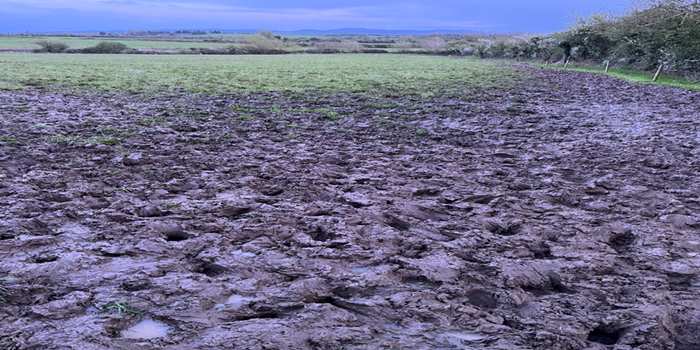
The scene above was very familiar in the western half of the country through March and April
Slurry storage and straw bedding
Admittedly, the cost of concrete is a big barrier to building now, with costs more than €160 per metre compared to less than half that a decade ago. At the same time, there are grants of 60% available subject, to some terms and conditions, and with a two-year tax write off available also, for those on the high tax bracket, a new slatted tank may not end costing as much as it initially seemed.
One thing is for definite though, anyone with adequate slurry storage to last six months or more on their farm this spring spent a lot less time stressing and pulling out their hair wondering where to go with the next tank of slurry to stop it appearing up through the slats. Windows to spread slurry this spring were few and far between. Any investment that takes pressure off spreading in these small windows is money well spent.
The same applies for suckler herds requiring straw-bedded areas. The majority of suckler herds had little or no stock out by mid-April and having enough lie backs and calving pens can be the difference between high and low vet bills and a high level or low level of calf mortality when the threat of calf scours and pneumonia sets in.
Silage quality
A drum that has been beaten for many a decade now is the issue of silage quality. And although wet years can negatively affect timing and preservation of silage, farmers who have long winters need to target harvesting top quality silage in mid-May and follow it up with good quality second cuts and paddock silage.
Typical early to mid-June silage will suffice for dry cows up to the point of calving. From calving time onwards, silage in excess of 70% DMD with a high protein content is a must to ensure no loss of body condition prior to breeding season. For weanlings and finishing cattle the same message applies, nothing below 70% DMD is welcome. Silage quality of close to 75% DMD is more warranted for this category of stock.
Additionally, farmers need to ensure adequate levels of soil fertility and swards consisting of a high proportion of perennial ryegrass that can utilise nutrients efficiently. It is essential that despite high fertiliser prices this year, farmers need to ensure that no skimping on crop nutrients occurs. Farmers who cut back on fertiliser in 2022 did so to their detriment with poorer quality swards and depleting levels of soil fertility.
Reseeding and soil fertility
Again, soil fertility must not be compromised this year. Lime is still the cornerstone of soil fertility and, while it may increase in cost to spread due to increased diesel costs this year, it is still a cheap product compared to chemical fertiliser. Farmers must also ensure they use up whatever P and K allowances they have on farm. Skimping here reduces the efficiency of the nitrogen you are spreading.
If weather allows, reseeding old, poor quality swards should be targeted. Ensure any land draining requirements are completed before reseeding. Red clover silage swards proved to be a success on many farms in the past three years and should be considered again where soil fertility is at an elevated level in terms of pH. These red clover swards suit out blocks targeted for silage quite well.
Summary
We look to be currently out of the woods with regards rainfall and hopefully once ground dries farmers will get plans back on target. It is worth remembering what put pressure on the system this spring again and if there is money in the bank to invest a farmer could do a lot worse than invest in slurry storage or grassland.
Alan Dillon is Manager of the Teagasc DairyBeef 500 Programme.