
Assessing Winter Feed Stocks

This year, completing a fodder budget could be one of the most important tasks any farmer undertakes. Keith Fahy, Teagasc Drystock Advisor, tells us more.
While farming is quite cyclical and repetitive from year to year, it encounters curveballs from time to time. In the last number of years, agriculture, like many other sectors, has had to face many challenges that had not been forecasted. Since 2020, we have had to deal with the COVID pandemic, wars, political change, environmental and regulatory restrictions, increased input costs, volatile commodity prices, labour shortages, and now, to add to this list, climate change and drought.
2026 will be a year remembered by many farmers across the country. Lack of rain, reduced grass growth, feeding silage reserves during summer, increased meal bills, and extra workload are some of the many challenges farmers have faced, especially throughout July and August. This can be extremely challenging for farmers in many ways, whether that be physically, financially, or psychologically. If you are struggling, it is always important to talk, whether that be to family, neighbours, agricultural advisors, or indeed to seek professional help from a GP or counsellor. Help is always available, and there is always a solution. Winter stocks may be low on farms, but there are many ways to try and ease pressure on the farm.
Completing a fodder budget is quite straightforward and can be done by entering your animal details into the table below, which can be used to predict months of feeding. Meal feeding, buffer feeding, roughage sources, and extended grazing, where possible, will all also help to reduce winter feed demand.
| Animal type | A No. of stock to be kept over winter | B Number of months | C Pit silage needed/animalmonth | Total tonnes of silage needed (multiply AxBxC) |
| Dairy cows | 1.6 | |||
| Suckler cows | 1.4 | |||
| 0-1 year old | 0.7 | |||
| 1-2 year old | 1.3 | |||
| 2+ year old | 1.3 | |||
| Ewes | 0.15 | |||
| Total tonnes needed | Tonnes = | |||
| or | or | |||
| Total bales needed (tonnes multiplied by 1.1) |
Bales = | |||
As a rough rule of thumb, farmers need 3 bales per weanling, 4 to 5 bales for stores, and 5 to 6 bales for suckler cows per winter. Obviously, this will depend on the length of winter, live weight of animals, quality of forage, level of wastage, and amount of meal being fed. If a 300 kg weanling eats 2% of their live weight in dry matter per day, this 6 kg of dry matter could be broken down into 4.5 kg of dry matter of silage and 1.5 kg of meal. Assuming there is 180 kg of dry matter in a bale of silage and assuming no waste, a bale would feed this animal for 40 days when supplemented with meal feeding at 1.5 kg per day.
A feed salesman recently informed me that some feed mills are working round the clock to try to keep orders filled. He also said that sales are up on the drought of 2018. While this might benefit the feed sales sector, it will also impact feed costs on farm and put pressure on farm profitability. Farmers and contractors have seen sharp hikes in fuel and fertiliser prices recently, and this is certainly not helping the situation. So, it is essential that farmers take an hour and count the bales of silage/hay/straw in stock and measure their silage pits to assess the volumes of feed that may be at hand for winter. As always, assessing passenger cattle and considering the sale of animals that are not performing or that are not leaving a margin is important now. Scanning cows and selling empty cows is always a help in trying to reduce demand at grass and reduce the amount of feed required for winter.
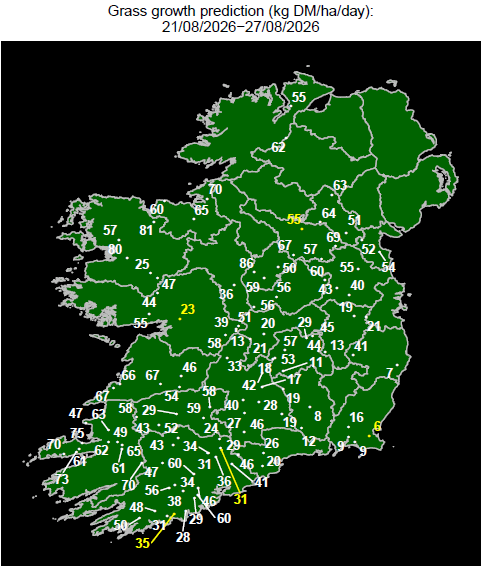
Grass growth rates are extremely variable throughout Ireland. This can be seen when we look at the Teagasc grass growth prediction tool, completed by Elodie Ruelle, Teagasc Moorepark. As can be seen in the image below, there is a significant difference in predicted growth rates throughout the country. Notable figures are highs of 70 and 80 kg DM/ha along the west coast, when compared to lows of 6–7 kg DM/ha per day on the east coast. So, some farms will grow 10 times more grass than others. Grass, as always, is our cheapest and most profitable feed, and so it is essential that we utilise this as best we can. As the chemical fertiliser application deadline is nearing on the 14th of September, farmers should ensure that they grow as much grass as possible into the autumn. According to Elodie Ruelle, “Soil moisture deficit is still limiting or stopping growth across the country, with the exception of the west and northwest. With the possible return of rain, grass growth should start to recover. Where swards have already greened up, recovery should be relatively quick once sufficient moisture returns. However, where grass remains yellow or stressed, recovery will take longer, as the sward will need to green up before growth rates begin to increase.”
Complete a fodder budget this week, as this will aid in making important decisions in the immediate future to reduce long-term pressures.