
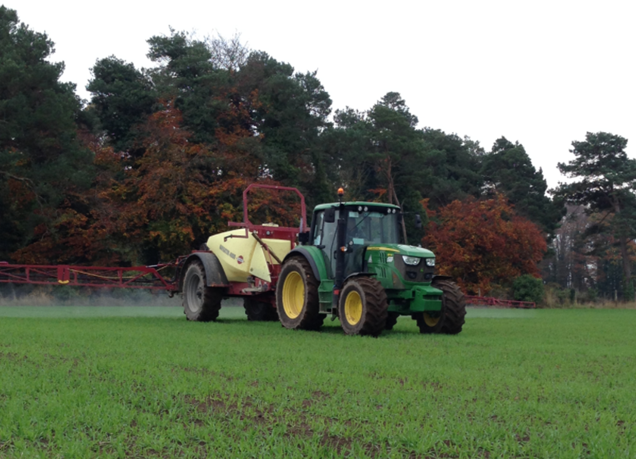
Crops Specialist at Teagasc, Shay Phelan takes a closer look at autumn weed control strategies, reminding farmers to choose products carefully to avoid the development of resistance.
With autumn drilling almost complete, except for crops going in after potatoes and beet, November has traditionally been the time when herbicides and insecticides have been applied to cereal crops.
There has been an increase in the amount of pre-emergence herbicides applied to crops this year, but there still remains quite a number of crops that will need post-emergence applications.
Here are a few points to consider when choosing what to apply:
- Are grass weeds and issue, if so which ones?
- Has there been any cases of poor control in previous years form certain herbicides?
- Which herbicides have been used previously and how often?
- Are crops following break crops? If so, was this in response to weed issues?
- Is there a long-term plan on the farm to include IPM practices as options in the future get tighter?
While the simplest thing to do is to select a product or mix of products that will control the weeds in the field, having a longer-term plan that includes product rotations, mixing active ingredients and crop rotations all will have to play a part in reducing herbicide resistance in years to come.
Bearing in mind that Firebird Met (Flufenacet + Metribuzin) is in the final weeks of use before it becomes illegal to use (Use by 23rd November), this will be followed more than likely by straight flufenacet, possibly in 2026. These will account for about 25% of the available autumn herbicide products that could possibly no longer be available in 2027.
This will leave the remaining products at risk of developing resistance. We already have grass weeds resistance to ALS (Pacifica Plus, Broadway Stara etc.) and ACCase (Falcon, Axial Pro, etc.) herbicides, while we also have some issues with broadleaf weeds – poppy, corn marigold and chickweed among others.
While we are still fortunate to seemingly have quite a number of options to choose from, in fact many contain the same active ingredient or mixture of active ingredients. We also have a number of options that can be applied in spring, but resistance issues are quickly making some of these products unusable – especially where grass weeds are an issue.
The table below shows most of the common products or mixture of products. While there are other trade names available, most will be based on one of the following active ingredients: pendimethalin, flufenacet and/or diflufenican. Therefore, it is important to choose products or mixtures that contain different active ingredients which can be changed from year to year to avoid development of resistance while also continuing IPM practices.
Table 1: Commonly used post-emergence herbicide options for wheat and barley
| Product(s) name | Active ingredients | Rate (L/ha) |
| Flight | Pendimethalin + Picolinofen | 4.0 |
| Defy + DFF | Prosulfocarb + Diflufenican | 2.0 + 0.1 |
| Tower | Chlorotoluron +Diflufenican +Pendimethalin | 2.0 |
| Firebird etc. | Flufenacet + Diflufenican | 0.3 |
| Firebird Met* | Flufenacet + Diflufenican + Metribuzin | 0.5 – 1.0 |
Note: *Use of Firebird Met is illegal from November 24th
The following video, made some years ago, clearly spells out the different aspects of weed control that need to be taken into account when applying autumn herbicides. Please note that some of the products listed in the video are no longer available.
For more insights, Conor Kavanagh, a Teagasc tillage advisor in Tipperary, joined Michael Hennessy on a recent episode of the Tillage Edge to discuss weed control strategies in winter cereals. Listen in below:
More from Teagasc Daily: Autumn update from the Teagasc Oak Park farm