
Award Winning Oats in West Cork
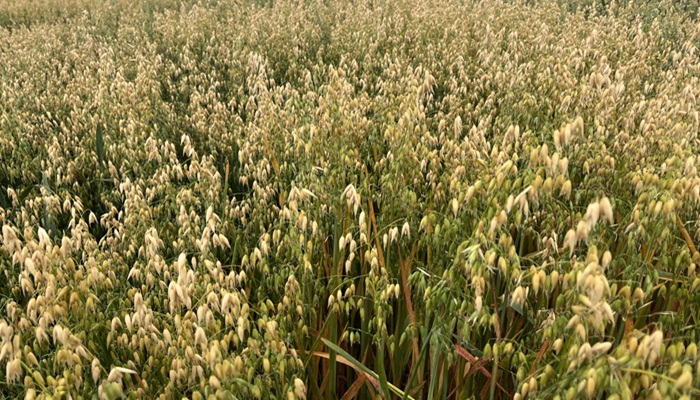
Named the Flahavan’s Conventional Oat Grower of the year in 2025, Martin and Jim O Regan place a firm focus on growing premium crops. Teagasc Tillage Advisor, Michael McCarthy spoke with Martin O Regan to find out more about their system in West Cork.
Martin O Regan and his father Jim run a large-scale tillage operation just outside Kinsale in Coolyrahilly, near Ballinaspittal, Co. Cork. Farming in excess of 400 hectares of cereals and beet, they grow a mix of crops including winter barley, spring barley for both malting and feed, winter and spring oats on contract for Flahavan’s, spring wheat, and both fodder and sugar beet as animal feed which is sold direct to livestock farmers.
The wide array of crops grown by the O Regans gives them a great crop rotation and spreads the workload over the winter and spring when it comes to planting, harvesting and spraying.
“The opportunities to get work done seem to be getting tighter and tighter each year so it is important for us to have a spread of crops especially at harvest time,” Martin explained.
They run a plough-based system and try to incorporate organic manures where possible to reduce chemical nitrogen inputs.
Premium crops
Martin tries to grow as many premium crops as he can to avail of the best prices for his produce. Premium crops in Ireland include malting barley, seed crops, roasting barley and milling wheat and oats.
All premium crops offer growers a bonus payment over ‘feed price’ once certain criteria are met. For the O’Regans, a significant portion of their cropping area is devoted to both malting barley and milling oats.
For Marin, it all comes down to economics: “The feed prices being offered in 2025 were simply not enough to cover the rising costs we have seen in the past few years, and we need the higher prices from the premium crops just to stay afloat.”
A well-earned boost
In 2025, Martin received a well-earned boost when he was named Flahavan’s Conventional Oat Grower of the year. The recognition was very welcome at a time when positivity and recognition is sadly lacking in the tillage sector. He had previously been runner up for the prize in 2022 and 2024.
The O’Regans have been supplying oats to Flahavan’s for over 20 years and have an annual contract for over 700 tonnes of milling oats. It is a very valuable asset for their tillage business and as Martin said: “We are very lucky to have it”.
Flahavan’s is a well-established household name in Ireland, and the quality of its product starts in the field. Oats are selected on various criteria including cleanliness – free of chaff and impurities, colour, KPH and moisture content.
Recently a tolerance level for mycotoxins was also introduced and oat growers will be well aware this can be a tricky hurdle as oats grown in Ireland can be prone to fungal disease. The average KPH or bushel weight for Martin’s oats in 2025 was 57, which is an outstanding result.
When it comes to growing oats, Martin pays great attention to detail when applying fungicides and growth regulators and says timing is key.
Crops are monitored frequently and products are applied at the correct growth stages to achieve maximum benefit. When fungicides especially are applied at both the wrong time, i.e. too late or too windy etc, fungal diseases such as mildew and crown rust can set it and passing the ‘milling spec’ can become very difficult.
Where possible, Martin tries to use pig slurry as an alternative to chemical nitrogen on his crops as a means of cutting costs. This coupled with chopping straw is great for soil health and also brings his carbon footprint close to carbon neutral when measured on AgNav.
Catch and alternative crops
Along with the main crops, Martin also grows a significant area of catch crops each year for both the ACRES scheme and Farming for Water.
He is a great believer in maximising the schemes that are available each year and plans to grow beans in 2026 also.
Catch crops are established as soon as possible after harvest using min till and are a great way of mopping up excess nitrogen that would otherwise be leached into ground water. A recent study in Teagasc Oak Park showed a well-established cover crop had the potential to store up to 70Kgs of Nitrogen per hectare and at today’s prices that’s €105/ha.
Outlook
When asked about the future, Martin commented: ‘It’s becoming harder and harder to grow crops every year with sprays being taken off the market and no alterative offered”.
“We grow oats because we have a market, it seems very unfair that tillage farmers are forced to grow crops they possibly do not have a market for due to the 3-crop rule while other sectors are not forced to use these crops in animal feeds,” he also said.
Conclusion
Martin and Jim are a prime example of what attention to detail can achieve. They show a great deal of awareness when it comes to both environmental sustainability and income sustainability, and recent investments in LESS technology for slurry and GPS technology for spraying and fertiliser really emphasises the low carbon and high-quality product that they produce.