
Ballyhaise suckler herd sets high standard
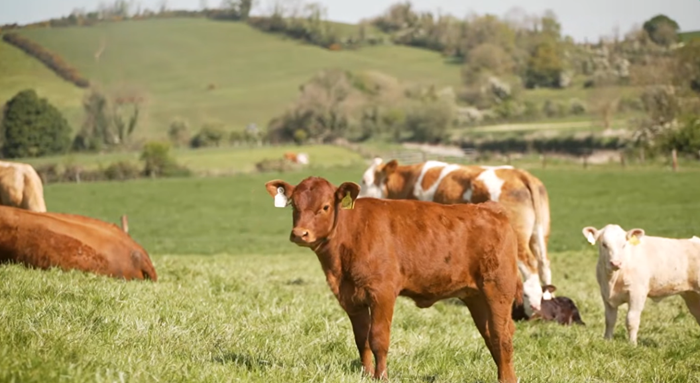
Exceptional production and environmental performance on challenging soil, Teagasc Beef Specialist, David Argue tells us about the high performing suckler-to-beef system at Teagasc’s Ballyhaise Agricultural College.
The college suckler herd consists of 40 continental type cows and operates on 26.9ha (66.5 acres). The land is drumlin soil type, characteristic of the area. All progeny apart from replacement heifers are brought through to beef.
“We are a working demonstration unit, showcasing best commercial practice in suckler-to-beef production for students,” says college beef teacher Liam McWeeney.
“Our emphasis is on breeding, nutrition, herd health, finishing, financial performance and sustainability.”
System
The suckler cows are mainly Limousin, Simmental, Charolais, Saler and Angus. They start calving in late January with most cows calved before first year students go on placement in mid-March.
“Male calves are finished as under-16-month bulls. Heifers are finished at 22 months,” says Noel Prunty who manages the unit. “Replacement heifers calve down at 24 months. Strong emphasis is placed on grassland management, with grass measured weekly, and on making top quality silage for young stock.”
Breeding
Improving genetics in the herd and, in particular, improving milk and fertility of the cow is key. This is achieved by breeding all replacements from within the herd. Cows are AI’ed for the first 3–4 weeks of the breeding season.
“If a decent proportion of the cows have been AI’ed or heat activity drops we turn out a Charolais stock bull to keep six-week calving tight the following spring,” says Noel.
Breeding for the replacement heifers usually starts two weeks later than the main herd and short gestation bulls are used. Heifers are watched for seven days and any that have not shown signs of heat are synchronised and AI’ed to Angus and Saler sires with easy calving (<5% calving difficulty % >90% reliability).
The heifers are bred for just six weeks to ensure only the most fertile heifers are entering the herd and that they calve early in the spring. When selecting cows to breed replacements, the previous year’s calf weaning weight is considered and only the highest performing cows that achieve a daily liveweight gain on 1.2kgs/day for their heifer calves and 1.3kg/day for their bull calves are bred to replacement bulls.
“One of the main sub-indexes when selecting bulls for replacements is the milk sub-index followed by carcass weight with an overall replacement index of 4- or 5-star,” says Liam McWeeney. “We scanned all of the cows after nine weeks of breeding in 2025.”
Scratch cards and teaser bulls are used to aid heat detection. Any animal that is not showing signs of heat two weeks after the breeding season starts is scanned by the local vet.
For further insights on the beef enterprise at Ballyhaise College, visit here:
Herd Health
The focus areas are scour prevention in calves and pneumonia prevention in weanlings at housing. Cows are vaccinated against scour 3–12 weeks prior to calving. All calves get adequate, quality colostrum within two hours of birth to ensure absorption of antibodies.
“We prepare calves for weaning and housing to ensure performance is maintained and stress minimised,” says Noel Prunty. “Weanlings get a first vaccine against pneumonia on September 1st and a booster shot on 1st October.” This ensures calves have full immunity from mid-October when weaning generally starts.
They are given a worm dose to avoid any stomach or lung worm burdens around weaning. Weaning takes place gradually. Starting off with the heifers being weaned first followed by 7–8 cows a week until all are weaned.
Cows are usually housed at weaning time and calves are left outdoors with the un-weaned group. Calves also receive clostridial vaccination while cows receive BVD and Lepto vaccines pre breeding.
Weanling performance and slaughter
“Weanlings are weighed several times during the year to monitor performance,” says Noel Prunty. “Last year’s male calves averaged a daily live weight gain of 1.34kgs/head/day with the top performing calves achieving 1.65kgs/head/day.
“The female calves averaged 1.14kgs/head/day with the top performing calves achieving 1.44kgs/head/day. First calving heifers had a weaning efficiency rate (Calf 200 Day Weight as % of Cow Weight) of 46% with the mature cows on target at 42%.”
Male calves are introduced to creep feeding in early September and are eating between 2–3 kgs/head/day by the end of October.
“We house in early November where the concentrate feeding rate is increased to 4 kgs/head/day building up to 6kgs/head/day by February 1st,” says Noel Prunty. At this point the change over from a 16% weanling ration to a 13% finisher ration begins. The change over usually takes two to three weeks before they are completely on the finisher ration.
Once the change in diet is complete, animals are gradually moved onto an ad-lib diet of concentrates, silage and straw for finishing.
In 2025, the young U-16 month bulls averaged 430kg carcass at 15 months of age achieving a grade of U-3+ and had an average kill out of 58.3%. The young bulls averaged a daily lifetime gain of 1.55kgs/head/day with the top performing bulls reaching 1.9kgs/day in the finishing period.
The heifers graze good quality grass in the second summer and are typically housed on the 1st October before being introduced to concentrated feed for the finishing period. Heifers are fed a diet of top-quality silage and 6kgs/head/day of concentrates. The heifers that were finished in spring 2026 had an average weight of 358kg carcass at 22 months with an average kill-out of 55.8%. All cull cows are finished on the farm.
Grassland management
“Grassland management includes improving soil fertility, grazing infrastructure, reseeding, clover incorporation and extending the grazing season,” says Liam McWeeney. “Our investment in grazing infrastructure and roadways has allowed us flexibility in early spring turnout and when managing individual paddocks.
“It is important that the college can demonstrate to students a high level of production and grassland management on a heavy farm. Grass is measured weekly and covers are uploaded to PastureBase Ireland.
First cut silage was harvested on 11th of May and had a DMD of 75%. Top quality silage is essential in driving animal performance over winter and reducing concentrate use.”
2025 Key Performance Indicators
| Your herd average | National average | Top 10% | Your national rank | |
| Replacement Index (Cows) | €140 | €93 | €120 | €97 |
| Replacement Index (1st calvers) | €148 | €101 | €139 | €93 |
| Herd calving interval | 355 days | 400 days | 361 days | 93% |
| Calves per cow per year | 1.03 | 0.85 | 1.00 | 93 |
| Heifers calves 22-25 months | 100% | 19% | 67% | N/A |
| Six week calving rate spring | 86% | 56% | 100% | 67% |
Sustainability
“Achieving carbon efficiency and protecting the environment and demonstrating how these are achieved to students is a major focus on the farm,” says Liam McWeeney. “We emphasise growing and utilising more grass, extending the grazing season and harvesting top quality silage.
“Soils are at optimum pH, P&K. Slurry is spread using LESS and all chemical nitrogen is spread as protected urea. Over 600m of hedgerows have been planted. Protecting water quality through careful fertiliser and slurry spreading and adhering to buffer zones are vitally important.
“We hope that we are demonstrating that high commercial performance and environmental sustainability can both be achieved on soils like ours.”
Ballyhaise Agricultural College offers a QQI Level 6 Advanced Certificate in Drystock Management. This is a two-year course which is made up of a Level 5 Certificate in Agriculture in year one followed by the Level 6 Advanced Certificate in Drystock Management in year two. Contact Ballyhaise Agricultural College for more information.