
07 April 2025
Be vigilant of Nematodirus
Each spring, farmers are advised of the predicted risk of disease, chiefly in lambs, caused by the roundworm Nematodirus battus.
Published by the Department of Agriculture, Food and the Marine, in collaboration with Met Éireann, UCD and Teagasc, the Nematodirus Forecast 2025 – an aid to prevent the disease impacting lambs – takes into consideration March soil temperatures in order to predict the peak Nematodirus hatch rate.
Signs and symptoms
As a parasite, Nematodirus worms may cause severe diarrhoea in young lambs in spring. This occurs due to the tendency of the worm eggs on pasture to hatch over a short period of time, leading to a surge in the numbers of infective larvae on the pasture which the lambs ingest. Along with profuse diarrhoea, dehydration and weight loss also occur. In outbreak scenarios, lambs can be seen congregating around water troughs due to the severe thirst that develops. Adult sheep are unaffected by the parasite.
Peak hatch rate
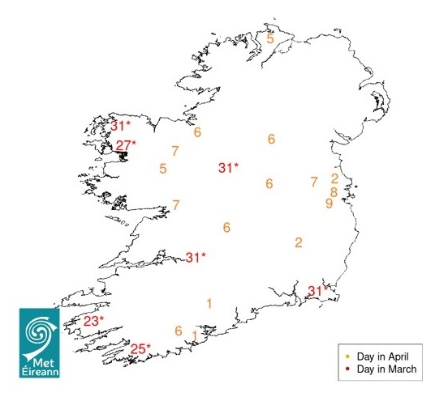
In 2025, the Nematodirus forecast shows that for most of the country the peak Nematodirus egg hatching will occur in the early days of April, the exception being the Atlantic coastal fringes where peak egg hatching was predicted for the end of March.
Further details on the expected dates of peak Nematodirus egg hatching on pasture are available in figure 1 below.
Figure 1: Estimate dates in March and April 2025 when peak Nematodirus egg hatching is expected to occur
Source: Met Éireann
When should lambs be treated and what wormer should be used?
The Nematodirus forecast also recommends treating at-risk lambs – typically those 6-12 weeks of age and grazing on contaminated pasture – two weeks after the peak Nematodirus egg hatching. However, caution is advised in that other conditions – such as coccidiosis infection – may cause similar symptoms to Nematodirus, so a discussion with your vet to ensure accurate diagnosis is recommended.
In terms of the choice of dosing products, white drenches (benzimidazoles) are preferred, as it is effect against both larval and adult stages, and it will help to reduce the exposure of other worms such as Trichostrongylus and Teladorsagia to other anthelmintic classes (e.g. macrocyclic lactones) at a point in the grazing season when treatment for these may not be necessary.
For further information on treatment options, view the Nematodirus forecast here.