
Benefits of AI and the use of Synchronisation in Suckler Herds
19 March 2025 Benefits of AI and the use of Synchronisation in Suckler Herds The calving season is coming to an end on farms and the focus will soon turn to the breeding season. Currently AI usage is low on beef farms with only 20% of all calves born to suckler herds by AI […]
19 March 2025
Benefits of AI and the use of Synchronisation in Suckler Herds
The calving season is coming to an end on farms and the focus will soon turn to the breeding season. Currently AI usage is low on beef farms with only 20% of all calves born to suckler herds by AI sires. James Mullane tells us more.
One of the main benefits of AI is increased genetic improvement, by allowing farmers to use a broader range of both high index replacement and terminal index bulls.
Synchronistaion is increasing in popularity and can pay dividends to the farmer who wants to use AI by:
- Allowing the use of genetically superior AI bulls both conventional and sexed
- Reducing the labour around heat detection or at least focussing it on a key period for when labour is more available
- Facilitating the use of AI on fragmented farms where frequent heat detection may not be as easily achieved
- Reducing the calving spread or bringing forward cows that have slipped in the calving pattern, thereby breeding an even bunch of calves which can be managed more easily when labour is more available
For anyone considering synchronising heats for the first time there are a few essential elements to ensure it is successful:
- Synchronisation should only be used in herds where there are high levels of management as heat detection may still be necessary depending on the programme chosen
- All vaccination programmes and mineral supplementation should be up to date well in advance of the breeding season
- Heifers should have reached target weight (60% of mature weight) and have already reached puberty
- Cows must should be on a rising plane of nutrition and in good body condition
- Cows should be at a minimum 40 days calved, cows which had a difficult calving or retained placenta may require a pre breeding scan and veterinary treatment
- Before deciding on the start of the programme notify the AI technician to ensure availability
Protocols
Replacement Heifers
Protocol 1: Heifer synchronisation with prostaglandin
Heifers can be the easiest animals to synchronise often just requiring heat detection and one treatment with prostaglandin (PG). The protocol (figure 1) can be used very effectively to breed the majority of heifers in 10 days and is the cheapest. Heifers are observed and mated during the first seven days of the breeding season. Any heifer which is not served after the first seven days then receives an injection of prostaglandin (PG). Over the following two to five days, heifers are again observed and any heifer on heat is served.
However, some heifers (<10%) may not show signs of heat after the first shot of PG and a second shot will be required 11 days after the initial injection. Again, observation following this shot is key and any heifer which fails to show signs of heat may be artificially inseminated 72 and 96 hours post injection.
This protocol will only work when heifers are cycling and works best when heifers are at target weight. With this synchronisation programme, observation is key and the use of heat detection aids are necessary to identify any heifers on heat.
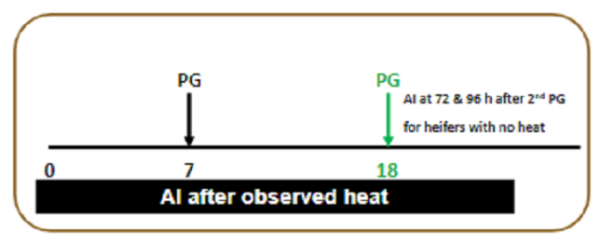
Figure 1: Heifer synchronisation with prostaglandin
Protocol 2: Heifer Timed AI (TAI)
This protocol is eight days from start to finish and allows for 100% submission rates to be achieved to first service, as fixed time AI is used regardless of signs of heat. It also promotes cyclicity in heifers that are not yet cycling, but these animals should be close to their target weights.
Day 0 (figure 2) is the day on which fixed time AI is carried out. Progesterone devices (CIRD or PRIDs) and an injection of GnRH is administered eight days before the mating start date. The progesterone device stays in-situ for six days and is removed two days before AI occurs.
Two injections of prostaglandin are involved. The first shot is administered three days before AI and the second injection two days before insemination. This two-shot programme is required as 10-20% of heifers don’t respond to the initial injection of PG and conception rates are increased 5-10% by administering the second dose.
On the day of AI, heifers are inseminated at a fixed time and also receive another shot of GnRH. When this protocol is used, the first round of breeding is completed over eight days and heifers are brought into the handling facilities on four occasions.
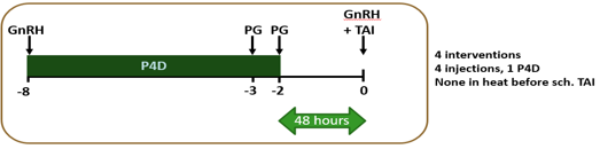
Figure 2: Heifer Timed AI Protocol
Cows
Suckler cows can be slower to return to heat as the effect of suckling from the calf can slow down the resumption of heat cycles. The majority of protocols will encourage the cow to cycle even if she has not been cycling previously. The protocol in figure 3 can be used on cows. This protocol is ten days from start to finish and allows for 100% submission rates to be achieved to first service, as fixed time AI is used regardless of signs of heat. It also promotes cyclicity in cows that are anoestrus.
Day 0 is the day on which fixed time AI is carried out. Progesterone devices (CIRD or PRIDs) and an injection of GnRH is administered ten days before the mating start date. The progesterone device stays in-situ for eight days and is removed two days before AI occurs.
Two injections of prostaglandin are involved. The first shot is administered three days before AI and the second injection two days before insemination. Cows also receive another injection of GnRH 16 hours before AI.
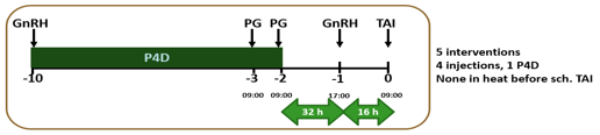
Figure 3: Cow Timed AI Protocol