
BETTER Farm update: Lambing edging closer on the Jacksons’ organic farm
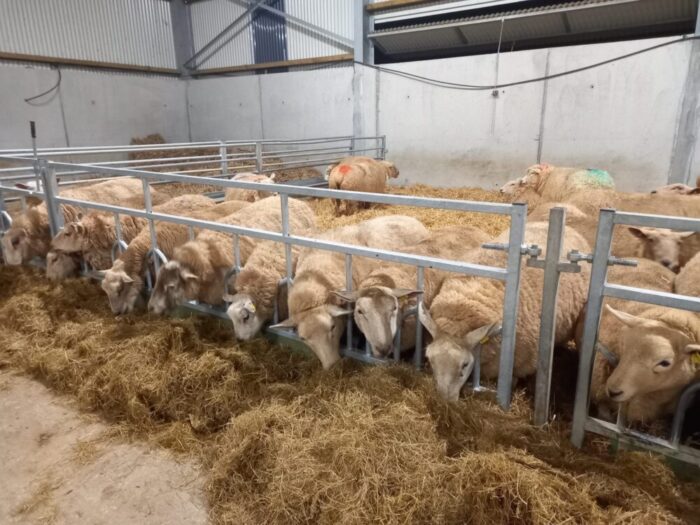
Michael Gottstein, Head of Sheep Knowledge Transfer, brings us insights from Amy and Ross Jacksons’ organic farm on the Tipperary/Offaly border, where lambing is just around the corner.
Amy and Ross Jackson farm just over 50 hectares organically in Lacka, close to Birr, on the Tipperary/Offaly border. The farm is a mixed tillage and sheep farm that has been operating under organic standards for the last 11 years.
On the grassland side, the grazing area consists of just under nine hectares of grass clover swards, approximately 10 hectares of multispecies grass swards which was sown in 2021 and four hectares of red clover swards, which was ploughed after a first cut last year and sown with a forage rape / turnip mix in May for finishing lambs. The grassland area supports a flock of 101 mature ewes and 33 replacement ewe lambs, which were mated in the autumn of 2025. A number of mature ewes were identified as culls at lambing time, and later when ewes were later checked prior to mating, were not mated but feed on and later sold at an average weight of 81kg for €2.10 / kg liveweight.
Scanning results
Scanning was completed on the 26th of January, and the results were as follows: 101 mature ewes had a litter size of 1.85 with a scan rate of 1.73 and 94% pregnancy rate. Ewe lambs were in excellent condition last autumn, with many ewe lambs in excess of 50kg at mating time. Of the 33 ewe lambs retained for breeding, 25 scanned pregnant with a litter size of 1.08.
Managing body condition score
There has been a large emphasis put on ewe body condition and consequently ewe body condition scores (BCS) were excellent at mating, and this condition was maintained throughout pregnancy. The table below shows the BCS Score of the ewes and ewe lambs taken at mating time and again at scanning time. The results demonstrate the impact of flock management on ensuring that ewes do not loose condition during pregnancy.
Table 1: Body condition score of breeding females on the Jackson farm
| Ewe lambs | Mature ewes | |
| Average body condition score | 3.1 | 3.4 |
| Percentage of ewes < BCS 3.0 (mating) | 15 | 4 |
| Percentage of ewes < BCS 3.0 (scanning) | 15 | 5 |
Lamb sales
All factory lambs were marketed pre-Christmas – this is a stark contrast to 2024 where a large number of factory lambs were carried over into the new year (due to an earlier anthelmintic resistance issue, which has since been resolved).
Feeding
The breeding flock (mature ewes and ewe lambs) were rotated on the grass swards until the new year and were then moved onto forage crops sown into cereal stubble with some access to baled silage and rolled barley (twins and triplets).
Ewes were housed during the first week of February and are being fed baled silage and rolled barley which will be supplemented with 200grams per head per day of organic soyabean meal for the last three weeks pre lambing. This will ensure that ewes will not only receive the required 240g of crude protein daily but also digestible undegradable protein (DUP) to ensure adequate high-quality colostrum.
Lambing is due to kick off around St. Patrick’s weekend, when approximately 200 lambs should start arriving from the 120 pregnant females. Here is hoping that the weather is conducive to getting lambs to grass quickly. In the meantime, a break from the rain would be welcome to get some field work done on the tillage area.
The above first appeared in the Farming Independent.