
Body condition scoring of dairy cows
Body condition scoring is a simple but valuable management tool that can have a significant impact on dairy cow performance, Padraig O’Connor tells us more.
Body condition scoring is an important farm management tool that allows farmers to assess the nutritional status of their dairy cows throughout the production cycle.
Body condition scoring should be carried out at least three times a year: at drying off, at calving and before the start of the breeding season. This makes it an ideal time to assess the body condition of the herd and identify any cows that may need attention.
Body condition scoring measures the amount of fat cover on specific areas of a cow’s body. It involves a combination of visual assessment and handling to determine whether a cow is too thin, too fat or in the correct condition.
Achieving the correct body condition at key stages of the production cycle is important for cow health, milk production and reproductive performance.
BCS is measured on a scale of 1 to 5, in increments of 0.25, where:
- 1 represents an extremely thin cow.
- 3 represents a cow in good condition.
- 5 represents an extremely fat cow.
One of the most important targets to remember is that cows should not lose more than 0.5 of a body condition score between calving and the start of breeding. Excessive body condition loss during this period can negatively affect the return to cycling, submission rates and conception rates, ultimately reducing overall herd fertility performance.
What are the target body condition scores
The recommended herd average targets and acceptable ranges at the three key stages of the production cycle are outlined below.
| Stage of production | Target herd average | Acceptable range |
| Drying off | 3.0 | 2.75–3.25 |
| Calving | 3.25 | 3.0–3.5 |
| Start of breeding | 2.9 | 2.75–3.25 |
The aim is to have cows in the correct condition at each stage, rather than allowing them to become too thin or too fat. Regular scoring allows farmers to identify problems early and take corrective action before they affect cow performance.
What are the implications of not achieving these targets
Cows that are too fat at calving (BCS greater than 3.5)
Over-conditioned cows are more likely to experience metabolic and health problems around calving. These include:
- Increased risk of milk fever and ketosis.
- Greater likelihood of difficult calvings and retained placenta.
- Reduced dry matter intake after calving.
- Lower milk production and poorer reproductive performance.
Cows that are too thin at calving (BCS below 2.75)
Under-conditioned cows may also experience significant performance problems, including:
- Reduced milk production.
- Slower return to cycling after calving.
- Lower submission rates during the breeding season.
- Reduced conception rates and poorer overall fertility.
Maintaining the correct body condition is therefore important to ensure cows are healthy, productive and ready for the next breeding season.
How to body condition score
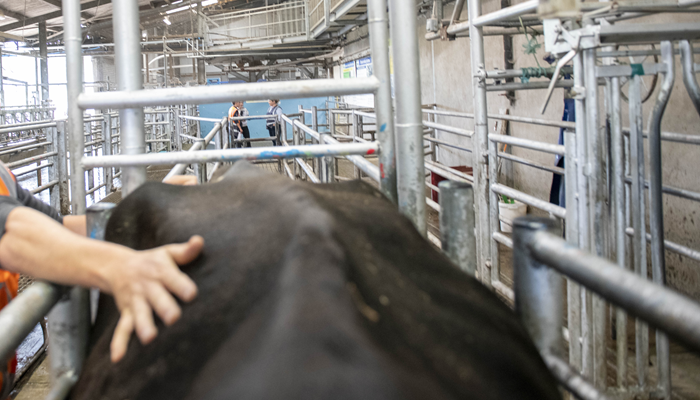
Ideally, cows should be assessed in a cattle crush, standing in a relaxed position rather than being tightly confined or bunched together. It is important to use the same hand when handling and scoring cows to ensure consistency between assessments.
There are three primary areas that should be handled when carrying out a body condition score:
- Pin bones: Assess the amount of fat cover around the pin bones.
- Loin or short ribs: Feel the amount of fat cover over the loin and the prominence of the short ribs.
- Long ribs: Assess how easily the ribs can be felt and the amount of fat covering them.
There are also four secondary areas that should be assessed visually:
- Backbone
- Hip bones.
- Pin bones.
- The area between the hip and pin bones.
Pay particular attention to the shape of the area between the hip and pin bones. A V-shaped appearance indicates a thinner cow, while a U-shaped appearance indicates a cow carrying more condition.
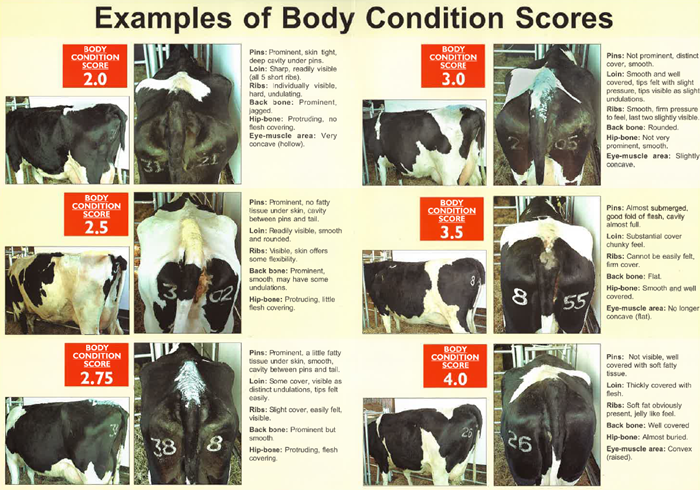
Examples of different body condition scores are outlined in Figure 1 below:
Conclusion
Body condition scoring is a simple but valuable management tool that can have a significant impact on dairy cow performance. By scoring cows at drying off, calving and before the start of breeding, farmers can identify animals that are either too thin or too fat and take corrective action where necessary.
The key is to maintain cows within the recommended target ranges and avoid excessive body condition loss after calving. In particular, limiting condition loss to no more than 0.5 between calving and the start of breeding is important for achieving good reproductive performance.
Taking the time to body condition score your herd a few times each year can help improve cow health, milk production and fertility, ultimately contributing to a more productive and profitable dairy herd.