
Botanically diverse swards can reduce farm gate emissions in pasture-based sheep systems
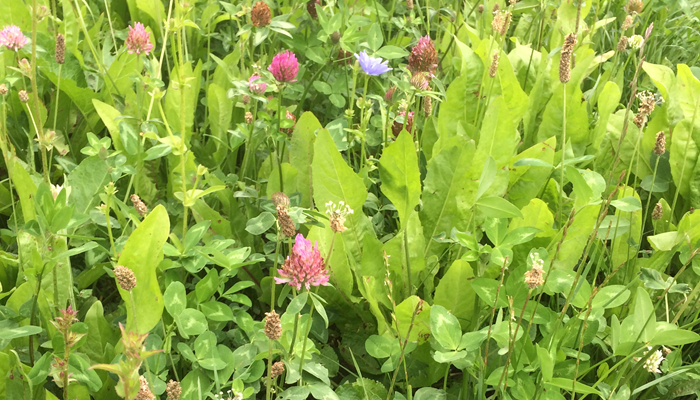
Dr. Sarah Woodmartin, Teagasc Research Officer, discusses the role of botanically diverse swards in improving the environmental and economic sustainability of pasture-based sheep production.
Agricultural greenhouse gas (GHG) emissions are dominated by enteric methane (CH₄) and nitrous oxide, making the mitigation of these gases a key priority for reducing the carbon footprint of ruminant production systems worldwide. Previous research has shown that incorporating companion forages, including legumes (white and red clover) and herbs (chicory and plantain), into perennial ryegrass (PRG) swards can improve production efficiency in sheep systems. These improvements are primarily attributed to enhanced post-weaning lamb growth, resulting from the superior nutritional quality of botanically diverse swards during the latter half of the grazing season. Improved forage quality can increase dry matter intake, leading to a higher average daily gain, reduced concentrate supplementation in the finishing period, and a younger age at slaughter.
These hypotheses were evaluated in a five-year systems study conducted at Teagasc Athenry between 2018 and 2022. Five grazing treatments were compared: perennial ryegrass (PRG), PRG plus white clover (PRG+WC), PRG plus red clover (PRG+RC), PRG plus chicory (PRG+Chic), and PRG plus plantain (PRG+Plan). All swards were stocked at 11.5 ewes/ha, managed under rotational grazing, and received 120 kg N/ha/yr.
Annual herbage production was similar across all treatments (10.5–11.5 t DM/ha). However, companion forage inclusion consistently improved sward quality during the post-weaning period. All companion forage swards had lower fibre concentrations, increasing sward digestibility over the PRG sward. White and red clover increased sward crude protein concentration, while chicory and plantain increased ash concentration, reflecting a higher sward mineral content.
The improvements in forage quality translated into superior lamb performance. Post-weaning average daily gain was increased by 25-41 g/day in lambs grazing companion forage swards than those grazing the PRG sward. Hence, age at slaughter was reduced by 16-32 days for lambs on companion forage swards with these lambs also requiring 5-11 kg less concentrate supplementation per head to achieve target slaughter weight. Across the five dietary treatments, performance was consistently highest for PRG+RC and PRG+Chic lambs, followed by PRG+WC, then PRG+Plan, while the PRG only diet consistently produced the poorest lamb performance. These findings demonstrate that botanically diverse swards can improve post-weaning sward quality, better meet animal feed requirements during this period, and enhance lamb growth performance when appropriately managed within pasture-based sheep production systems.
To evaluate the wider system impacts, production, profitability, and GHG emissions associated with each grazing treatment were modelled using the Teagasc Lamb Production bio-economic model. Model outputs, together with farm physical data, were incorporated into a life cycle assessment (LCA) to quantify farm-gate GHG emissions. The primary findings of this analysis showed that the inclusion of companion forages reduced farm-gate emissions by 5-11%, expressed as kg CO₂ equivalents per kilogram of carcass weight, driven by the reduced age at slaughter and reduced reliance on concentrate feed. In addition, the PRG+WC, PRG+RC, and PRG+Chic swards generated, on average, €104 ha⁻¹ greater net farm profit than the PRG system, whereas the PRG+Plan sward increased net farm profit by €47 ha⁻¹ relative to the PRG system.
This study demonstrates that incorporating companion forages into perennial ryegrass swards is a practical strategy for improving the environmental and economic sustainability of pasture-based sheep production systems when managed appropriately. Although plant persistency remains the primary barrier to widespread adoption, our improved understanding of the establishment, management, and persistence of these species now enables the implementation of management strategies that maximise their benefits at the system level. As a result, companion forages can improve the efficiency of lamb finishing while providing a viable pathway towards more sustainable pasture-based sheep production systems.