
07 November 2023
Bringing benefits in the bulk tank through grassland management
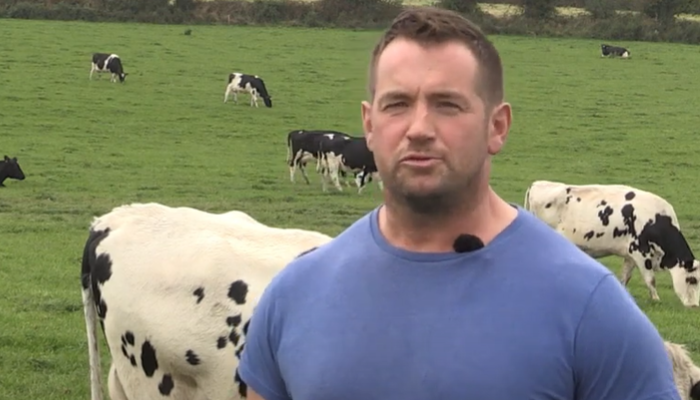
Farming outside New Ross in Co. Wexford, Shay Ryan farms 97ha, with 56ha of this area being the milking platform. Milking 180 cows and carrying 45 replacement heifers, there is also a small beef enterprise on the farm.
The EBI of the herd is €213; the young stock have an EBI of €261 and €271. Last year, he supplied 486kg of milk solids per cow and the plan is to raise this to 500kg.
The soil fertility on the milking platform has been improved to Index 3 and 4 for phosphorous (P) and potassium (K) and the farm grew 15.7 tonnes of grass DM/Ha in 2022. Shay aims to reseed 10% of the milking platform every year. This year, he went with the Pasture Profit Index grass Nashota and 1.5kg of white clover seed.
Below Shay details the management practices on his farm over recent weeks and why he pays such close attention to grass quality.
Paddocks
It’s hard to imagine we’ve started to grow our spring grass now. We started to close paddocks on October 10th. The first paddocks closed were the furthest away paddocks, as this was handiest. They are dry and have ok access for grazing. These are the paddocks that will be grazed from March 10th, so they will have plenty of time to build cover on them. Teagasc research has shown that every week delay in closing reduces spring grass supply by 100kg DM/ha.
The aim is that these paddocks will have a cover of around 1,200kg DM/ha on them when being grazed in spring. At that stage, there will be a good mob of cows calved and adjusted to grazing so they will be able to deal with the level of cover.
The second lot of paddocks to be closed will be dry paddocks near the yard for the first cows to be turned out. We are lucky as our land is very dry, so we have a good amount to choose from and have worked to ensure we have plenty of access to these.
These will be grazed first and the cover needs to be lighter (800-1200kg DM/ha) to give the cows a chance to get accustomed to grass in the diet again and get a good graze out. It also helps to get through a larger percentage of paddocks grazed off earlier, which will give paddocks time to recover and ensure there is enough grass back for the second round of grazing.
Among the last to be closed will be anything with clover; we are leaving them to last to give the clover a chance over the winter. Clover did really well this year and even paddocks not noted for clover had a big increase. We don’t exactly know why, maybe the drought period in May/June meant that we didn’t get the peak growths until later this year and the clover had being given a chance to get strong enough to compete with the grass.
Also, in the last few years we are being more strategic with use of P and K fertiliser and slurry, which will have contributed as clover needs good P and K and pH levels.
Spring grass
I know from talking to other farmers and from discussion groups a lot of farmers aren’t thinking of spring grass now and will say they just will keep grazing until all the grass is gone and then house the cows. However, for a spring-calving herd, grass in spring is worth more to us than grass in autumn, so for us the grass year starts now.
Weather permitting, we are trying to graze down to a residual of 4cm now. This will stimulate growth throughout the winter and avoid the carryover of dead material. The strip wire is used for heavy covers and when conditions are very wet. The target is to have 65% closed by November 1st. This won’t be a problem this year, as we found it hard to build up cover this autumn and cows are flying through grass with the lower dry matters.
PastureBase
Someone once said to me to ‘look at the grass not the litres in the bulk tank’. It’s what is in front and behind the cows in the paddock that will sort the milk in the tank.
We are measuring grass for nearly a decade now and are using PastureBase Ireland for around five years. I have the app on my phone and it’s a super job, as it’s so easy to use. I use it in the field when doing a grass measure and even when I’m bringing in cows I can enter the date they came out the paddock.
More recently I’ve started to use it to track fertiliser and slurry applications. PastureBase has some great reports which show: how each paddock is performing; how many grazings or silage cuts were taken off each paddock during the year; and growth during different seasons etc. They say knowledge is power. Grass measuring gives me the knowledge – it’s up to me to use it!
Shay Ryan is a participant in the Teagasc/Tirlán Future Farm Programme and a participant in the Teagasc Signpost Programme. This article first appeared in the Farming Independent. For more information on Shay’s farm, click here. To learn more about the Teagasc Signpost Programme, click here.
Also read: Dairy advice: Act early when managing body condition score over an extended dry period
Also read: Assessing silage quantity and quality