
Busy start to the Spring in County Carlow
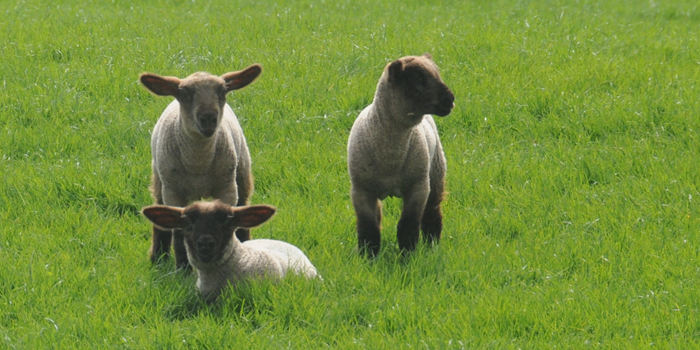
It’s a busy time on Eddie Gavin’s farm in Co. Carlow with lambing underway. Ciaran Lynch, Peter Lawrence, and Frank Campion tell us more.
Eddie Gavin is a participant in the Teagasc BETTER Farm Sheep Programme. He is farming alongside his wife, two young children, and his parents near Bagenalstown, Co. Carlow, while also carrying out machinery contracting for local farmers. Eddie operates a mixed farming enterprise comprising sheep, beef, and tillage systems.
It’s been a busy start to the spring on the farm. Eddie purchased 234 male hill and hill-crossbred store lambs last September/October, and along with 20 remaining ram lambs from his own flock, they began grazing a hybrid brassica crop last October. The hybrid brassica crops were sown in early August after Eddie harvested the winter barley. By the end of February, 69% of lambs had been drafted off the crop with an average carcass weight of 22 kg.
At the start of March, a concentrate ration was introduced to the remaining lambs to push on performance and bolster feed supplies, with only 3–4 weeks of forage crop supply remaining. A 14% crude protein (CP) concentrate, fed in hoppers topped up twice weekly, is being offered. Eddie hopes to draft all remaining lambs by the end of March so he can get the fields ready for sowing spring barley.
As shown in Table 1, ewe performance to date has been good. This is a knock-on effect of the good body condition of the flock at mating, which has been maintained to scanning, with only a small handful of thin ewes in the flock at scanning time (less than BCS of 3). In the lead-up to lambing, ewes have been receiving high-quality grass silage that tested at 41% DM, 76 DMD, and 14.5 CP, which is being supplemented with a high-quality 19% CP pelleted ration.
Table 1. Ewe scanning performance
| Scanned litter size | 1.94 |
| Scanned pregnancy rate (%) | 97.3 |
| Scanning rate | 1.89 |
Setup is Key
With the work done in terms of pre-lambing nutrition and ewe body condition, efforts turned to getting the shed and supplies set up and ready for lambing. In advance of lambing, Eddie cleaned out the group pens in mid-February and has kept them topped up regularly with fresh straw, while lime is also being applied to the group pens weekly, particularly around the feed troughs and drinkers.
This spring, he has also invested in new individual lambing pens to increase capacity, as well as having post-lambing group pens set up to take some pressure off for lamb turnout. Lambing started at pace on 1st March, with just shy of 100 ewes lambed in the first week. Despite some poor weather for the first few days, he did get the opportunity to get ewes and lambs out to grass in good conditions, which took some pressure off the shed.
Aside from being busy, lambing is going well, with particular care being placed on hygiene, navel care, and ensuring each lamb has suckled. All lambs born on the farm are being tagged and performance recorded at lambing, and performance will be tracked for the rest of the year.
On the grass side, Eddie has had the benefit of a very good opening cover of 1,200 kg DM/ha, which is ahead of target. This is not unusual on this farm due to a large proportion of reseeded fields, good soil fertility, and adhering to a closing plan. Fertilizer application has, like almost everywhere in the country, been delayed, with hopes of spreading 25 kg/ha protected urea during the second week of March, conditions allowing.
On the cattle side, Eddie is planning to turn out the 40 dairy-cross yearling bullocks, which consist of 20 Friesian and 20 Hereford-cross bullocks, as soon as conditions allow. Despite being a dry farm underfoot, conditions are tricky and wetter than normal for this farm at this time of year.
The first 20 of this year’s calves have also arrived on the farm and have settled in well. All calves are vaccinated when they arrive on the farm, an investment Eddie has found has paid off over the years. These calves are on twice-a-day milk feeding and ad-lib meal at present, with the balance of calves due later in the month. Eddie has sourced the calves from the same farm for a number of years and is happy with how they have performed. This setup has its advantages when it comes to calf health and consistency.
As the month progresses and lambing finishes up, Eddie will be swapping the lambing shed for the tractor seat, as his sights will be set on the tillage fields. He must get this year’s spring barley crop in as priorities shift on the farm.