
10 February 2025
Calf scour: Know your enemy
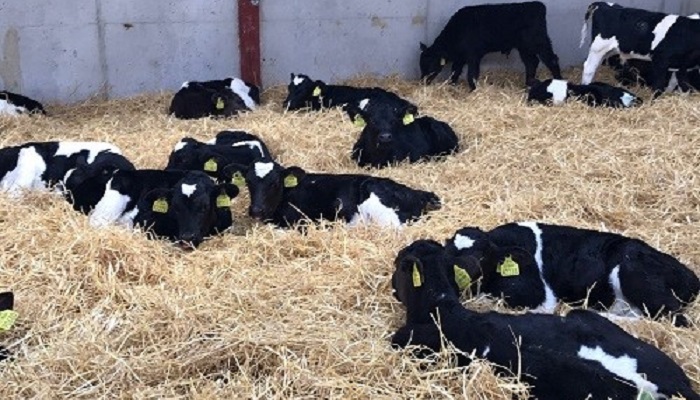
A scour outbreak will significantly increase workload and stress at a time when farmers are already stretched. Read key tips on diagnosing scour, treatment options and ways of reducing its impact in this article.
Scour refers to watery or custard-like faeces. It results from a badly damaged gut, which leads to a loss in function. An intestine that is not functioning properly causes the calf to lose salts and water in the form of diarrhoea. The initial damage to the gut is caused by a variety of infectious agents, including parasites, viruses and bacteria.
Once the damage is done, the calf will continue to scour until the intestine has healed. No treatment is available to speed up this repair time. Calf care takes over 20% of the hours needed to run a dairy farm in spring. Research has found that one of the most challenging and stressful aspects of spring calving is managing calf sickness. Farmers also noted that time needed to care for calves increases massively when calves are sick.
What causes scour
A number of infectious agents can cause scour in calves and often more than one of them is involved. Contrary to popular opinion, it is not possible to tell from the appearance of the scour what has caused it.
Fresh whole milk or good quality milk replacer given in reasonable portion sizes does not cause scour. Scour is rarely caused by nutritional reasons (over-feeding, poor quality milk replacer) alone and generally will have an underlying infectious cause.
Figure 1: Findings from Regional Veterinary Laboratories for most common causes of calf scour in spring 2022
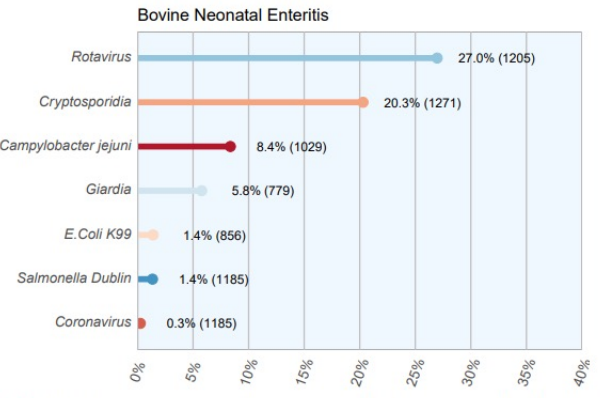
Rotavirus and Cryptosporidia are by far the most common causes of scour diagnosed in calves in the Regional Veterinary Laboratories. Coccidia cause scour in older calves, E. coli K99 is less common and affects very young calves. Bacterial causes of scour such as Salmonella are rarer but cause more acute disease.
How to diagnose scour
When performing an investigation of scour on farm it is advisable to submit samples from a number of affected animals. Animals that have been sick for a while are not suitable candidates for sampling. Ideally three to five scour samples should be collected from early scouring and untreated calves. Faecal samples should only be submitted in screw-top plastic containers.
In addition, blood samples should be submitted to check if there has been adequate colostrum drunk by the calves. Five to ten blood samples should be taken from healthy calves aged less than ten days old, and these samples should not be collected from sick animals.
How should you treat a calf with scour?
Separate the scouring calf
Remove the calf from the group – this helps prevent spread of infection and gives the calf a better chance to recover.
Give oral rehydration solutions
The single most important treatment is to replace the salts and fluids that are lost with scour. Healthy calves need at least 6 litres of good quality milk (or milk replacer) a day and scouring calves need an additional 4 litres of fluid to replace lost fluids. Give one or two extra feeds (2 litres each) of a good quality oral rehydration solution as soon as the calf starts scouring and while it is scouring. These should be given independent of the milk feeds (for example, at lunchtime and, if the diarrhoea is severe, again late in the evening).
Continue to feed milk
Continuing to feed with milk or good quality milk replacer does not cause, worsen or prolong scour. The milk actually helps the healing of the intestine. Continue to offer scouring calves normal amounts of milk or milk replacer as long as they want to drink. Do not feed diluted milk to calves. Leave suckler calves with their dams.
Products to prevent scour
Vaccines against scour-causing viruses and bacteria have been available for some time; you will need to know the cause of scour on your farm to choose a vaccine. A vaccine against Cryptosporidia has only recently come on the market. An oral dose of Halofuginone is licensed to protect against Cryptosporidiosis. To be of benefit, it should be given as a preventive according to the manufacturer’s instructions. However, Halofuginone on its own is unlikely to solve a Cryptosporidia problem if general hygiene is not improved along with the treatment.
Reducing infectious pressure
Even if you have excellent colostrum management, good hygiene is still critical. Keeping the calf comfortable, dry and clean is important through all stages of calf rearing (calving area, calf housing and bedding, and on pasture). Cryptosporidia, in particular, can cause severe diarrhoea even in calves that have received adequate amounts of colostrum, if the hygiene is poor. A variety of housing and feeding systems can be used to successfully rear calves. Some basic hygiene rules are important to follow, no matter what system you use.
- Individual or group calf pens or hutches must be cleaned out between calves.
- Clean, dry bedding is essential wherever your calf is housed. This can be done by cleaning out regularly or by generously topping up a straw bed. Get on your knees: the bed needs to be dry enough so that your knees do not get wet.
- As the calving season progresses there is a tendency for infection to build up. It is important to have your calf housing as clean at the end of the season as at the start.
- Do not forget to keep the feeding equipment clean.
Conclusions
Workload is at its highest on dairy farms in spring. Calf care accounts for over 20% of spring workload. A scour outbreak will significantly increase workload and stress at a time when farmers are already stretched. Also, attracting calf buyers is of upmost importance to dairy farmers. Therefore, prevention is essential. Excellent colostrum management and hygiene are the main factors reducing infectious pressure. Both require time and planning, farmers working solely on their own will struggle to have excellent colostrum management and hygiene. Therefore, having additional help may be required.
The above article was adapted for use on Teagasc Daily from the paper titled: ‘Calf Scour: Know your enemy’, delivered by Ian Hogan, Limerick Regional Veterinary Laboratory and Dr. Emer Kennedy, Teagasc Moorepark at the Teagasc National Dairy Conference. Find out more about the Teagasc National Dairy Conference here.