
26 April 2022
Calving date impacts on feed and forage costs
In 2020 & 2021, 29% of spring-calving dairy cows calved between April and June. Teagasc’s target is that only 10% of spring calving cows should calve in April to June – and these should all calve in April, not in May and June. George Ramsbottom, Teagasc dairy specialist explains the recommendations
Nationally an average of 1.4m cows calved between January and June in 2020 and 2021. Of these an average of 29% calved (that’s just over 400,000 cows) between April and June. Teagasc’s target is that only 10% or 140,000 spring calving cows should calve in the period – and all of these should calve in the month of April not in May and June.
Maximise the proportion of grazed grass in the cow’s diet
The reason why we recommend calving the majority of cows in February is to maximise the proportion of grazed grass in the cow’s diet (see Table 1). The months of March and January rank as second and third as the next best months to calve cows. April calving is apparently close but requires milking through into the following February to ensure that the full milk yield is obtained. A February calving cow can derive 72% of her diet from grazed grass compared to 46% of the diet of a June calving cow producing a similar yield of milk. Conversely the February calving cow only derives 9% of her diet from purchased concentrate while 16% of the diet of the June calver comes from purchased feed. This is important because of the relative costs of grass, forage and feed. The values of the three feedstuffs has increased substantially over the past six months especially because of the increases recorded in the price of fertiliser, feed and fuel.
Table 1: Feed and forage costs (€/cow*) by month of calving.
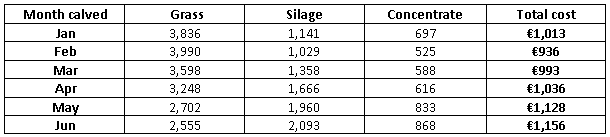
*500 kg milk solids; 6,500 litres produced per cow. Using costs of 12, 24, and 40 c/kg DM for grazed grass silage and meal respectively. Source: Joe Patton, Teagasc.
Taking a planned end of milking date of 15th December, the expected milk yields for cows with the potential to deliver 6,500 litres in a 305-day lactation and the residual milk remaining to be produced over the winter and through the following spring are presented in Table 2 for cows calving between January and June.
Table 2: Milk produced per cow by month of calving between calving and 15th December and from 15th December until the end of calving in cows with the potential to produce 6,500 litres in a 305-day lactation.
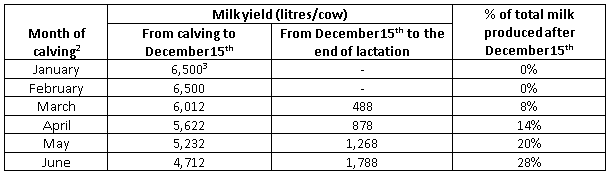
**Assumes a mid-month calving date and that the cow is dried off 305 days later.
***A mid-January calving cow will have been dried off in mid-November.
Drying off in mid-December will reduce concentrate feed requirement but comes at the cost of reduced days in milk and consequently a reduction in milk yield (see Table 2). With later calving the proportion of milk produced over the winter period increases. This is you concentrate and silage requirements are higher and costs increase as a result.
Messages for the breeding season ahead
Based on the factors detailed above and in light of changing forage and feed costs Teagasc recommends that for most farms a mean calving date of between 5th and 15th February is optimum for spring calving herds. However we recommend that this is achieved with a compact calving pattern with calving starting 15-20 days before mean calving date and expected magic day coming around 60 days after the start of calving. Doing this will help to ensure that grazed grass intake is optimised and that costly forage and feed requirements are minimised in the diet of the spring calving cow. Target a submission rate of 90% of the cows and 100% of the heifers in the first three weeks of the breeding season.
The Teagasc Dairy Specialists issue an article on a topic of interest to dairy farmers every Monday here on Teagasc Daily. Check out Managing late calving cows to shorten calving interval
If you have any questions about breeding you can also talk to your Teagasc advisor.