
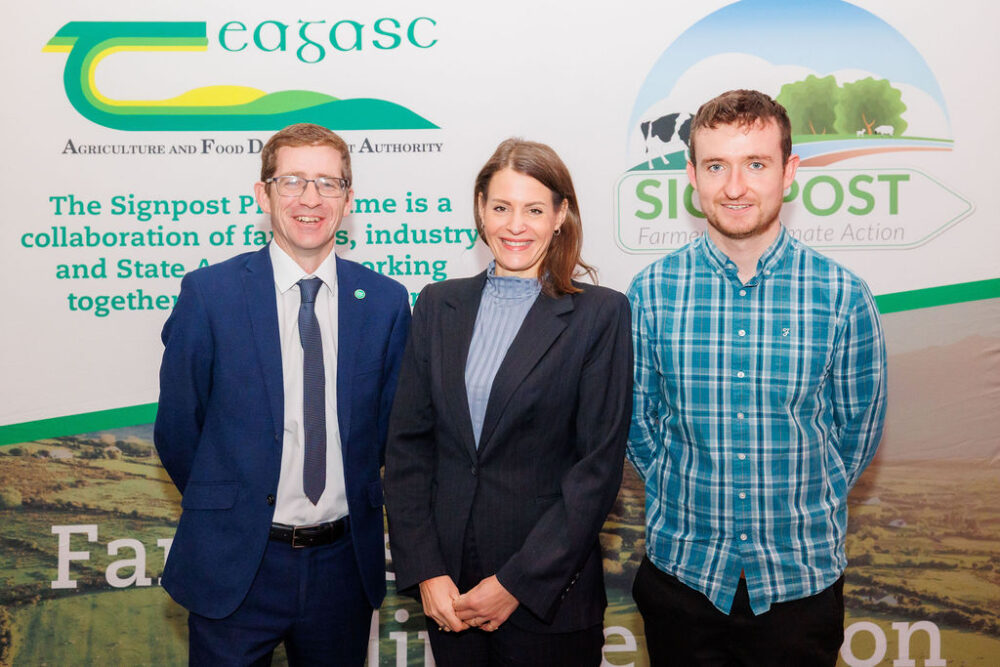
Leading researchers, policymakers, industry personnel and farmers gathered in Co. Offaly today, November 11, to discuss practical and emerging solutions to enable farming for a better climate.
The Signpost Programme and the Teagasc Climate Centre hosted conference titled: ‘Farming for a Better Climate: Practical and Emerging Solutions’ dealt with topics including global sustainability expectations and Ireland’s progress toward meeting them.
Other topics discussed included what’s in the methane toolbox, updates on AgNav and the role of forestry in meeting our greenhouse gas emissions targets. There were research updates on the carbon footprint of Irish grains, hedgerow carbon measurement, fertiliser inhibitors and reducing methane emissions from slurry.
Addressing delegates at the conference, Bord Bia’s Mick Houlihan highlighted the increased demands of consumers and international purchasers for verifiable sustainable sourced foods, but he stressed “the considerable strengths we have in Ireland to meet this demand, including robust infrastructure, collaboration between public and private sectors, advanced data use, high-quality production systems, strong regulation, and world-leading research and innovation.”
The day concluded with a hands-on Carbon Farming Framework Workshop with the Department of Agriculture, Food and the Marine (DAFM) and Department of Climate, Energy, and the Environment (DCEE), allowing participants in the conference to have their say in how this new framework might work in practice.
“There are plenty of tools and technologies already available to help farmers cut greenhouse gas emissions, and many of these can also make farms more efficient and profitable,” said Head of the Teagasc Climate Centre, Karl Richards.
He explained that carbon farming offers another way for farmers to be rewarded for reducing emissions and storing more carbon if the schemes are simple to use and make financial sense to farmers.
For more information and to read the presentations from today’s conference, visit here.