
Challenging prospects for young bull finishers
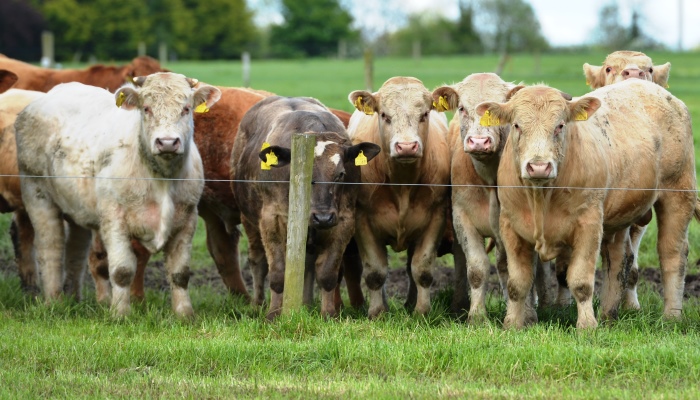
Farmers finishing under 16-month bulls need to know their cost of production now more than ever.
That was a key message delivered by David Argue, Beef Specialist at Teagasc, when joining Catherine Egan on a recent episode of the Beef Edge podcast.
With input costs such as meal, fertiliser and contractor charges set to increase, David Argue reminded farmers that there is huge volatility in the cost of finishing animals.
“At this stage, it is impossible for anyone to know where beef price is going to be later on in the year,” he said. “But we can easily estimate what price we are going to require per kilogram for our beef at the end of the year by completing a simple budget.”
Through his appearance on the Beef Edge podcast, the Beef Specialist discussed Teagasc’s under 16-month bull finishing budget. Based on a high level of efficiency, excellent quality silage, average daily gains of 1.4kg/head from purchase to the point of sale and meal costs of €340/t, this budget tracks the costs associated with purchasing a 400kg young bull in October and carrying to beef in late May to mid-June.
After an assumed feeding period of 230-240 days, the target is to bring the animal to 730kg liveweight or 430kg of carcass weight from a silage and concentrate input of 4t and 1.9t, respectively.
Using prices obtained from the Irish Farmers Journal in late August / early September, David Argue commented that the purchase price for the top third of 400kg bulls was €2,536 or €6.34/kg.
“When we include our variable costs, such as meal, silage, vet, transport and levies, and our fixed costs, we have a total cost on that system of about €1,000 against that young bull. Between buying the young bull and including our total costs, we are looking at €3,535/head or €8.22/kg as a breakeven selling price,” David Argue said.
When re-examining the prices achievable from the market a few weeks ago, David Argue added: “The base price for these bulls was €6.70/kg. Assuming the bull met the quality assurance specification, worth 12c/kg, and received 21c/kg on the grid, the animal was returning about €3,023. This means there was a loss of €512/head on that under 16-month bull.”
“At today’s beef prices,” he added, “cattle that were bought last autumn and have been slaughtered over the last number of weeks are unfortunately losing money.”
David Argue also noted that steer and heifer winter finishing systems are coming under pressure. In winter finishing systems where steers received 750kg of meal, every 10c/kg drop in beef price equated to a further loss of €40/head or more.
The impacts of meal price were also discussed. For the steer system, a €40/t increase in meal would add about €30/head in costs and require an additional 8-10c/kg in beef price to cover costs. For under-16-month bull systems, with bulls eating 1.8-2t of meal, a €20-40/t increase in meal price would require a further 16-18c/kg on top of the breakeven price.
For full insights and more information, listen to the full episode of the Beef Edge podcast below: