

A partnership agreement is a really sensible way to smooth the succession process. Ruth Fennell, Collaborative Farming Specialist, outlines how Registered Farm Partnerships (RFP) are often seen as the first step in a family’s succession story and profiles the O’Connell family who farm outside Carrick-on-Suir in Co. Waterford.
Originating as ‘Milk Production Partnerships’ addressing issues around farm scale, fragmentation and labour, the partnership model was opened up to all enterprises in 2015. There are now over 5,000 Registered Farm Partnerships (RFP) covering all farm types on the Department’s register.
There is no requirement to transfer assets as part of the standard RFP. Each partner outlines the assets that they are licencing to the partnership and if/when the partnership is dissolved, is entitled to have its assets returned once any partnership debts have been settled.
The financial values of these assets are outlined in the capital accounts of the partnership agreement and it is important that this is kept up to date each year. This legally binding document means the owners know that their assets are protected.
RFPs are often seen as the first step in a family’s succession story. They introduce the next generation to the farming business at an earlier stage and allow their input to be formally recognised. When a young trained farmer is added to the herd number they can qualify for financial supports such as the Complementary Income Support for Young Farmers and the National Reserve.
Within an RFP, a young, trained farmer can avail of increased rates of TAMS funding. Grant rates increase from 40% to 60% and the total ceiling rises to €160,000 versus the €90,000 that a sole trader can apply for. There are also advantages in relation to stock relief. A young, trained farmer can avail of up to €100,000 in stock relief over four years, with a maximum of €40,000 in any one year. Where this young farmer is in a RFP, the other partners can avail of 50% stock relief on up to €20,000 over three years.
This stock relief is calculated based on their profit sharing ratio within the partnership. To help with the associated professional costs of setting up these agreements, new partnerships that contain a qualified young farmer can apply for a collaborative farming grant. This provides 50% funding up to a maximum spend of €3,000 (max grant of €1,500).
Succession Farm Partnership
To encourage the earlier transfer of agricultural assets, the Succession Farm Partnership model was launched in 2017. As part of the agreement, the asset owner (generally parent/aunt/uncle) must commit to transfer a minimum of 80% of the agricultural assets to the successor between year four and year 10 of the succession plan.
The time and details of the transfer are outlined in the succession agreement. The financial benefits of the succession plan lie in the additional tax reliefs that are afforded to the partnership members who sign up to a succession partnership. The tax relief is €5,000 per year, for a maximum of five years, up until the year prior to the young farmer turning 40. This relief is divided between the partners in line with the profit-sharing ratio and can be used against both farm and off farm income. There are currently 162 active Succession Farm Partnerships registered.
The O’Connell farm
John G, Catherine and Niall O’Connell farm 300 acres in five blocks just outside Carrick-on-Suir in Co Waterford. After secondary school, due to his father Tom’s poor health, John G took over the farm, with the assistance of his mother, Bridget. The farm was transferred to John G when he was 21. In 2012, he inherited an additional block of land from his uncle, which is approximately three miles away from the home block.
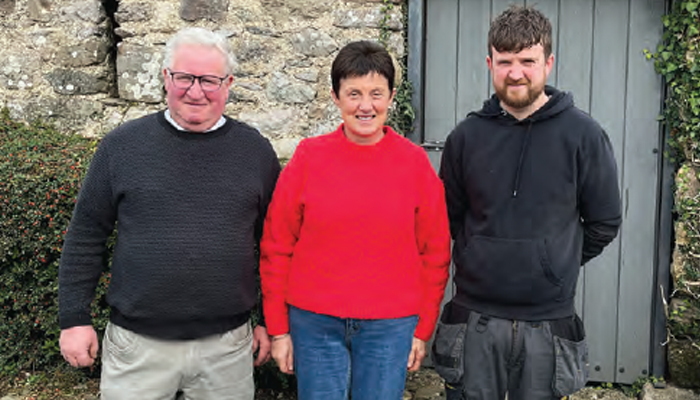
John G, Catherine and Niall O’Connell
John G and Catherine have five children: four boys and a girl. The eldest, Thomas, is now a successful chemical engineer. Second son, Michael, is a construction manager in Canada. Third son, Niall, is working on the farm alongside John G and Catherine. Fourth son, Robert is also a chemical engineer, in New Jersey, and the youngest, Elaine, is a chemist.
This farm is very much a family-run operation with all members having helped on the farm over the years and Catherine and John G are still very involved in all aspects of the day to day running of the farm. The O’Connells have made significant changes over the last ten years and are now operating a spring calving dairy system.
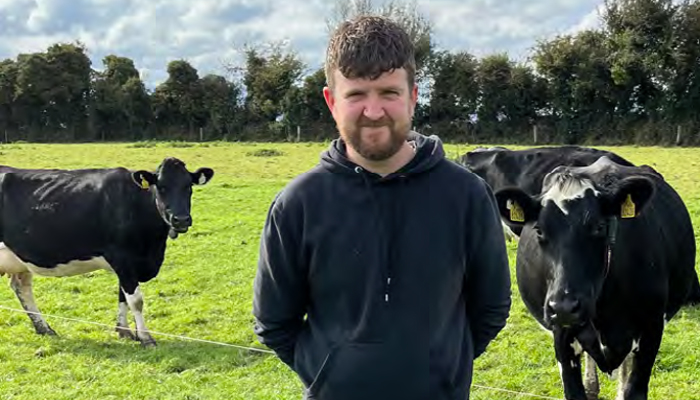
Niall was anxious to pursue a career in farming and following his secondary education he attended Teagasc Kildalton Agricultural College. He completed a Level 6 Certificate in farming in 2013. With a good education and having gained extensive practical experience of working on other well operated farms, Niall returned home to farm full time. Following Niall’s return, John G, Catherine and Niall formed a single herd number Registered Farm Partnership.
Niall’s name was added to the herd number by way of an ER1 form and a bank account was opened in the names of all the partners. “I was then eligible to apply for the Young Farmers Scheme and National Reserve that were available at the time,” says Niall. “As part of the partnership application, we discussed the future direction of the farm and how it should generate enough income for all partners.”
The partnership agreement outlined the assets that all parties were bringing to the partnership and stated how the profits from the farm were to be divided. The on-farm agreement ensured that the family discussed how the arrangement would work on a day to day basis. “We had lengthy talks on planned changes to the farming business and the restructuring of the system,” adds John G. “We agreed the future direction and the financial commitments needed.”
John G and Catherine have been able to share the wealth of experience that they have gained over the years with Niall, resulting in a balance of new ideas and uptake of advances in technology alongside years of practical experience. Making maximum and efficient use of the TAMS funding that could be availed of through the partnership structure, a new unit with a single Lely milking robot, slurry storage and cubicles for 80 cows and silage pits was constructed on a greenfield outside block.
The grants were used wisely to cover the slurry tanks, milking robot and a slurry aeration system with the aim of ensuring labour efficiency. This block is now used to milk 68 cows, cut silage and rear the heifers when grass availability allows. Cow numbers on the home block were increased to 140 and a beef enterprise was discontinued.
“The Registered Farm Partnership has allowed Niall to take greater responsibility gradually,” says John G. “This has led us to the point where Catherine and I are happy to begin the process of transferring the ownership of the farm to him, ensuring its safety within the O’Connell family.”
This article first appeared in the November/ December 2025 edition of Today’ Farm