
Choosing the correct paddock to reseed
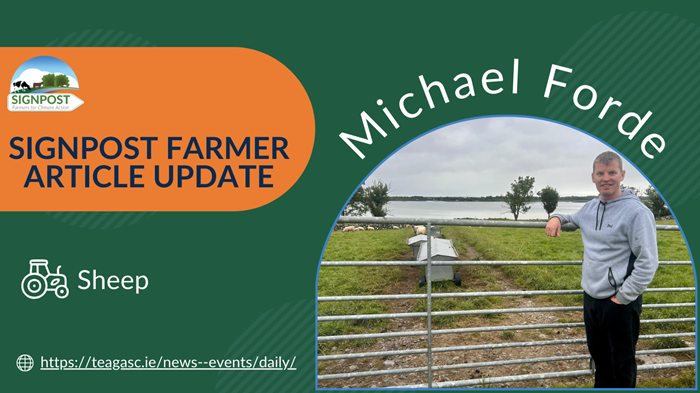
Participant in the Teagasc Signpost and Better Farm Sheep programmes, Michael Forde shares some of the latest happenings from his sheep farm in Co. Galway, providing an update on reseeding, silage and flock health.
The recent spell of good weather was extremely welcome on the farm. One wouldn’t be long forgetting about the previous six months of rain when we can get a week or two of excellent weather. It is such a relief having all stock out and all stock seem to be thriving well now also which is very reassuring. Having the sheep and cattle out to grass has really reduced the workload and the cost of feeding/bedding/straw.
Reseeding plans
Grazed grass is by far the cheapest and best feed we have on our farm. Every year we try grow and, most importantly, utilise more grass. Measuring grass for the last few years has really given me the confidence to know when I can remove surplus paddocks. It has also helped identify low performing paddocks.
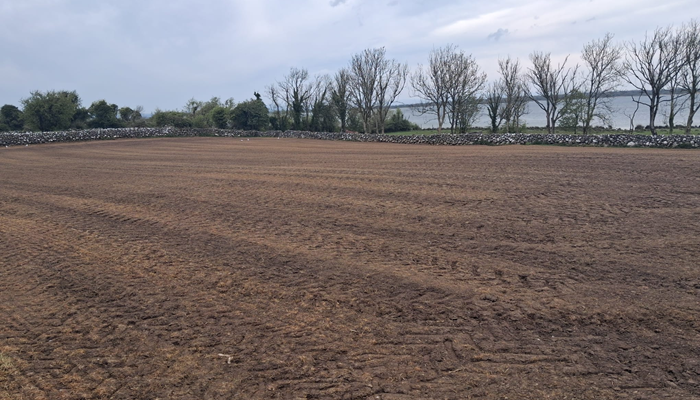
This year, I plan on making less silage around the home block and utilise this more for grazing. This will increase the stocking rate at home. By measuring grass, I have also identified a paddock near the yard that was not growing sufficient grass and was always slow to recover. I decided to reseed this paddock and it has recently been sown with new seed. It is a few years since we reseeded so we are hoping this paddock will go well. If it does, I have identified a few more paddocks that I would like to reseed. The paddock that we reseeded was grazed bare over the winter with some hoggets and we sprayed it off with glyphosate and gave it slurry and reseeded it.
We wanted to pick a variety of grass that could be utilised for both silage and grazing. So, it is a highly digestible and persistent grass mixture we went with that has good spring growth which is important for us when letting out ewes and lambs.
Changing the silage strategy
In terms of silage, as previously mentioned we are planning to change our silage routine this year and give some silage fields a rest. When looking at the soil results with my advisor while doing my BISS and sheep welfare scheme application, it was easy to identify the silage fields as these were my lower Phosphorous and Potassium soils. I have decided to swap silage fields this year, and I will also be spreading slurry and some 0-0-50 on my low K (Potassium soils).
We are on target to cut some silage before the end of May. Making some good quality early bales has really improved cattle and sheep performance over the winter whilst also reducing our concentrate bill.
Scheme actions
I have applied for the Sheep Welfare Scheme, and it was relatively easy to pick the actions from both category A and B as we are actually doing all the actions on the farm already. As part of the Better Sheep Programme, ewes are regularly body condition scored. Ewes are shorn yearly; ewes are vaccinated and foot bathed and we also plunge dip the sheep. So, we actually ticked all boxes for the Sheep Welfare Scheme.
Bluetongue vaccination
I was contemplating vaccinating for Bluetongue and having talked to my vet and other agri professionals, I have decided to go ahead with the vaccination. We have spent years increasing the flock number and the breeding quality of our ewes and for the sake of a few euro per head, it is a good insurance policy against an outbreak of Bluetongue. Saying that, I have not heard of any incidences nearby and am aware that the vaccination I am giving is not applicable to all strains of the Bluetongue virus. However, I feel it is better that we vaccinate and reduce the risk of contracting the disease in our flock.
Ewes and lambs have also been put through the footbath already and, as mentioned in previous articles, we built a roofed footbath facility last year and this has made life for both man and beast a lot easier as we can batch footbath larger numbers of sheep together, thus reducing labour. Labour efficiency is vital on farm as I work off farm, it is important that jobs can be done quickly and efficiently.
We have also completed our 7-week lamb weights recently and we will analyse these results more closely in my next article.
The above first appeared in the Farming Examiner as part of a Signpost Programme update.
Michael Forde is a participant in the Teagasc Signpost Programme working closely with Teagasc Advisory, Keith Fahy.