
Collaborative farming is gaining popularity in Ireland, offering landowners, existing farmers and new entrants the chance to improve resource use, work-life balance, and succession planning.
Collaborative Farming Specialist at Teagasc, Ruth Fennell explains that these models help young farmers access land without the high costs of ownership, while allowing older farmers to stay involved without full responsibility.
Key Collaborative Farming Models
Registered Farm Partnership
A Registered Farm Partnership (RFP) is a formal legal arrangement where two or more people farm as a single business. Profits, responsibilities and decisions are shared. Often used as the first step in succession planning, RFPs can also work well between non-family members.
- Assets: No asset transfer is required; each party lists what they contribute, and valuation of assets is outlined in the capital accounts.
- Profits: Shared according to profit-sharing ratio outlined in partnership agreement.
- Registration: Must be registered with the Department of Agriculture, Food and the Marine.
- Scheme support: Partnerships are eligible for a €160,000 TAMS ceiling (vs. €90,000 for sole traders). If a young trained farmer is involved, the first €90,000 qualifies for 60% support. In addition, partnerships containing a young trained farmer can avail of the Complementary Income Support for Young Farmers and the National Reserve, where eligible.
Over 5,000 RFPs are registered in Ireland. To be eligible to form a RFP, there must be at least one experienced farmer (category 1 – has farmed for at least 2 years with >3ha of land). The second partner can be either another experienced farmer or a trained farmer (category 2 – hold a recognised agricultural qualification). Category 2 partners must be entitled to at least a 20% share of the profits. The application process requires both a partnership agreement (assets, land, profit share) and an on-farm agreement (daily duties and schedules). Where capital investment is planned, the agreement should outline how this will be funded and if the partnership was to be dissolved, what the financial implications are for these capital projects.
Share Farming
In the case of share farming arrangements, two separate businesses operate on the one block of land. Each party provides resources and shares the output.
- Structure: No legal partnership is formed.
- Independence: Each party runs their business, files their accounts, and is responsible for their own profits and costs.
- Use: Particularly suitable in dairy and tillage, where yields are measurable.
In dairy share farming, the share farmer may supply the cows and labour, while the landowner usually provides land and facilities. Outputs like the milk cheque are split as per the written agreement. The initial set up costs for the share farmer are often less than the capital that would be required in the case of a leased farm and therefore, for new entrants, it may be a more viable first step towards running their own business.
Finding the right individuals for such an arrangement requires careful consideration. From the landowner’s perspective, it is important that any potential share farmer has good stockmanship skills, is capable of managing the farm, has excellent quality cows so output can be maximised and has attributes that align with their goals. Given that the output is divided, it is important that the share farmer can maximise output economically, thus increasing the financial return for both parties.
Table 1. Comparison of Registered Farm Partnerships and Share Farming arrangements
| Registered Farm Partnerships | Share Farming | |
| Structure | Formal partnership between two or more parties | Two individuals operating separate businesses on the same land |
| Business Structure | One bank account with shared income and expenses | Separate businesses, with individual bank accounts, income and expenditure |
| Profit & Loss | Profits and losses shared according to partnership agreement | No sharing of profit/losses; each party earns based on their own share of output and expenditure |
| Herd Number | In the name of all partners/partnership name | In the name of the land owner, share farmer not listed on herd number |
| Day to day labour | Provided by partners within the partnership | Provided by the share farmer |
| Ownership of Assets | Can include individually owned and jointly owned assets, outlined in partnership agreement | Assets are separately owned by each party |
| TAMS III | Ceiling of €160,000 | Ceiling of €90,000 |
| Stock relief | 100% for Young trained farmer (YTF) for four years, enhanced relief of 50% for other partners, subject to limits | Only available if they own livestock: 100% for Young trained farmer for four years, standard relief of 25% for landowner, subject to limits |
| Eligibility for YTF schemes | Complementary Income Support and National Reserve, where eligibility requirements met | Not eligible as YTF not listed on herd number |
| Control & decision making | Joint decision making as outlined in the agreement | Independent decision making; collaboration on specific aspects only |
Land leasing
Land leasing is the most widely used collaborative model in Ireland. It allows landowners to step back while earning tax-efficient income. For new entrants, leasing offers a viable entry point into farming without the prohibitive cost of purchasing land.
Registered leases, running for a minimum term of five years, provide significant tax-free income, with relief starting at €18,000 per year for a five year lease and rising to €40,000 in the case of a 15+ year lease. There can be current and future tax implications when dealing with land leasing arrangements, so it is important that landowners discuss any potential options with a financial or legal advisor before they proceed. Land must be owned for 7 years to be eligible (where purchased after 31st December 2024).
Table 2: Income tax thresholds for long-term land leasing
| Term of lease | Max tax free income/year |
| 5-7 years | €18,000 |
| 7-10 years | €22,500 |
| 10-15 years | €30,000 |
| >15 years | €40,000 |
Aside from the models above, there are many other examples of collaborative arrangements in operation within the Irish agricultural industry. Examples of these include contract rearing, cow leasing, machinery shares and contract growing of crops. The best model for each particular circumstance depends on goals resources, and life stage for the parties involved. The following questions should be asked to determine what option would work best for you:
- Do you want to be actively involved, or step back entirely?
- Are you looking for a long-term commitment or seasonal arrangement?
- Do you have a successor in mind, or are you open to partnering with a non-family member?
- What kind of responsibility are you willing to share?
Seek profession advice before making a decision. Speak with farmers that are currently operating under different collaborative arrangements, discuss the legal and tax implications with your accountant and solicitor, explore your options, do your homework, and find a model that works for you.
Collaborative Farming Webinar
Today, September 8th at 7.30pm, Teagasc will host the first of its webinars as part of Generational Renewal Week.
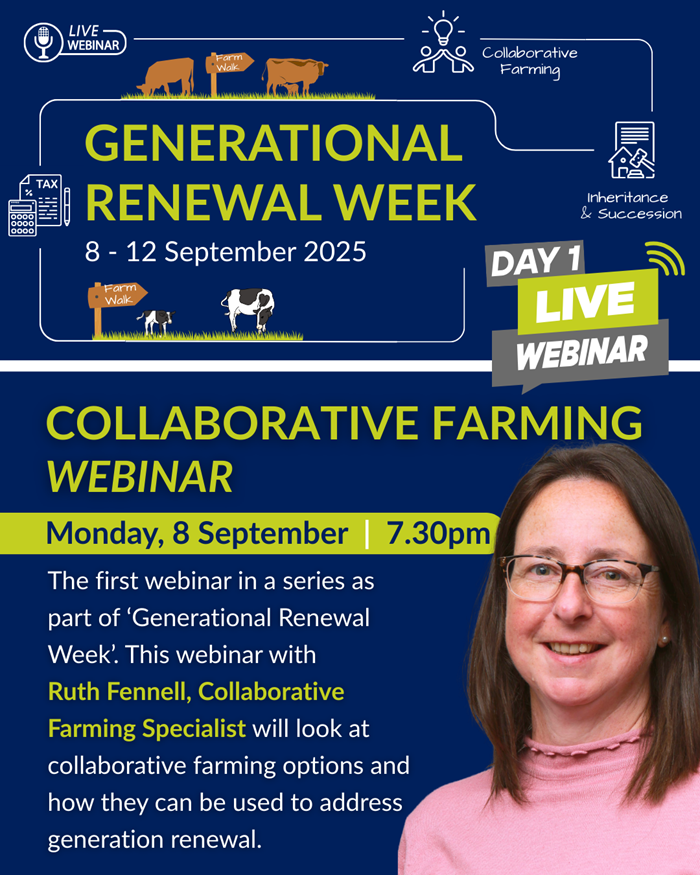
The Collaborative Farming Webinar will feature Ruth Fennell and will look at collaborative farming options and how they can be used to address generational renewal.
Register for the Collaborative Farming Webinar here.
More from Teagasc Daily: Generational Renewal – why it matters