
Combining organic tillage and sheep in Co. Carlow
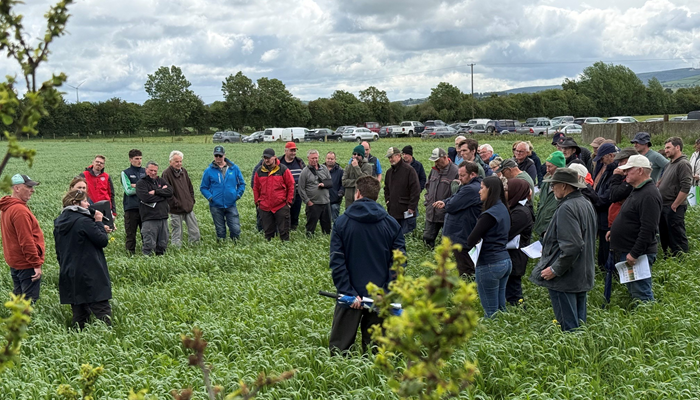
Joe Nolan, host of a recent Teagasc Organic Crop Walk, is balancing a sheep and tillage enterprise on his farm in Kilconnor, Fenagh, Co. Carlow, Teagasc Organic Advisor, Marianne Mulhall tells us more about the enterprise.
Stretching to over 98ha, and combining spring cereals, protein crops, grassland, red clover swards, riparian grassland and native woodland, the farm is home to a 310 ewe March-lambing flock, 20 pedigree Charollais ewes, while a further 300 store lambs were carried over the winter.
Since making the move to organics, Joe has altered the sheep system, moving towards the Easy-Care breed of sheep. Cover crops of rape and leafy turnip, sown after tillage crops, form the basis of the winter diet, while protein crops are under-sown with grass and clover to provide overwinter grazing. Cereals and legumes produced on the farm are also used. Post grain cleaning, barley and oats are used to supplement store lambs, while peas were fed to ewes to boost milk production.
As an organic farmer, Joe had to develop a flock health plan. Some of the key treatments included are:
- The flock is vaccinated against clostridial diseases, while worming is based on faecal egg counts, taken monthly during spring and summer. In 2025, lambs were dosed in July, October and December.
- Withdrawal periods are managed, with triple withdrawal periods applied for factory processors and double withdrawal periods used otherwise.
- The farm hopes to phase out tail docking as the Easy-Care sheep system develops.
- Clikzin is used for flystrike prevention, while zinc sulphate is used for foot bathing. Both are non-organophosphate products.
- Ewes receive a mineral bolus twice a year, while lambs receive a bolus in May and October.
- Ewes are also dosed for fluke twice annually.
Growth in the tillage area
Almost 55% of Joe’s farmed area is now under a tillage crop – 34.34ha of spring oats, 16.72ha of barley/pea/oats and 2.75ha of spring wheat grown on the farm – having increased considerably since his conversion to organics.
A traditional plough, till and sow method is used for establishment, with crops being destined for numerous markets. Oats are sold to Flahavan’s, retained for home feeding and grown as seed oats on contract for Goldcrop. Protein crops are grown both for on-farm feed and under contract for other farmers. A new addition to the tillage rotation in 2026 is a heritage wheat variety, which Joe plans to sell to a local bakery.
Attendees at the farm walk heard how crop rotation is central to managing weed and disease pressure on farm. The farm’s current rotation is centred on oat, protein crop, oat, and a red clover ley system, with the latter forming a key part of the farm’s reseeding programme.
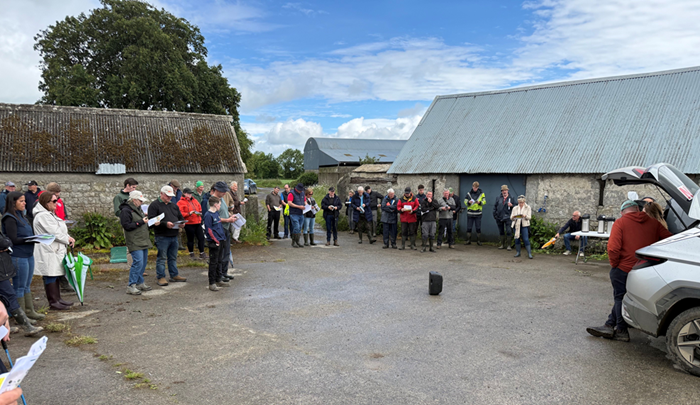
The Straw Incorporation Measure is also availed of to improve soil structure, while investments in a seed cleaner, grain dryer and seed drill have also taken place, much of which was financed through cashflow.
As is the case with organic farming systems, seed costs can be higher, but Joe is limiting this somewhat through the use of home-saved oat seed, on which a royalty is paid. Additionally, a 50% protein payment is being availed of for the barley/oat/pea crop.
Grown under contract for Goldcrop, seed oats are one crop where Joe has seen a promising return. In 2025, the crop achieved a net margin of €1,261/ha. However, maintaining yields in the long run will be a challenge. One avenue being explored is the use of sulphate of potash on oats, with trial rates of one bag per acre, half a bag per acre, and an untreated control on low-potassium plots.
Table 1: Financial performance of seed oats
| 2025 Oats | 2025 Seed Oats | 2025 Barley/Pea/Oats | |
| Area | 26.26 | 7.43 | 16.4 |
| Yield/ha | 4.9 | 5.9 | 5.18 |
| Price (€/tonne) | €415 (Flahavan’s) | €454 (Goldcrop) | €400 |
| Sales (€/ha) | €2,033 | €2,678 | €2,072 |
| Variable costs | €646 | €590 | €881 |
| Fixed costs | €601 | €827 | €664 |
| Net profit (€/ha) | €786 | €1,261 | €527 |
| Organic payment (€/ha) | €270 | €270 | €270 |
For further details on the Teagasc Organics Programme, visit here.